Endangered
Conus hieroglyphus
Conus hieroglyphus
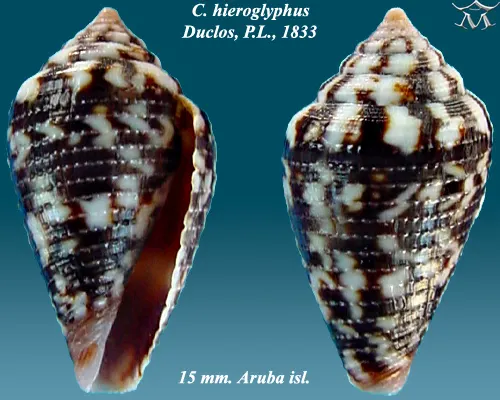
The hieroglyphic cone (Conus hieroglyphus) is a tiny venomous sea snail known only from shallow reefs off Aruba. The IUCN Red List rated it Endangered in 2025, citing a very small range that is still shrinking. Its shell is white with orange, chestnut or chocolate markings.
How to recognise it
It's a small cone. The largest recorded shell is 23 mm long, though a local article gives adults up to 21 mm. The white shell is marked with spots and cloud-like patches in orange, chestnut or chocolate brown, often arranged in broken bands. The base is grooved, and the spire has one broad groove. The French zoologist Pierre-Louis Duclos described it in 1833.
Researchers on Aruba use the genus name Arubaconus for it, but the accepted name is Conus hieroglyphus. Arubaconus hieroglyphus, Gladioconus hieroglyphus and Conus armillatus are listed as synonyms.
Where it lives
The IUCN lists Aruba as the only country and treats the snail as endemic there, in the western central Atlantic. It lives in shallow water, from about 1 to 10 m deep, on coral reef and on the soft sand and rubble between reef patches. The IUCN counted 2 to 4 locations, an area of occupancy of about 196 and an extent of occurrence of about 369 square kilometres.
A February 2026 article in ArubaNews places it off Arashi Beach, in sandy areas near dead coral or rocky ground at 4 to 6 m.
Pins are Wikidata “endemic to” fields. Orange dots, when present, are GBIF occurrence tiles — survey bias included.
How it lives
Like every cone snail, it is venomous. It fires a harpoon-like tooth into its prey to paralyse it, then grows a new tooth. ArubaNews lists sea turtles, octopuses, rays, crabs and lobsters as predators. The IUCN gives a generation length of 5.5 years and does not consider the species a migrant.
Why it is in trouble
The IUCN lists tourism and recreation areas as an ongoing threat across more than 90 percent of the range, along with run-off and small-scale harvesting. The habitat area is still shrinking, and the population trend is unknown. ArubaNews also names dredging and shell collecting by beachgoers, and says shells are sold illegally to collectors abroad. The IUCN records international specimen collecting as a use.
Some protection exists: the IUCN says conservation sites have been identified over the entire range and the snail occurs in at least one protected area. The assessment lists no further conservation actions.
Sources
Written for this catalog in our own words from the sources below, checked against them on 12 November 2026. Population figures are estimates and carry the year they were made. Status and assessment year: IUCN. 2026. The IUCN Red List of Threatened Species. Version 2026-1. iucnredlist.org.