Critically Endangered
Conus fernandesi
Conus fernandesi
Conus fernandesi is a small venomous sea snail found only on Santo Antao in the Cape Verde archipelago, along a coastal strip about 1 km long. The IUCN Red List rated it Critically Endangered in 2025, up from an earlier Endangered listing.
How to recognise it
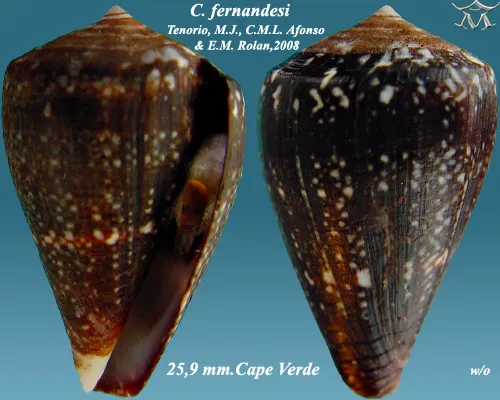
The shell is small, 18 to 27 mm long. Like every cone snail it is a venomous hunter, and cone snails can sting people who handle them, so a live one is best left alone.
It was formally named in 2008 by Tenorio, Afonso and Rolan in the journal Vita Malacologica. Africonus fernandesi is an older name for the same species.
Where it lives
It is known from one island, Santo Antao, along a coastal strip roughly 1 km long. It has been found among algae and in crevices at depths of 2 to 4 m, on loose rock, pebble and gravel on the seabed.
The IUCN estimates both its area of occupancy and its extent of occurrence at 4 to 8 square kilometres, and counts a single location. It lives nowhere else.
Pins are Wikidata “endemic to” fields. Orange dots, when present, are GBIF occurrence tiles — survey bias included.
How it lives
Cone snails as a group hunt with a barbed, harpoon-like tooth fired from a proboscis, backed by a venom gland whose neurotoxins paralyse prey. This species is presumed to feed the same way, but its diet and breeding have not been studied in detail.
The IUCN's use and trade record for the species lists sport hunting or specimen collecting as a use, without giving figures.
Why it is in trouble
The coast it lives on has very heavy ferry traffic, which exposes it to habitat damage and pollution. The IUCN lists oil spills and small-scale subsistence harvesting as threats, and records a continuing decline in the area of habitat.
Its population trend is unknown, and no systematic monitoring scheme is in place. With a single location, one pollution event or a loss of shoreline habitat could affect the whole population.
What is being done
The IUCN lists site or area protection as an action needed, along with research on habitat trends, population size and distribution, and life history. The species' biology is poorly documented.
Sources
Written for this catalog in our own words from the sources below, checked against them on 12 November 2026. Population figures are estimates and carry the year they were made. Status and assessment year: IUCN. 2026. The IUCN Red List of Threatened Species. Version 2026-1. iucnredlist.org.