Endangered
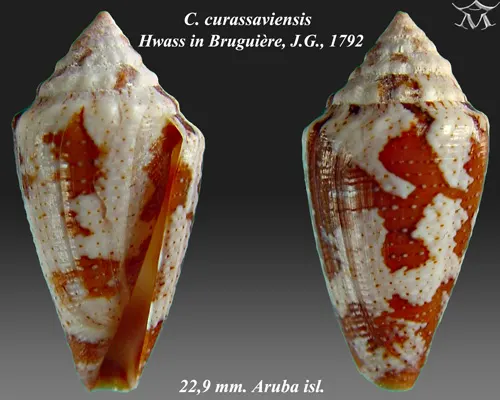
Conus curassaviensis
Conus curassaviensis
Conus curassaviensis is a small venomous sea snail in the cone snail family, found only around Aruba in the southern Caribbean. The IUCN Red List rated it Endangered in 2025, with a very restricted range, and it is legally protected on the island.
How to recognise it
It's a cone snail, a predatory sea snail with a tapering, cone-shaped shell. The shell reaches about 5 cm, and the largest recorded one measured 51 mm. Colours vary: white with black spots, orange or red with white, or brown with white.
It's venomous. Like other cone snails it stabs prey with a harpoon-like tooth called a radula and uses venom to paralyse it. Live cone snails can sting people, so they should be left alone or handled with great care. The species has also been placed in the genus Tenorioconus in some references.
Where it lives
Despite the name, which refers to Curacao, the species is found only in Aruba. Aruba's Department of Nature and Environment describes it as one of three protected endemic cone snails on the island, along with Conasprella wendrosi and Conus hieroglyphus.
It lives at 2 to 9 m depth, on coarse white sand next to coral. The IUCN assessment lists sandy sea floor, coral reef and soft ground between reefs, with a depth of 1 to 6 m, and gives the number of locations as between one and five.
Pins are Wikidata “endemic to” fields. Orange dots, when present, are GBIF occurrence tiles — survey bias included.
Why it is in trouble
The IUCN lists three threats: small-scale collection of the animals, changes to the shoreline ecosystem, and recreational activity. These lead to habitat degradation, deaths and disturbance. The assessment estimates its area of occupancy at 180 km2 and its extent of occurrence at 340 km2, and records a continuing decline in area, although the population trend is unknown.
The IUCN records specimen collecting as a use of the species, and Aruba's authorities ask people not to take the shells as souvenirs or sell them to collectors.
What is being done
The assessment records that conservation sites cover its whole range and that it occurs in at least one protected area. It lists no further conservation actions, and whether a monitoring scheme exists is unknown.
Sources
Written for this catalog in our own words from the sources below, checked against them on 12 November 2026. Population figures are estimates and carry the year they were made. Status and assessment year: IUCN. 2026. The IUCN Red List of Threatened Species. Version 2026-1. iucnredlist.org.