Critically Endangered
Caridina striata
Caridina striata
Caridina striata, the red line shrimp, is a tiny freshwater shrimp from the ancient Malili lakes of Sulawesi, Indonesia. Red with white stripes, it is also a popular aquarium animal. The IUCN Red List rated it Critically Endangered in 2019, mainly because of one small range and a projected collapse linked to introduced fish.
How to recognise it
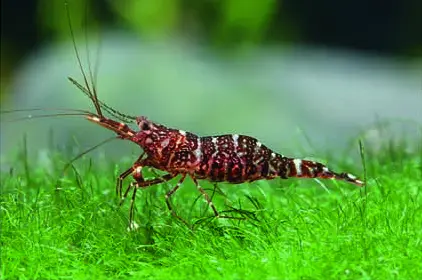
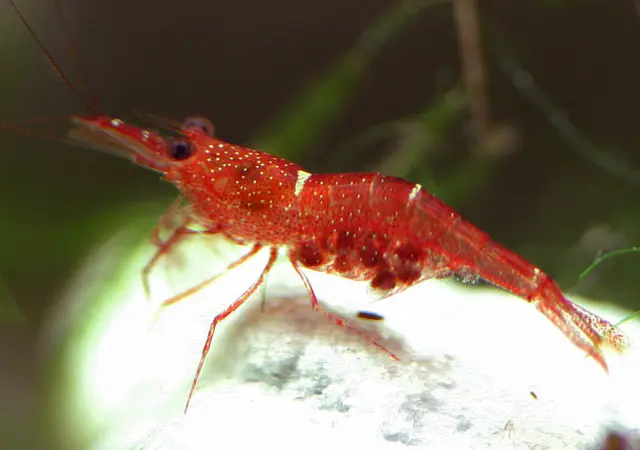
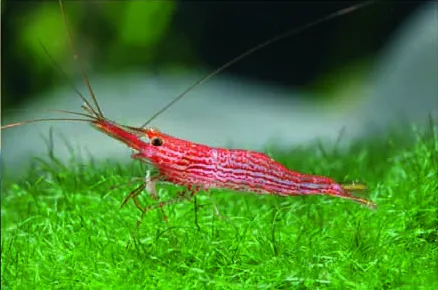
The body is red, with white stripes along the sides and a few white spots on the back. The first two pairs of walking legs are usually white, and the claws show up clearly when the shrimp feeds, while the darker body blends in. The pattern stays visible even when the animal is stressed, though it fades a little. The Latin name striata means striped.
Adults reach about 2.5 cm, according to a hobbyist guide. Females carrying eggs in the original description held 17 to 38 eggs. In aquariums, the young hatch as miniature adults with no drifting larval stage.
Where it lives
The species is endemic to the Malili lake system in South Sulawesi. It is widely distributed and often numerous in Lake Towuti and has also been found in neighbouring Lake Mahalona. The IUCN assessment gives an area of occupancy of 68 and an extent of occurrence of 682 (square km), treats the whole population as a single location, and lists permanent freshwater lakes as its habitat.
The scientific description of 2009 records it only from the Malili lakes, and the type specimens came from Lake Towuti.
Pins are Wikidata “endemic to” fields. Orange dots, when present, are GBIF occurrence tiles — survey bias included.
How it lives
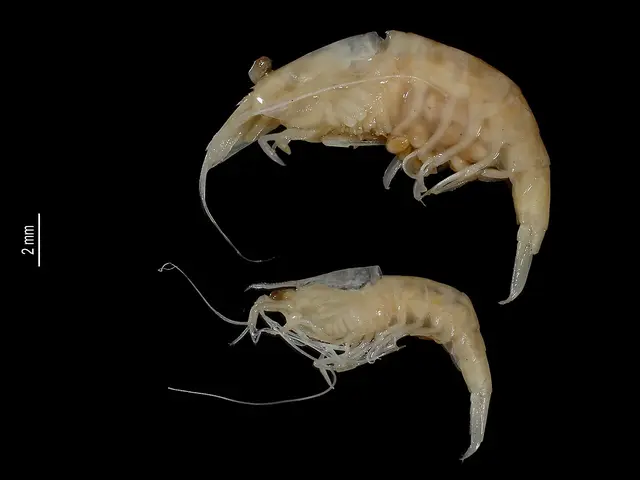
It lives on hard surfaces. In shallow water it sits on and under small rocks, and below about 3 m it lives between boulders. When disturbed it tends to dart sideways or downwards. Two similar rock-dwelling shrimps of Lake Towuti (Caridina glaubrechti and C. woltereckae) look much like it in preserved specimens, but it is more active and faster than they are, and it also shares rocks with several other Caridina species in the lake.
Why it is in trouble
The 2019 assessment names sewage and mining and quarrying as ongoing threats across the whole range, each causing slow but significant declines. Nickel mining near the lakes is the usual source of concern. Introduced fish are the other big risk, and the assessment projects a population reduction of 90 percent in the future, based on the effects of introduced species. The flowerhorn cichlid has been named as one such fish, and one hobbyist guide also mentions Nile perch.
Large-scale harvest, which includes collection for the aquarium trade, is listed as an ongoing threat too, though it affects only a minority of the population. The shrimp is sold to hobbyists as the red line or red stripe shrimp. It is considered a demanding species that needs hard, high-pH water at about 27 to 29 C, and it does poorly below 27. The population trend is listed as unknown.
What is being done
The assessment lists site and area management and invasive species control as measures that apply to it. No dedicated rescue programme for the species has been published.
Sources
Written for this catalog in our own words from the sources below, checked against them on 12 November 2026. Population figures are estimates and carry the year they were made. Status and assessment year: IUCN. 2026. The IUCN Red List of Threatened Species. Version 2026-1. iucnredlist.org.
- IUCN Red List assessment (von Rintelen, Wowor and Klotz, 2019)
- IUCN Red List API record for the assessment
- von Rintelen and Cai 2009, Raffles Bulletin of Zoology 57(2) (original description)
- Practical Fishkeeping, Eight new shrimps described from Sulawesi
- Fishkeeper, Sulawesi red line shrimp
- Caridina striata (encyclopedia entry)