Critically Endangered
Caridina profundicola
Caridina profundicola
Caridina profundicola, the Sun Stripe Shrimp, is a small freshwater shrimp found only in Lake Towuti on the Indonesian island of Sulawesi. It lives among boulders in deeper water. The Red List assessed it as Critically Endangered in 2019, and its population trend is unknown.
How to recognise it
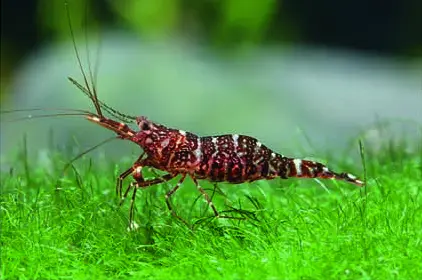
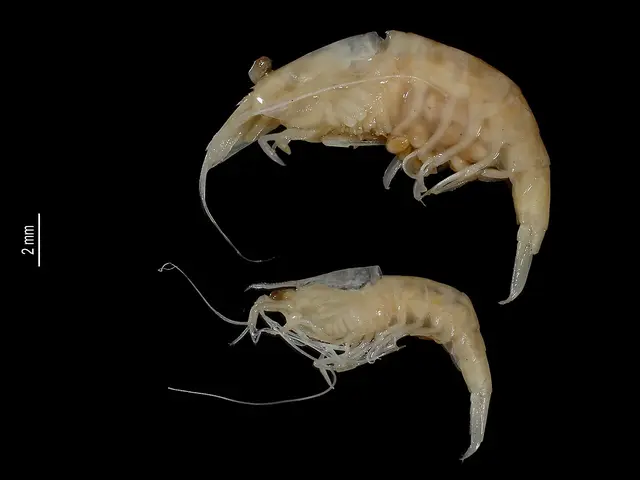
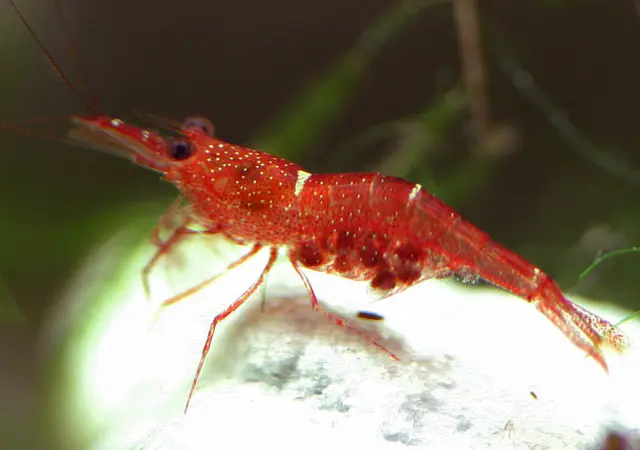
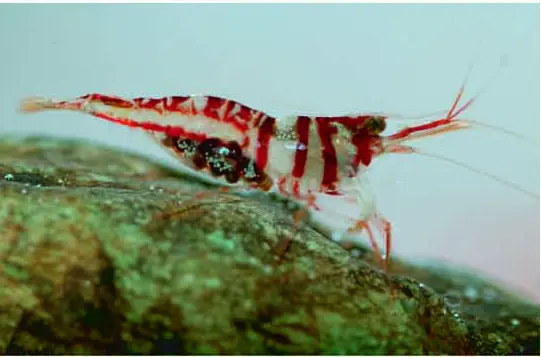
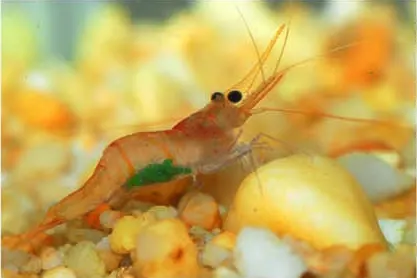
Together with Caridina spinata, it is the largest lake-dwelling shrimp of the Malili lake system. Adults have a carapace (the shell over the head and chest) of 2.7 to 4.9 mm, with a median of 4.0 mm. The body is yellowish and see-through, sometimes tinged red, and usually carries two bright yellow bands across the abdomen. The bands are already visible in juveniles.
The best feature for scientists is the rostrum, the pointed beak at the front of the head. It is very slender, but its base is triangular, which sets it apart from the other Malili shrimps. Eggs are green and contrast with the body.
Where it lives
Lake Towuti is part of the Malili lakes, a chain of ancient connected lakes in South Sulawesi. It is the largest lake on the island and the second largest natural lake in Indonesia, with a maximum depth of about 203 m. The Red List gives its surface as 561 square kilometres. The water is very clear and low in nutrients, and stays between 27 and 31 degrees Celsius.
Caridina profundicola is known from nowhere else. The Red List gives its extent of occurrence as 99 square kilometres and its area of occupancy as 28, and treats the lake as a single location.
Pins are Wikidata “endemic to” fields. Orange dots, when present, are GBIF occurrence tiles — survey bias included.
How it lives
Adults were found only in deeper water, roughly below 3 m, mostly between large boulders. Two juveniles turned up in leaf litter in the shallows. The scientific name, from Latin, refers to this deep-dwelling habit. The shrimp often shares rocks with its relative Caridina spinata, but is much calmer. It tends to keep still when disturbed, and a collector could almost catch it by hand, though it can dart away fast when needed.
Of three egg-carrying females examined, each held 12 to 15 eggs, under a millimetre long. Researchers von Rintelen and Cai named the shrimp in 2009 from specimens collected in 2003 and 2004. The holotype came from the south west shore of the lake near Loeha Island.
Why it is in trouble
The Red List assessed the shrimp as Critically Endangered on two grounds: a very small range, and a predicted population reduction of more than 90 percent over ten years. That prediction rests on flowerhorn cichlids, an invasive fish. They spread through neighbouring Lake Matano within about a decade and wiped out most of its Caridina shrimps, and have since reached Lake Mahalona upstream of Towuti. The assessment expects them to reach Towuti too.
Sewage and mining are rated as ongoing threats across the whole range, causing slow, significant declines. Dams, small-scale harvest and other introduced species are listed too, and the assessment notes that the shrimp is sold in the aquarium trade. A 2025 paper in Cybium found that local fishers' catches in the Malili lakes have shifted from mostly native, often endemic fish to introduced ones.
What is being done
Lake Towuti has been a nature tourism park since 1979. The Red List says no conservation plans are in place for this shrimp, and calls for protection of its sites and habitat and for research on its population, ecology and threats.
Sources
Written for this catalog in our own words from the sources below, checked against them on 12 November 2026. Population figures are estimates and carry the year they were made. Status and assessment year: IUCN. 2026. The IUCN Red List of Threatened Species. Version 2026-1. iucnredlist.org.
- IUCN Red List API record, Caridina profundicola assessment (2019)
- von Rintelen & Cai 2009, Revision of Caridina from ancient lakes of Sulawesi, Raffles Bulletin of Zoology 57(2)
- Caridina profundicola (encyclopedia article)
- International Parks, Danau Towuti
- Rahmawati 2025, fisheries in the Malili ancient lake complex, Cybium