Critically Endangered
Caridina spongicola
Caridina spongicola
Caridina spongicola is a decapod crustacean in the family Atyidae (order Decapoda), recorded as Critically Endangered.
Appearance
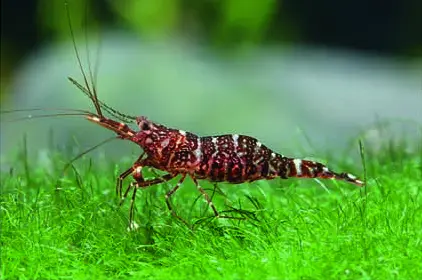
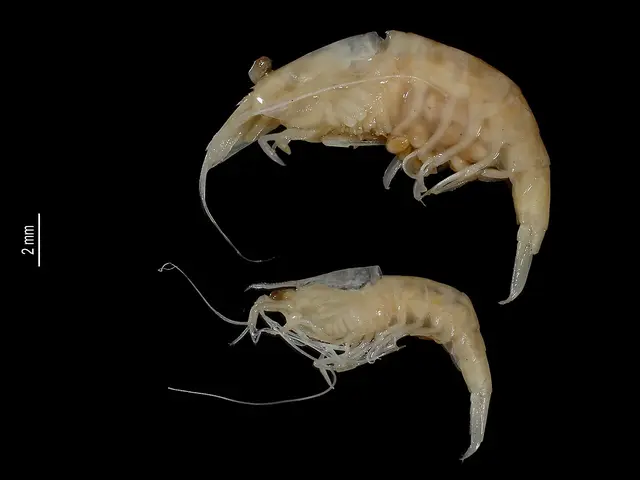
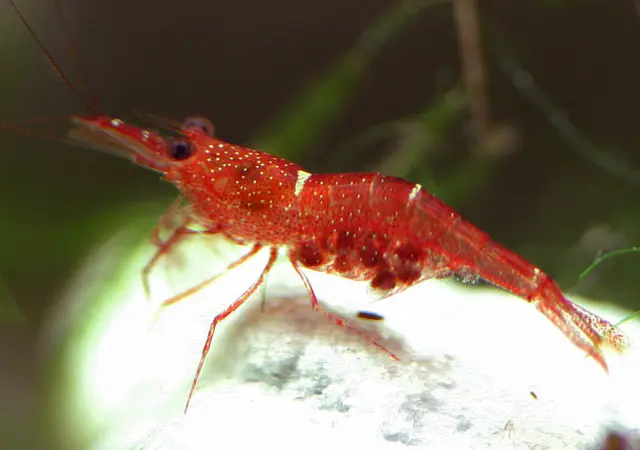
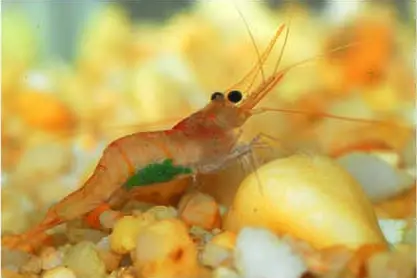
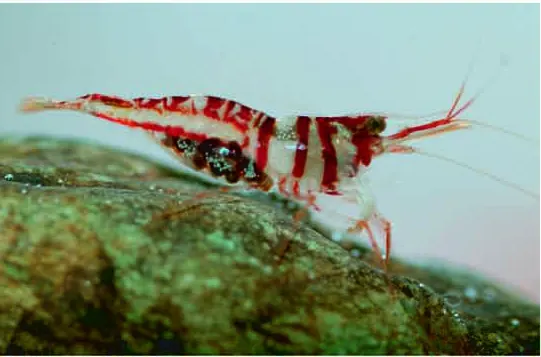
The species has a red- and white-patterned body that has made it popular in the tropical fish industry. Legs and feelers have bands of both red and white along their lengths, eye stalks are red, and the eyes themselves are black and fairly large in size (0.8-0.9 x 0.4-0.6 mm). The carapace of the species has three red stripes running along it, the final one at the base of the tail, with red coloration running halfway along the top of the head, from the tip.
Caridina spongicola is a small species of freshwater shrimp from Sulawesi (Indonesia) that reaches 0.64 to 1.27 cm (0.25 to 0.5 in) in length.
Range and habitat
Caridina spongicola is endemic to Lake Towuti, the largest and southernmost lake in the Malili complex of the island of Sulawesi, fed by a river that flows from the lake to the Boni Bay. It is only known from the northwestern arm of Lake Towuti, but it can be locally common, with as many as 137 individuals recorded on a single sponge and one study finding an average of about 29 individuals per sponge. This soft-tissued, undescribed species of sponge is also restricted to the northwestern arm of the lake and reaches up to about 20 cm (8 in) in diameter.
Pins are Wikidata “endemic to” fields. Orange dots, when present, are GBIF occurrence tiles — survey bias included.
Breeding
Caridina spongicola is a "complex breeder", meaning that young are hatched as miniature adults with the same coloration (although not as intense), with no need to transfer from salt and/or brackish water to freshwater as they develop through larval stages.
In crisis
Caridina spongicola is Critically Endangered on the IUCN Red List (assessed 2018, criteria A3cde; B1ab(iii,v)+2ab(iii,v)). Confirm the official criteria and any later count on the assessment page.
Sources
Adapted from the English Wikipedia article on Caridina spongicola (CC BY-SA 4.0; authors are listed in the article history; changes were made), Wikidata item Q13456021. Family and order context is original field-guide writing about the group, not a copied assessment of this one species. Not an IUCN assessment. Counts, when quoted, can change — confirm them on the recovery programme and on iucnredlist.org. Status and assessment year: IUCN. 2026. The IUCN Red List of Threatened Species. Version 2026-1. iucnredlist.org.