Endangered
Belgrandiella mimula
Belgrandiella mimula
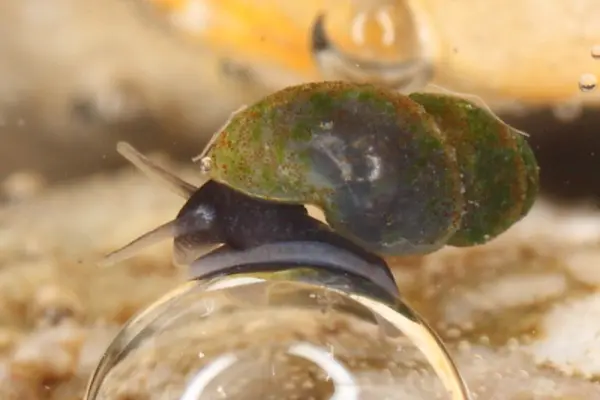
Belgrandiella mimula, the Fischauer dwarf spring snail, is a minute freshwater snail known only from the warm springs of Bad Fischau-Brunn in Lower Austria. The IUCN Red List lists it as Endangered (2026 assessment), after earlier Critically Endangered listings. Its occupied area is only a few square kilometres.
How it was named
The zoologist Martin Haase described Belgrandiella mimula in 1996. It belongs to the Hydrobiidae, a large family of small freshwater snails that breathe with a gill and close the shell with a lid, the operculum. Published descriptions call it minute.
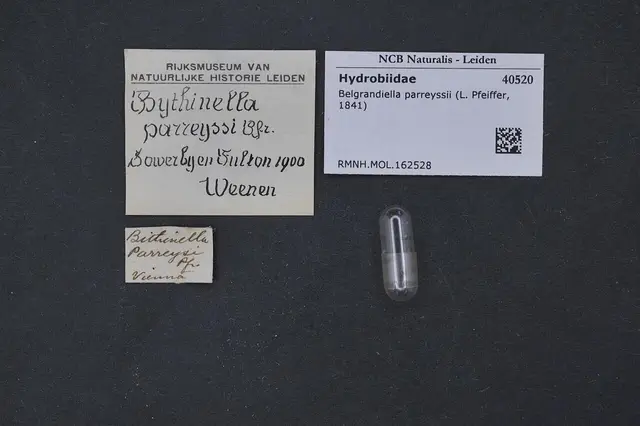
Older names now treated as synonyms of this species include Belgrandiella fuschi (Boeters, 1970) and Belgrandiella parreyssii (Pfeiffer, 1841). The species is endemic to Austria.
Where it lives
Bad Fischau-Brunn is a municipality in the Wiener Neustadt-Land district of Lower Austria, about 50 km south of Vienna. It is known for thermal springs of roughly 19 degrees Celsius, which were developed into a spa in 1872. A 2021 survey by Otto Moog and colleagues reported the snail in the springs and spring brooks of the village, apart from the two coldest springs, the one in the Eisenstein cave and the Park spring.
The Red List records Austria as its only country and gives its habitat as geothermal wetlands and freshwater springs. The assessment puts the occupied area at about 4 square kilometres and the extent of occurrence at 4 to 5 square kilometres, with one to eight locations.
Pins are Wikidata “endemic to” fields. Orange dots, when present, are GBIF occurrence tiles — survey bias included.
Why it is in trouble
The species is listed under criterion B2ab(iii), which applies to a very small area of occupancy with few locations and continuing loss of habitat quality. The Red List records a decreasing population trend and a continuing decline in the occupied area. No population size has been estimated, and the population is not considered severely fragmented.
The threats listed are recreational activities, which affect a minority of the population, and the abstraction of surface water for commercial use, which affects the majority (50 to 90 percent). Both are ongoing and could cause fluctuations in numbers. A further threat is recorded of unknown type.
What is being done
The assessment lists no conservation measures in place. Whether the snail occurs in a protected area is recorded as unknown, and it is not covered by international legislation or trade controls.
The Red List history shows Critically Endangered assessments in 1996 and 2010 and an Endangered assessment in 2026. The trend in the latest assessment is still decreasing, so the lower category does not signal recovery.
Sources
Written for this catalog in our own words from the sources below, checked against them on 12 November 2026. Population figures are estimates and carry the year they were made. Status and assessment year: IUCN. 2026. The IUCN Red List of Threatened Species. Version 2026-1. iucnredlist.org.