Endangered
Anodonthyla pollicaris
Anodonthyla pollicaris
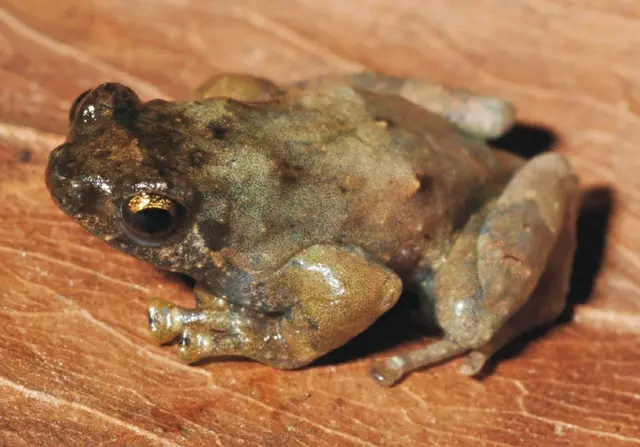
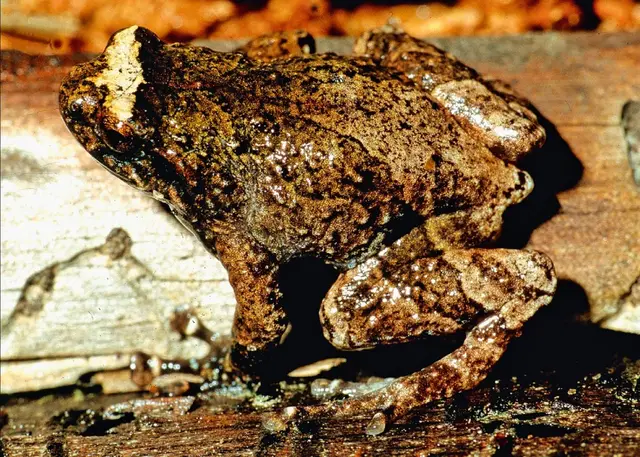
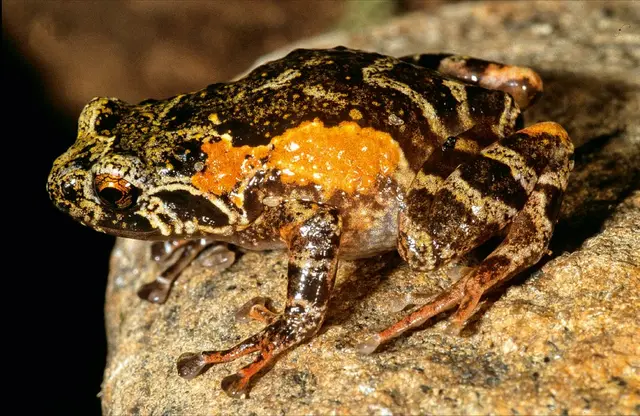
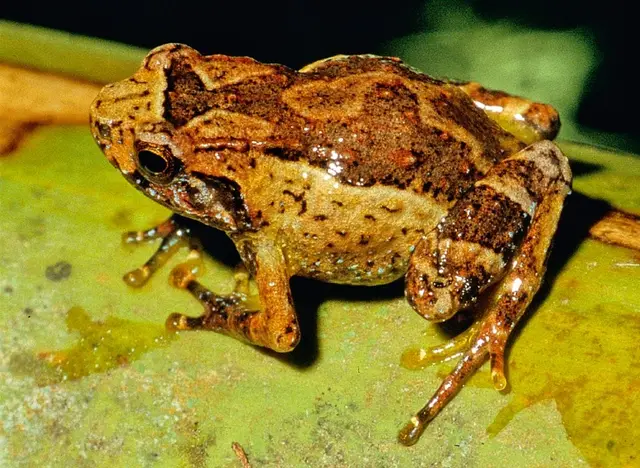
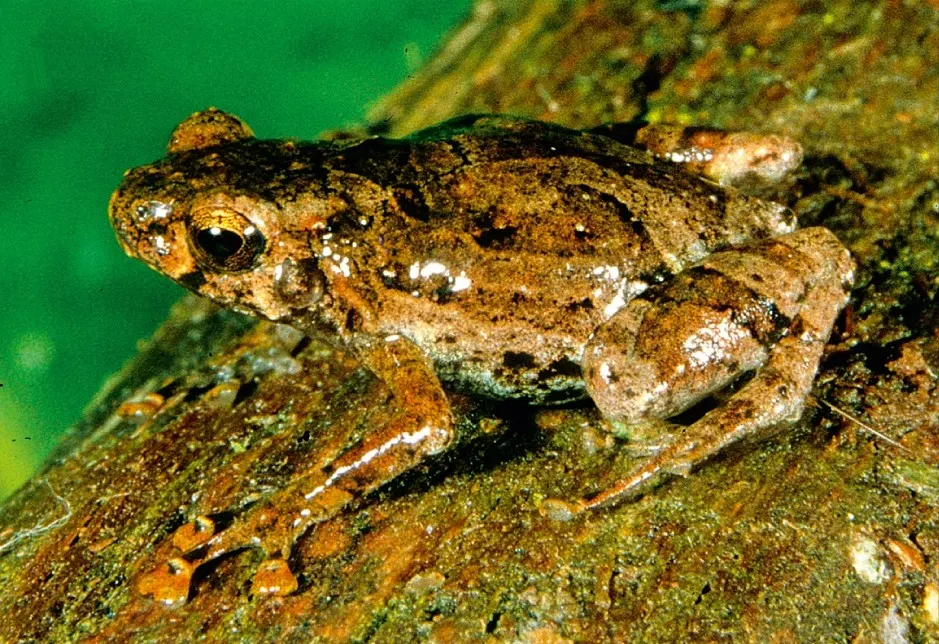
Anodonthyla pollicaris is a small arboreal narrow-mouthed frog from the moist forests of eastern Madagascar. Known from only four localities, it was rated Endangered in 2023 and again in 2025, after an earlier Data Deficient listing in 2012. Males guard their eggs in water-filled holes in plants.
Naming and relatives
Oskar Boettger described it in 1913 as Mantella pollicaris, from a specimen labelled Anevoka in eastern Madagascar. It belongs to the narrow-mouthed frog family (Microhylidae) and the subfamily Cophylinae. For most of a century it was treated as a synonym of a similar frog, Anodonthyla boulengeri. In 2010 Miguel Vences and colleagues used molecular trees to show that A. boulengeri was not a single natural group, and they brought the name pollicaris back. They found its call has a high note repetition rate, and that its closest relative is A. theoi, whose call repeats slowly.
Where it lives
Only four localities are known: Anevoka, the Andasibe area (including Analamazaotra and Mantadia National Park), Ambavaniasy and Ankeniheny. It lives in moist lowland and montane forest at about 770 to 1,475 metres. The Red List puts its area of occupancy at just 40 square kilometres inside a wider range of 4,881 square kilometres, and records a continuing decline in that area. It occurs in at least one protected area.
Pins are Wikidata “endemic to” fields. Orange dots, when present, are GBIF occurrence tiles — survey bias included.
How it breeds
Most of what is known comes from a captive colony kept by Association Mitsinjo near Andasibe. Its founders were collected in February 2016 in the Analamazaotra forest, and the group bred mainly from December to May, following the local seasons. The frogs laid eggs in water-filled holes, most often bamboo segments, and males stayed with the eggs and larvae until metamorphosis. Egg guarding has also been recorded in the field.
Across 25 clutches there were 731 eggs, around 29 per clutch, and 554 were fertile. The tadpoles do not feed. The fastest tadpoles completed metamorphosis in about 20 days from egg laying, and 151 young frogs developed in all.
Why it is in trouble
The assessment lists small-holder farming and grazing, shifting agriculture, mining and quarrying, more frequent fire, drought and temperature extremes, plus small-scale unintended harvest. The population trend is decreasing. Site protection, site management and awareness work are the actions listed, and the assessment calls for research on threats, life history and population size.
Sources
Written for this catalog in our own words from the sources below, checked against them on 12 November 2026. Population figures are estimates and carry the year they were made. Status and assessment year: IUCN. 2026. The IUCN Red List of Threatened Species. Version 2026-1. iucnredlist.org.