Endangered
Anodonthyla jeanbai
Anodonthyla jeanbai
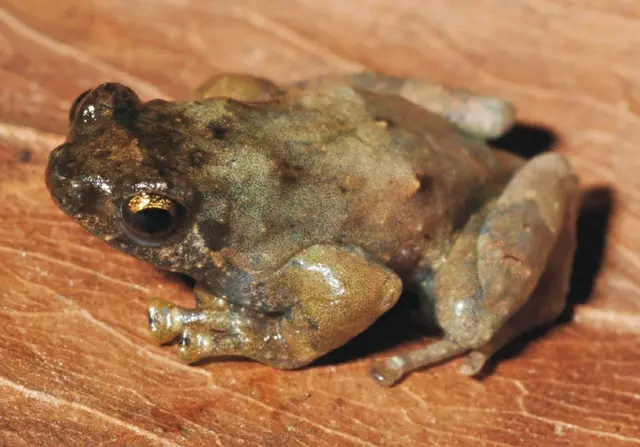
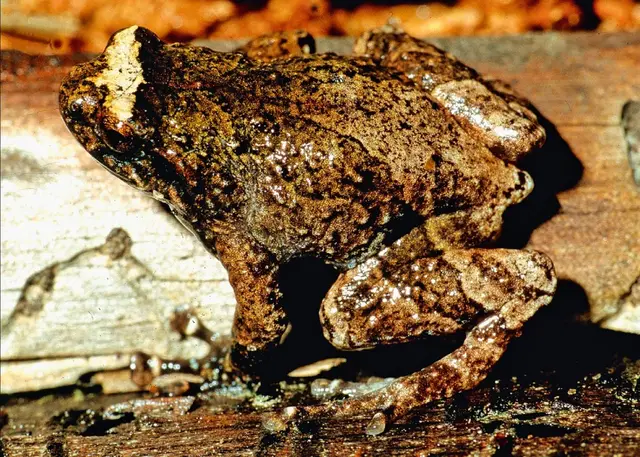
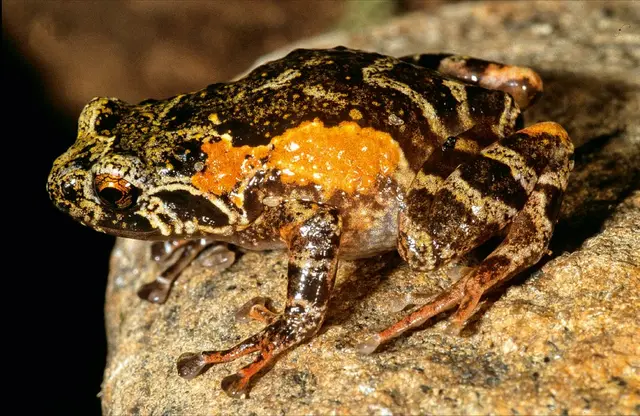
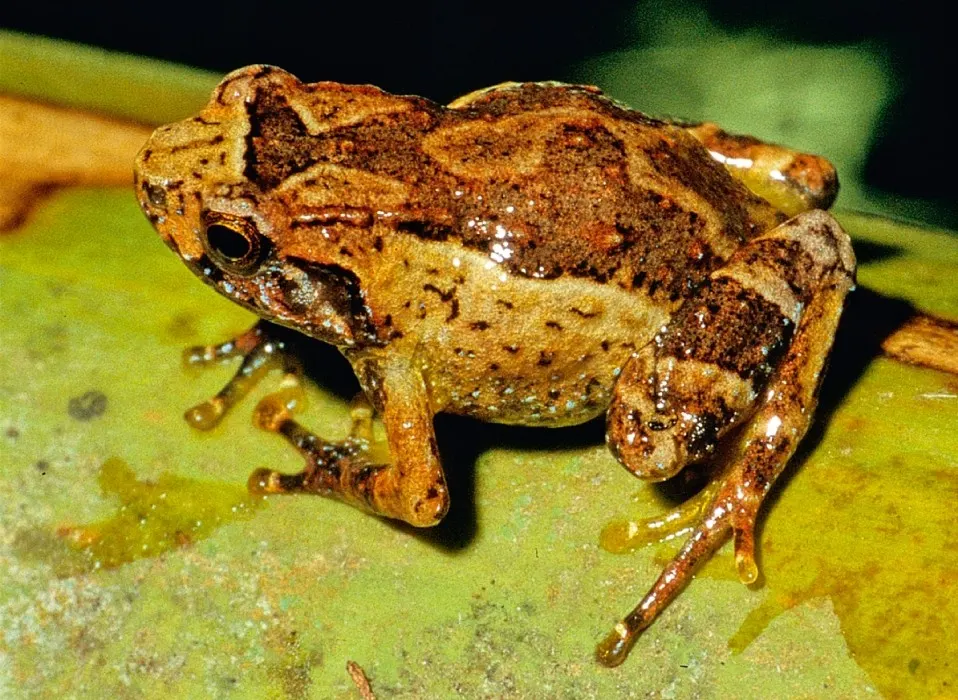
Anodonthyla jeanbai is a tiny tree frog from the mountains of southern Madagascar, known from a single bamboo forest in Andohahela National Park. The IUCN Red List rates it Endangered (assessed 2020), with a decreasing population. It stands out for its yellowish belly, a short ridge behind each eye, and an almost vestigial first finger.
How to recognise it
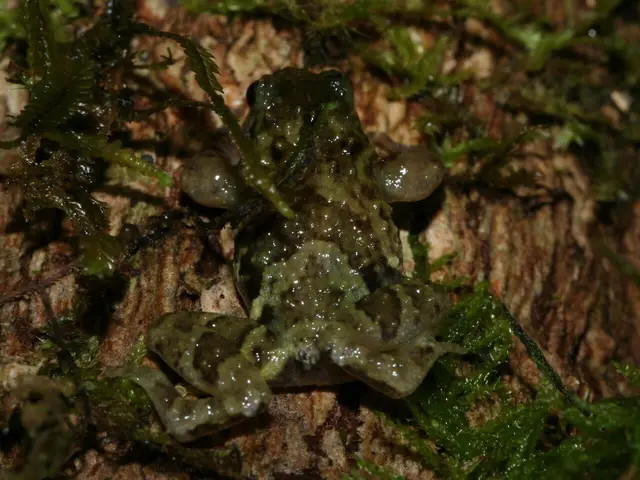
This is a small, slender frog. Adult males measure about 14 to 20 mm from snout to vent, which is far smaller than several of its relatives in the genus, where males reach 23 to 34 mm. The head is long and narrow, the eardrum is easy to see, and a short, bumpy fold runs back from each eye to the shoulder.
Its colour varies a lot. Some individuals have a pale stripe down the middle of the back and others don't. Many carry a dark hourglass shape over the shoulders and small reddish-brown bumps on the back, and the upper side of the body ranges from plain light brown to flecked. The iris is bronze. Every specimen has a yellowish tint on the limbs and rear belly, which no other Anodonthyla shows except A. moramora, whose belly is often greenish. Its first finger is so reduced that in most animals it is barely longer than the small spur beside it.
Where it lives
The species is known only from the upper part of Andohahela National Park, in the far south-east of Madagascar. The animals described to science were collected at about 1,548 m above sea level in January 2005, and the Red List treats this as a single location. The estimated extent of occurrence is 963 square kilometres, though the frogs themselves have only ever been found at that one surveyed site.
The habitat is montane rainforest with dense stands of bamboo. All of the known population falls inside the protected area, which also holds the only known populations of two other amphibians and is recognised as a Key Biodiversity Area.
Pins are Wikidata “endemic to” fields. Orange dots, when present, are GBIF occurrence tiles — survey bias included.
How it lives
Very little has been recorded. The frogs are arboreal and active at night. On the night of the original survey they were very common and sat 1 to 2 m up on bamboo trunks. Another bamboo-dwelling frog, Anodonthyla rouxae, lived in the same patch but turned up less often.
No recording of the male's call is known. No calling was heard during the single night of that survey, so how it breeds, where it lays eggs and how long it lives are all unknown.
Why it is in trouble
A frog with one known site is vulnerable almost by definition. The Red List records a continuing decline in habitat area and lists two ongoing pressures: small-holder farming and grazing, and the unintended effects of small-scale wood harvesting and logging. The Key Biodiversity Area record for the wider park also lists nomadic grazing, fire, mining and hunting.
The Red List names population size and distribution, life history and ecology, and threats as research needs. There is no systematic monitoring scheme for this frog.
What is being done
All of the known population lies inside Andohahela National Park, which Madagascar National Parks manages, and the park is part of the Rainforests of the Atsinanana World Heritage Site. The Red List first rated the frog Data Deficient (2011) and has listed it as Endangered since 2015, but no species-specific recovery plan is recorded.
Sources
Written for this catalog in our own words from the sources below, checked against them on 12 November 2026. Population figures are estimates and carry the year they were made. Status and assessment year: IUCN. 2026. The IUCN Red List of Threatened Species. Version 2026-1. iucnredlist.org.