Endangered
Ocellate Eagle Ray
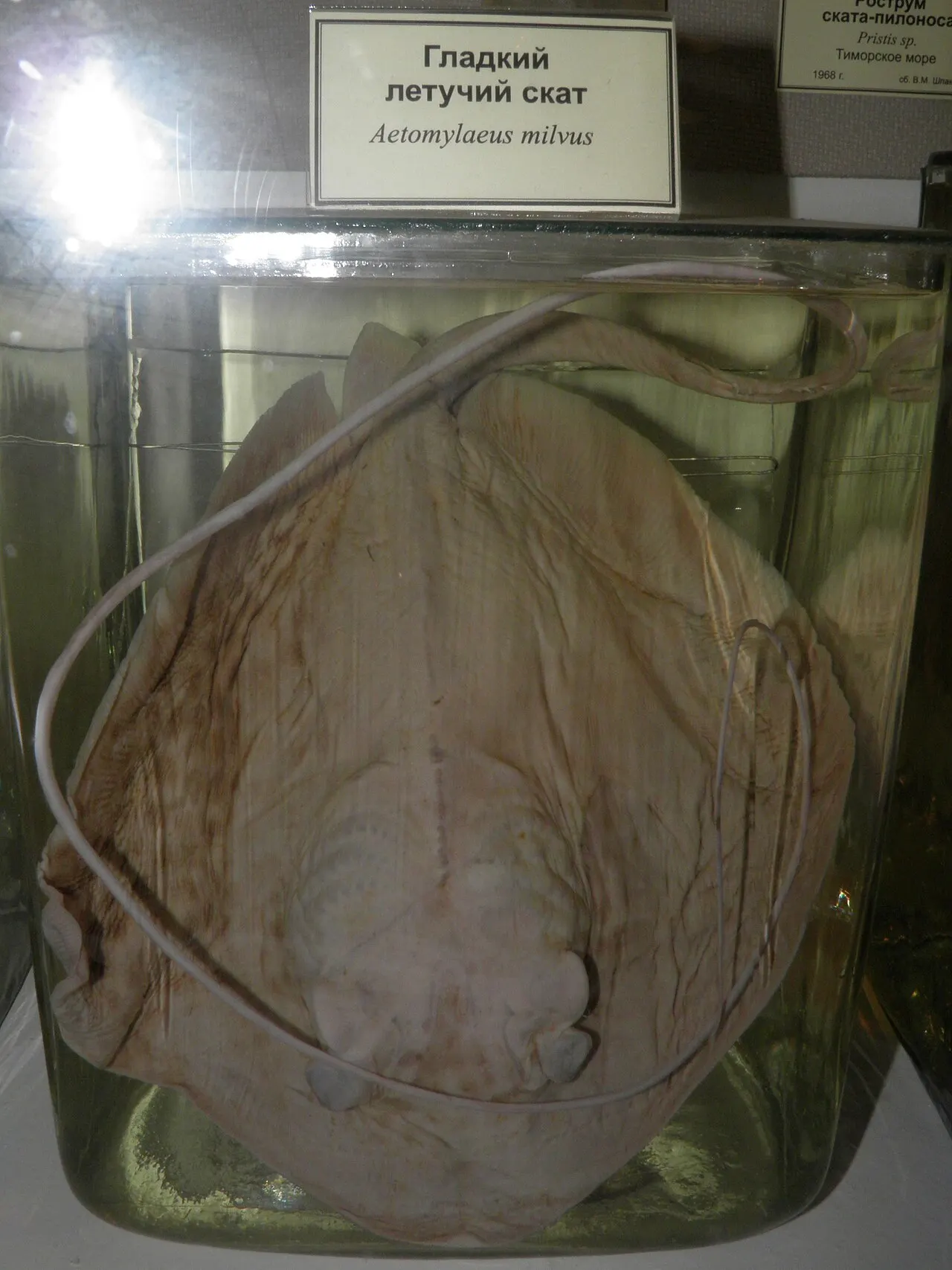
Aetomylaeus milvus
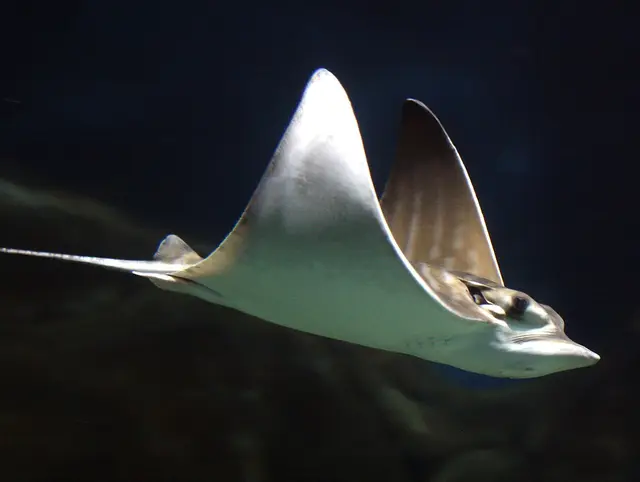
The ocellate eagle ray (Aetomylaeus milvus) is a flat-bodied relative of the stingrays that lives over soft sea floors in the Arabian Sea region, including the Arabian Gulf. The IUCN Red List rated it Endangered in 2017, mainly because fishing keeps removing animals. Its basic biology is still poorly known.
How to recognise it
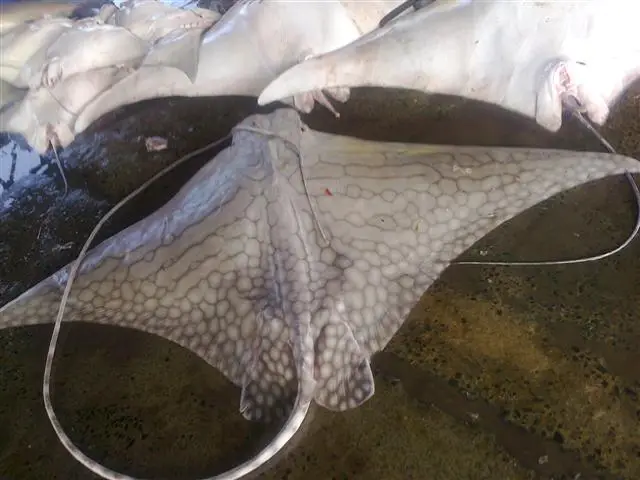
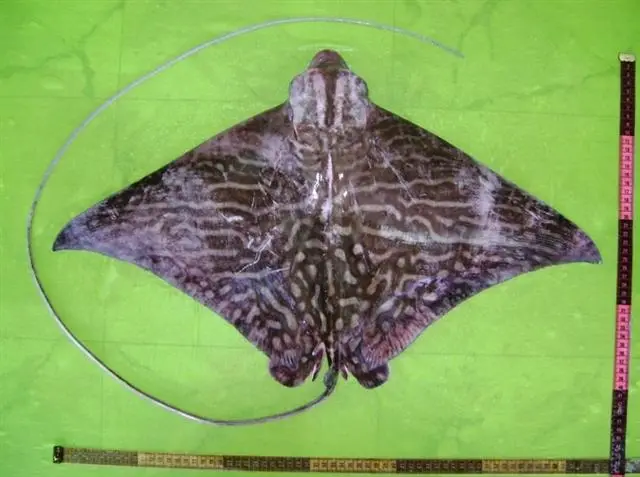
It belongs to the eagle rays, family Myliobatidae, a group of rays with broad, wing-like fins. The species reaches a disc width of at least 123 cm, according to the national assessment for the United Arab Emirates. Males mature at about 50 cm across. Nobody has recorded when females mature or how big newborns are.
Identification has been a problem. The ray was long mixed up with the mottled eagle ray (Aetomylaeus maculatus) and possibly the ornate eagle ray (Aetomylaeus vespertilio), so older records from other seas may refer to different animals.
Where it lives
Current assessments place it in the Arabian Sea region, from Oman to Gujarat in India, including the Arabian Gulf. The IUCN assessment lists Saudi Arabia, Qatar, Pakistan, Oman, Kuwait, Iraq, Iran and Bahrain. Some older references, including FishBase, give a much wider range from the Red Sea to China and Indonesia, which may reflect confusion with lookalikes.
It is thought to stay over soft bottoms of sand and mud, in inshore water down to about 90 m. The UAE assessment treats rays there as part of a larger, interconnected, migratory population in the north-western Indian Ocean, and the species shows aggregating behaviour.
Pins are Wikidata “endemic to” fields. Orange dots, when present, are GBIF occurrence tiles — survey bias included.
How it lives
Very little has been written about its daily life. Like other eagle rays it gives birth to live young that develop inside the mother, feeding at first on yolk and later on nourishing fluid from the uterus. Litters are suspected to be small, up to four pups.
Nobody knows how long it lives. Assessors estimate a generation at about 15 years by borrowing figures from the bat ray (Myliobatis californicus), a related species that grows larger. A long generation time usually means slow recovery once numbers have dropped.
Why it is in trouble
The main threat is fishing. The ray is caught by accident in trawl nets and gill nets, and in the UAE it makes up a fairly large share of the landed rays and skates. Fishing pressure is heavy and rising across much of the Arabian Sea, and many gill net, longline and trawl fisheries outside UAE waters are largely unregulated.
Habitat loss adds to it. In the Gulf, dredging, land reclamation, desalination plants, industry and shipping lanes have degraded or removed shallow coastal areas. The IUCN assessment, which uses criteria A2d+3d, records a decreasing population. A 2019 national assessment for the UAE rated the species Endangered too, suspecting a decline of at least 50% over three generations, about 45 years. Neither assessment is backed by a direct population count.
What is being done
The species lives in at least one protected area, but the IUCN assessment found no recovery plan, no monitoring scheme and no harvest management plan in place. It lists harvest management, habitat protection, policy and awareness work as actions that are needed. Some fisheries management exists in the Arabian Sea, although the UAE assessment expects domestic fishing to continue.
Sources
Written for this catalog in our own words from the sources below, checked against them on 12 November 2026. Population figures are estimates and carry the year they were made. Status and assessment year: IUCN. 2026. The IUCN Red List of Threatened Species. Version 2026-1. iucnredlist.org.