Critically Endangered
Ornate eagle ray
Aetomylaeus vespertilio
The ornate eagle ray (Aetomylaeus vespertilio) is a large, net-patterned stingray of warm Indo-West Pacific coasts, from the Red Sea and East Africa to northern Australia. It is rarely seen. The IUCN Red List moved it to Critically Endangered in 2024, after heavy fishing pressure and a suspected steep decline.
How to recognise it
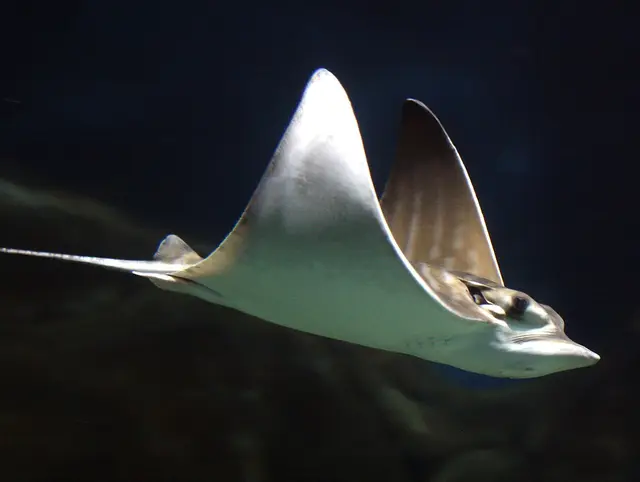
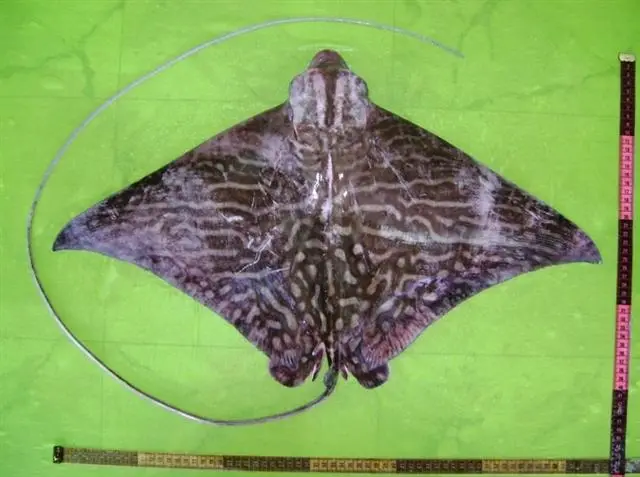
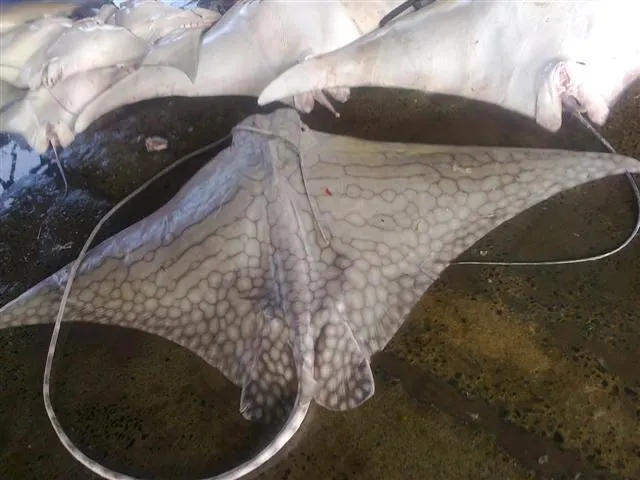
The back carries a net-like pattern of dark lines and rings. Individuals can be told apart by their dorsal spot patterns, and researchers have used photos of those patterns to recognise the same rays 9 and 13 months after first spotting them.
It is big. Disc width is reported up to about 240 cm in one account and at least 300 cm in the Australian fisheries assessment, with males maturing at roughly 170 cm. The tail can be very long, and including it, the whole animal can reach about 4 m. The tail has no spine, so the ray is regarded as harmless to people.
Where it lives
The IUCN assessment lists dozens of range states and territories, scattered through the Indo-West Pacific. They include South Africa, Mozambique, Tanzania, the Seychelles, the Maldives, Egypt, Saudi Arabia, India, Thailand, Indonesia, the Philippines, Palau, China, Taiwan and northern Australia. In Australia it ranges from Shoalwater Bay in Queensland to Shark Bay in Western Australia.
It lives over the continental shelf, over coral reefs, sandy bottoms, seagrass and in muddy bays and estuaries, from the surface down to about 110 m. Researchers consider it semi-pelagic, meaning it spends time off the bottom as well as on it. Its movements are otherwise not well known.
Pins are Wikidata “endemic to” fields. Orange dots, when present, are GBIF occurrence tiles — survey bias included.
How it lives
Little is known. It is a predator that takes mostly small invertebrates, including polychaete worms and some echinoderms. Like other rays in its family, it gives birth to live young hatched from eggs held inside the mother, and it is thought to produce few of them. The IUCN assessment uses a generation length of 13 years, while another source gives 15, with a lifespan of up to 24 years.
It is seen so rarely that it is reportedly nicknamed the unicorn of the sea. A 2020 study in Aquatic Conservation, led by Gonzalo Araujo, gathered 53 reports from Facebook, Instagram, Twitter and YouTube, four of them of dead animals. Every live record came from shallow reef or lagoon water. Reports came from places including the Maldives, the Seychelles, the Egyptian Red Sea, the Philippines, Palau and the Great Barrier Reef, and one from Richards Bay, South Africa, the southernmost Indian Ocean record at 28 degrees south.
Why it is in trouble
Fishing is the main cause. The ray is caught by accident in trawls and nets across its range, and in at least Indonesia it is kept for its meat and cartilage. The 2024 IUCN assessment scores both large-scale and small-scale unintended catch as ongoing and causing rapid declines over most of the range. It records a past reduction of about 80 percent, on the basis of habitat decline and exploitation. Habitat change, temperature extremes and urban development are listed too, but their impact is unknown.
It was reportedly once common in the Gulf of Thailand and is now considered rare there. Eagle rays breed slowly, so recovery would be slow. An Australian assessment suggests the species may also be naturally uncommon.
What is being done
The IUCN assessment records no recovery plan, monitoring scheme or international trade controls. It does occur in at least one protected area. Regulations on bottom fisheries are reportedly tightening in some places.
Australia is the clearest bright spot. Retention of rays is prohibited in nearly all fisheries that might catch it, and bycatch reduction devices, required in most northern trawl fisheries since the early to mid 2000s, cut catches of this ray by more than 90 percent, though they may be less effective at letting juveniles escape. Australia rates the species Near Threatened because the animals there are likely linked to the wider regional population. Outside Australia, fishing is intense and largely unregulated.
Sources
Written for this catalog in our own words from the sources below, checked against them on 12 November 2026. Population figures are estimates and carry the year they were made. Status and assessment year: IUCN. 2026. The IUCN Red List of Threatened Species. Version 2026-1. iucnredlist.org.