Critically Endangered
Achatinella lila
Achatinella lila
Achatinella lila is a small, glossy, left-coiled tree snail found only in the northern Ko'olau Mountains of Oahu, Hawaii. The IUCN Red List classed it as Critically Endangered in 1996. A 2014 study counted fewer than 200 known wild individuals, and a captive colony has been kept since 1997.
How to recognise it
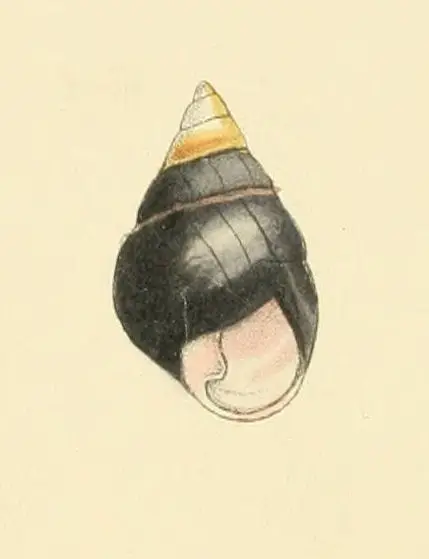
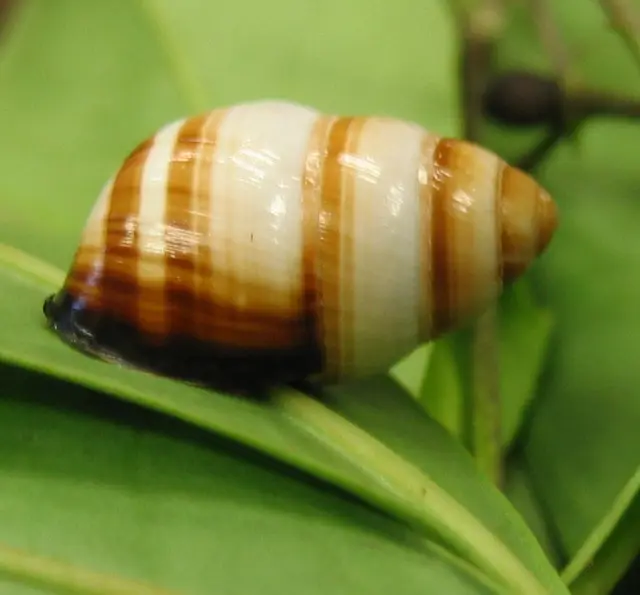
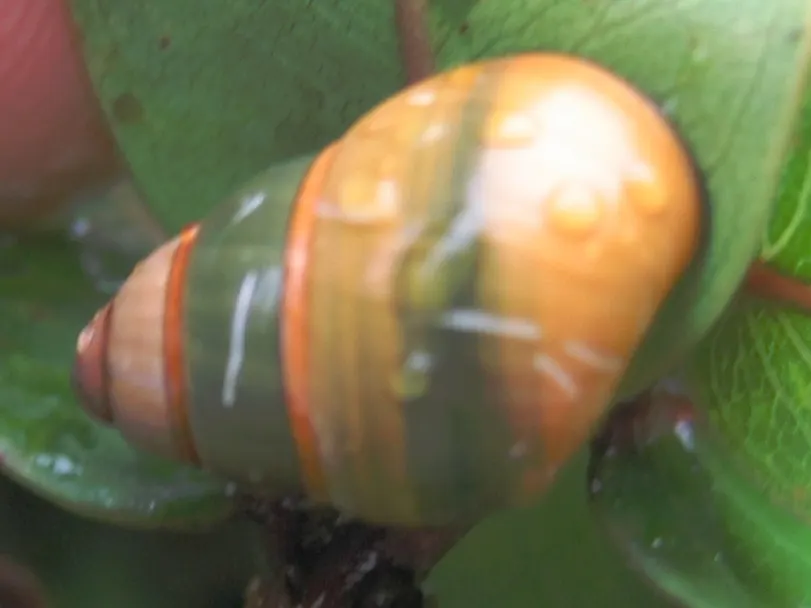
The shell is about 17 mm tall and 11 mm wide, ovate and cone-shaped, thin but strong, with about five and a half whorls. It coils to the left (sinistral). The surface is nearly smooth and very glossy, in yellow and green, with the earliest whorls a burnt brown that often weathers to whitish.
The last whorl varies between animals, from uniform dark chestnut to chestnut bands on yellow, with some patterns in between. Inside, the opening is white or faintly lilac, with a purple or white fold on the central pillar. The species was formally described by Henry Pilsbry in 1914.
Where it lives
It is endemic to the northern Ko'olau Range on Oahu. The snails live on native plants in forest dominated by ohia (Metrosideros polymorpha), on windward slopes at about 700 to 850 m. A 2014 genetics paper in PLOS ONE put the known range at roughly 2 km from north to south, less than 5 percent of its historic range.
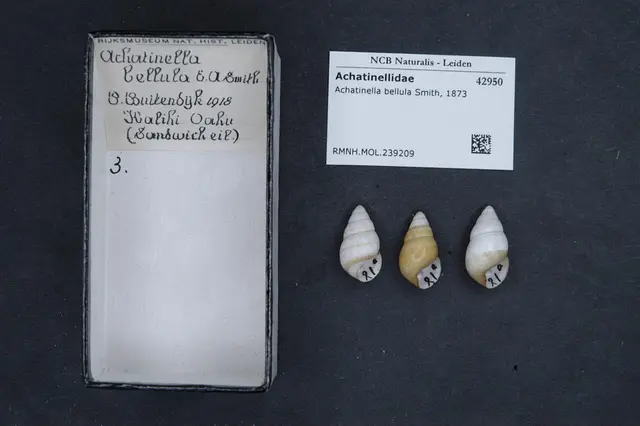
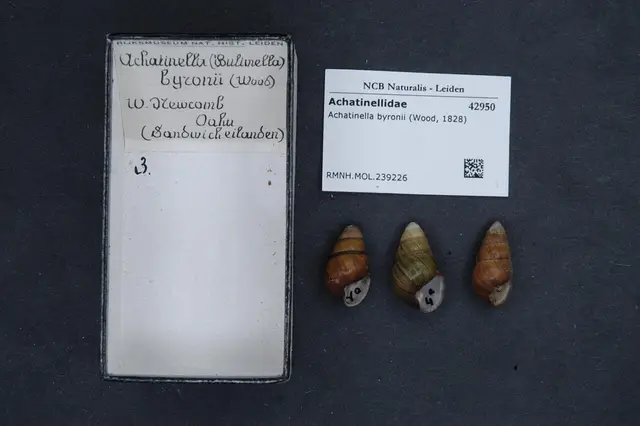
Two sites were known then. The northern one held perhaps 100 to 200 snails, while only 12 were seen at the southern site in 2013. The snail shares its forest with related tree snails, including Achatinella sowerbyana, A. byronii and A. bulimoides.
Pins are Wikidata “endemic to” fields. Orange dots, when present, are GBIF occurrence tiles — survey bias included.
How it lives
Hawaiian tree snails feed on a fungal film growing on leaves. This species is a hermaphrodite and reaches adulthood at about four years, when the shell reaches roughly 15 mm and develops a lip. Instead of laying eggs, it gives birth to single live young.
Fecundity is low. In the captive colony, founders averaged 3.4 young and first-generation adults 4.0, but second-generation adults only 1.5. The generation time was estimated at about 5.6 years, which means populations rebuild slowly.
Why it is in trouble
Introduced predators are the central problem, above all the rosy wolf snail (Euglandina rosea), which has devastated Hawaii's native snails. The 2014 study blames heavy predation for most recent wild declines. Habitat loss and over-collection have added to the toll. The 1996 IUCN assessment lists criteria A1ce and B1+2abcde but records no population trend or numbers.
The captive colony has had its own troubles. It was founded in 1997 from seven adults (six from the southern end of the range, one from the north), peaked at 668 snails in 2009 and fell below 200 by 2013. Adult yearly survival dropped from 0.84 in 1998 to 2002, to 0.59 in 2003 to 2008, and 0.43 in 2009 to 2013, and only 27 percent of third-generation juveniles survived. Healthier, more genetically varied snails tended to survive. The study could not identify the cause of the decline.
What is being done
The species is on CITES Appendix I. Since 2012, the Snail Extinction Prevention Program, a partnership between the US Fish and Wildlife Service, Hawaii's Division of Forestry and Wildlife and the University of Hawaii, has bred rare snails, controlled predators and maintained predator-proof enclosures where snails are released. Captive-bred Achatinella lila have reportedly been returned to the wild in cohorts of 50.
The 2014 study recommended crossing captive stock with wild snails to restore genetic variety. It also said an enclosure near the southern site would need extra gene flow from wild snails, since enclosures shield snails from predators but limit exchange between groups.
Sources
Written for this catalog in our own words from the sources below, checked against them on 12 November 2026. Population figures are estimates and carry the year they were made. Status and assessment year: IUCN. 2026. The IUCN Red List of Threatened Species. Version 2026-1. iucnredlist.org.