Critically Endangered
Achatinella decipiens
Achatinella decipiens
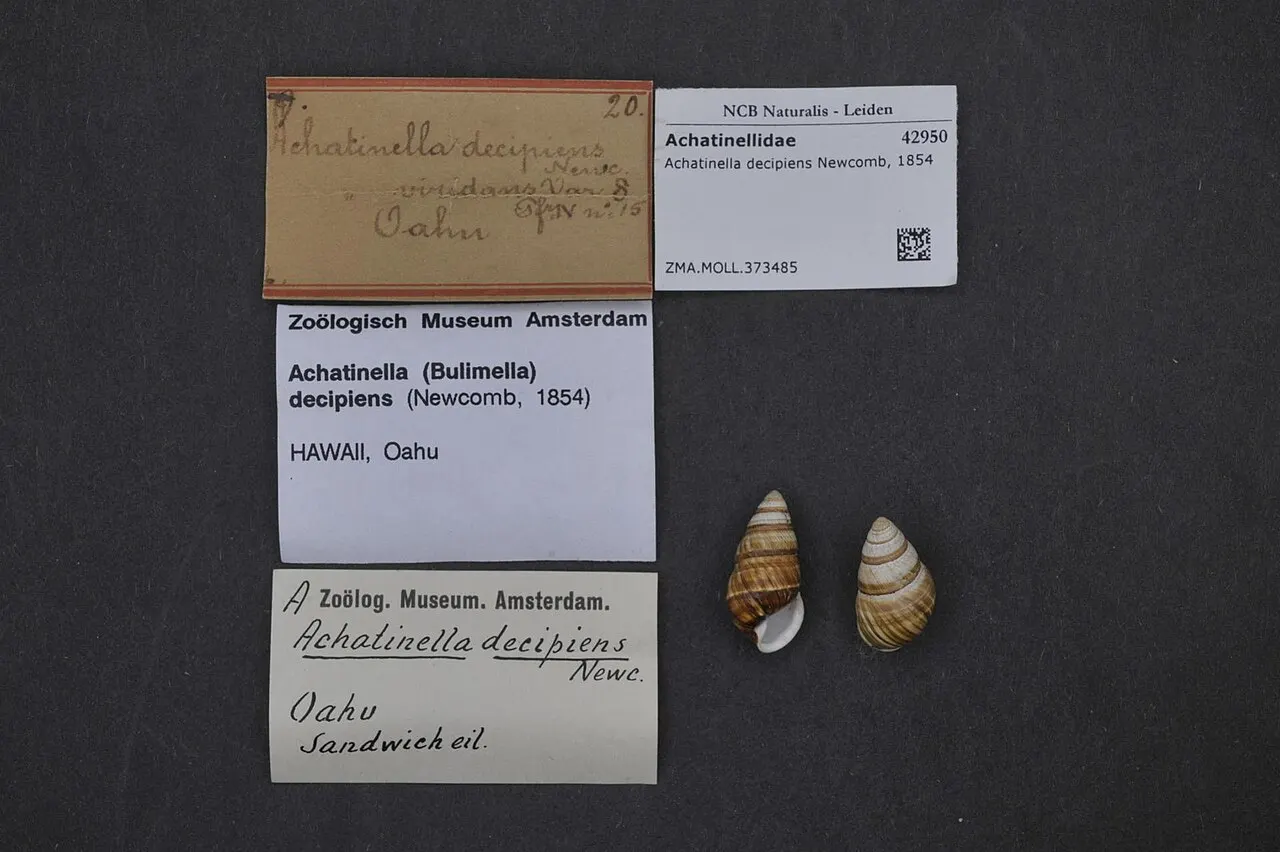
Achatinella decipiens is an Oahu tree snail, a small, brightly banded mollusc that lives in trees in the northern Koolau Mountains of Hawaii. The IUCN Red List last assessed it as Critically Endangered in 1996. It looks so much like its relative A. byronii that specialists struggle to tell them apart.
How to recognise it
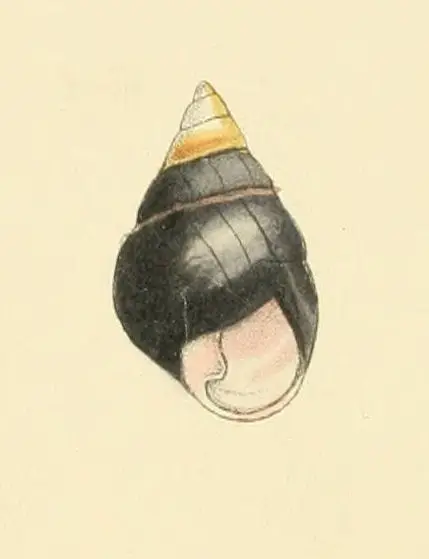
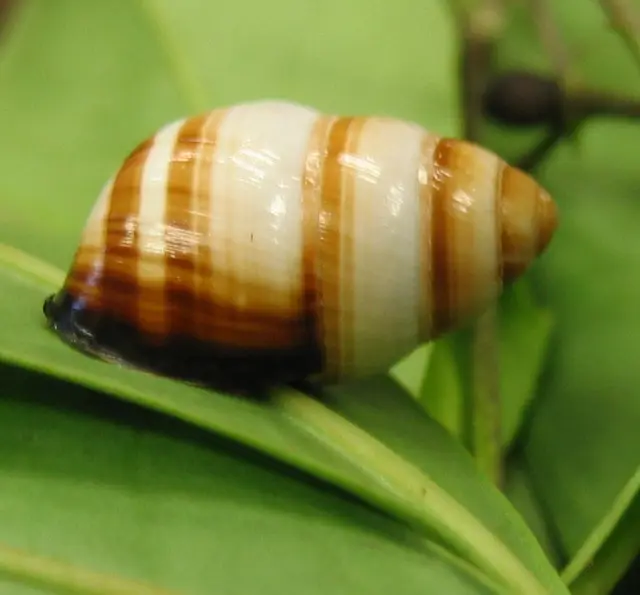
The shell is solid and conical, about 20.5 mm tall and 9 mm wide, with six whorls. Colour varies: white with yellow bands, or yellow with white lines and chestnut stripes. Together with its near twin A. byronii, colour runs from dark brown to light gold and even green.
Coiling depends on where the snail lives. Snails in the eastern part of the range have a rough, left-handed (sinistral) shell, while those in the west have a smooth, right-handed one.
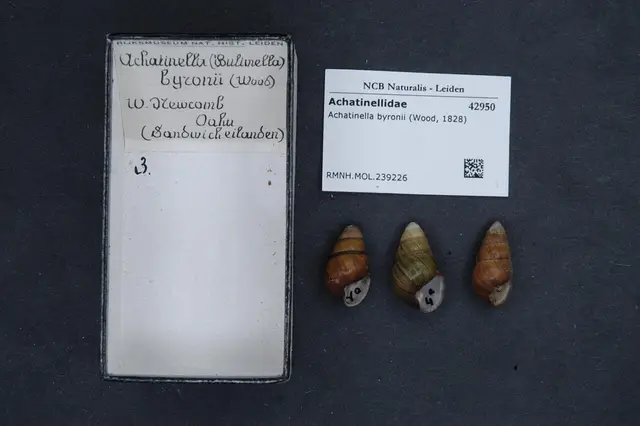
Telling it from Achatinella byronii is hard, because the two are very alike and the variation between them is continuous. A genetic comparison of one specimen of each found a difference of a single base pair in a mitochondrial gene. No publication has formally merged them, so both stay listed.
Where it lives
Like every Achatinella, it is native only to Oahu. This species occurs in the northern Koolau Mountains, at about 549 to 768 m above sea level. A 2011 federal review reported that Army biologists monitored 15 sites, nine of them at least 100 m from the others and so counted as separate populations. The habitat near the summit was in good condition, with tall native vegetation and some invasive grass.
Pins are Wikidata “endemic to” fields. Orange dots, when present, are GBIF occurrence tiles — survey bias included.
How it lives
Oahu tree snails are nocturnal and live in trees, grazing the fungus that grows on leaf surfaces. Each snail is both male and female and gives birth to live young, not eggs. Newborns measure 3 to 4 mm. An adult has one to four young a year, and they don't mature for five to seven years, so numbers rebuild very slowly.
Why it is in trouble
The rosy wolf snail, an introduced predator, eats snails of every size and can wipe out a local population in under a year. Rats eat the larger snails and leave crushed shells. Jackson's chameleon, which reportedly reached Hawaii in the early 1970s, has also been recorded eating tree snails, though its impact is not well documented.
Invasive plants are spreading into higher forest with the help of feral pigs and goats, and pigs trample the host plants the snails live on. Illegal shell collecting is a further pressure.
The most recent count in the 2011 review was from 6 May 2009, when eight live snails were seen. Only one monitored population had a predator-proof enclosure at the time.
What is being done
A captive-propagation lab at the University of Hawaii at Manoa has held A. decipiens since 1990, when five adults were collected, with eight more added in 1997. Breeding has been slow, and the lab held 18 animals in December 2009. A 2024 federal review still lists the species among the 10 Achatinella known to survive. It is covered by CITES Appendix I and, as part of its genus, by the US Endangered Species Act.
Sources
Written for this catalog in our own words from the sources below, checked against them on 12 November 2026. Population figures are estimates and carry the year they were made. Status and assessment year: IUCN. 2026. The IUCN Red List of Threatened Species. Version 2026-1. iucnredlist.org.