Holothuroidea in crisis
5 records. Red List version 2026-1
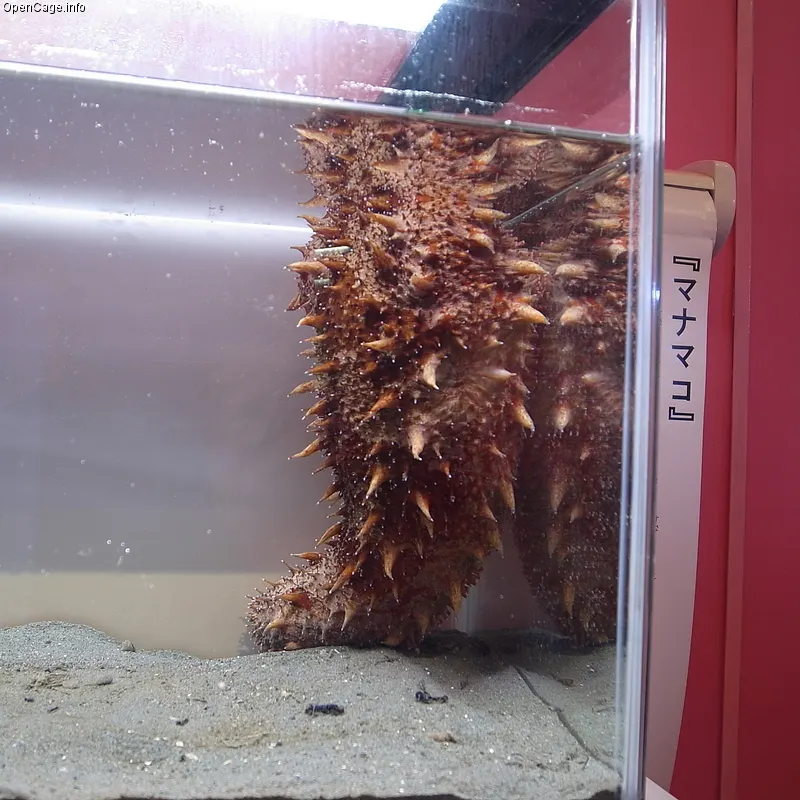
In this catalog, Holothuroidea stands for sea cucumbers. We list 5 sea cucumbers that the IUCN Red List records as threatened enough to be Critically Endangered, Endangered or Extinct in the Wild: 2 Critically Endangered and 3 Endangered.
The biggest groups are the orders Synallactida (3) and Holothuriida (2), and the families with the most listed species are Stichopodidae (3) and Holothuriidae (2). The full list below is grouped by order.
A class is a filing shelf, not a measure of risk: it says nothing about how fast any one species is declining. Status and assessment years come from the IUCN Red List (version 2026-1); how to read an IUCN assessment explains what the categories and criteria mean, and each record links to its own assessment.
Sea cucumbers are soft-bodied echinoderms, relatives of sea stars and urchins, that live on the seafloor from shallow reefs to the deepest trenches. Counts vary by source: roughly 1,100 described species on one reference page, and 1,430 or 1,786 on another, which gives both figures without reconciling them.
Most are deposit or suspension feeders. They take in sediment and organic debris, and a single animal can swallow more than 45 kilograms of sediment in a year. When threatened, some species release sticky threads or expel their internal organs, which they later regrow.
Why these animals are threatened
The pressure is fishing. Dried sea cucumber, sold as beche-de-mer or trepang, is exported mainly to Asian markets, especially for Chinese cuisine. Heavy fishing for those markets in the 20th century caused many stocks to collapse quickly, and concern has grown since the 1970s.
A 2013 review of 77 fisheries found that most are poorly managed, which drives declining stocks. About 3 million people take part in sea cucumber fishing worldwide. Countries with overexploited or depleted fisheries had significantly lower national human development scores.
Farming began in the early 1980s as a response to overexploitation. Hatcheries in China and Japan first succeeded with Apostichopus japonicus, and culture of Holothuria scabra started in India in 1988.
What the catalog lists
The catalog has 5 records in this group: 3 Endangered and 2 Critically Endangered. By family, 3 are Stichopodidae and 2 are Holothuriidae. They are in the orders Synallactida and Holothuriida.
The records include the brown sea cucumber (Isostichopus fuscus), listed as Critically Endangered. It ranges along the eastern Pacific, from Mexico to northern Peru and the Galapagos, and is fished for export to East Asia. Mexico's National Institute of Ecology declared it in danger of extinction in 1994, and Ecuador adopted a marine management plan for the Galapagos in 1999. Other records are Apostichopus japonicus, Thelenota ananas, Holothuria nobilis and Holothuria whitmaei.
Five records out of more than a thousand species mostly show which valuable species have been assessed, not how the group fares overall.
Sources for this section
- Sea cucumber, Wikipedia: species counts 1,786 and 1,430, sediment processing, beche-de-mer trade, 20th century stock collapses, aquaculture history
- Holothuroidea, Animal Diversity Web: about 1,100 species, feeding, defences, Isostichopus fuscus in Baja California 1994, Galapagos plan 1999
- Purcell et al. 2013, Fish and Fisheries (abstract): 77 fisheries, poor management, 3 million fishers, Human Development Index link
- Isostichopus fuscus, Wikipedia: range Mexico to northern Peru and Galapagos, export demand, Galapagos fishery decline
Status breakdown
5 records: Critically Endangered 2; Endangered 3.
All species
Synallactida (3)
Holothuriida (2)
- Holothuria (Microthele) nobilis Holothuria nobilis CR
- Holothuria (Microthele) whitmaei Holothuria whitmaei EN
The A to Z index lists the species with a full account; the catalog search finds any record by name.
Quick answers
- How many sea cucumbers are in this catalog?
- 5, listed by the IUCN Red List as 2 Critically Endangered, 3 Endangered.
- What is Holothuroidea?
- Here, Holothuroidea means sea cucumbers. It is a taxonomic class used to group the catalog.
- Where do the statuses come from?
- From the IUCN Red List (version 2026-1), with a link to each species' assessment on iucnredlist.org.