Endangered
Holothuria (Microthele) whitmaei
Holothuria whitmaei
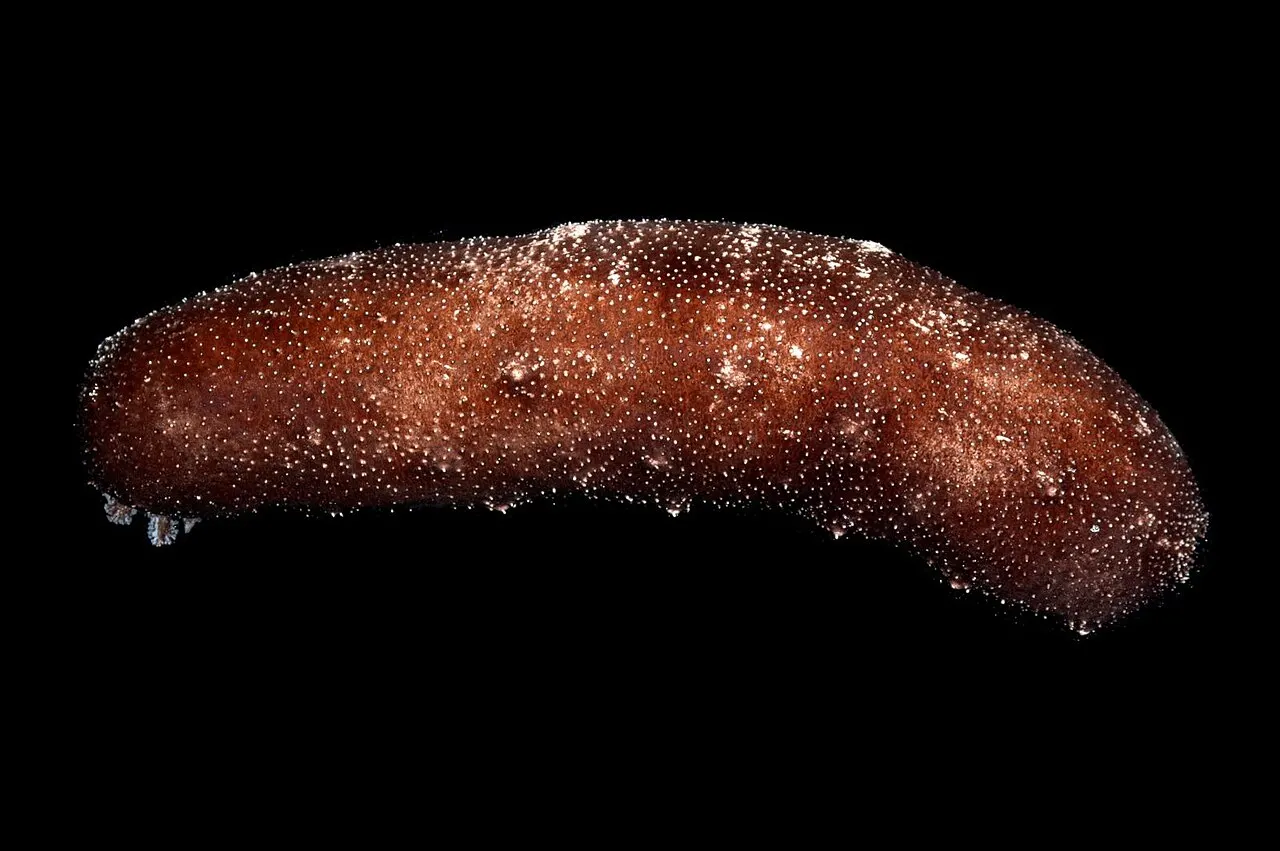
The black teatfish (Holothuria whitmaei) is a large, dark sea cucumber of Indo-Pacific coral reefs, found from Australia to the central Pacific. The IUCN Red List rated it Endangered in 2013. Its dried flesh is among the most valuable of all sea cucumbers, and the demand for it has driven its decline.
How to recognise it
It's a heavy, sausage-shaped sea cucumber that reaches about 55 cm in length. It often lies on sand or dead coral with a layer of sand over its back.
A 2004 genetic study in Marine and Freshwater Research by Uthicke, O'Hara and Byrne found that H. whitmaei is entirely black and lives in the Pacific. Its Indian Ocean relative, H. nobilis, has white dots along the lower sides. The two were long treated as one species, so older accounts often blur them together.
Where it lives
The IUCN assessment lists it across the tropical Indo-Pacific, including Australia, Papua New Guinea, the Solomon Islands, Fiji, Vanuatu, New Caledonia, the Philippines, Indonesia, Palau, Hawaii and many smaller island groups.
It lives on coral reefs and in seagrass beds, from the shallows down to roughly 30 to 40 m, depending on the source. It is densest on reef flats but also turns up on back slopes and reef fronts. Groups of 5 to 25 animals are usual.
Pins are Wikidata “endemic to” fields. Orange dots, when present, are GBIF occurrence tiles — survey bias included.
How it lives
Adults move very little. Growth is thought to be slow, and modelling suggests they may live for several decades. Young animals settle onto the reef only in low and irregular numbers.
Sea cucumbers of this group release eggs and sperm into open water, and the larvae drift as plankton before settling. The black teatfish is one of the few sea cucumbers that spawns in winter, a habit that may leave it exposed to climate change, with Torres Strait expected to feel the effects first. At Ningaloo Reef in Western Australia, more animals were reportedly sheltering in the morning than in the afternoon.
Why it is in trouble
The main threat is harvest for the beche-de-mer trade. The IUCN lists both large-scale and small-scale harvest as ongoing, and the species is taken for human food. Top-grade dried product has reportedly sold for US$70 to 190 per kilogram, depending on size and quality.
Slow growth and patchy recruitment mean depleted reefs recover slowly. Black teatfish fishing was banned on the Great Barrier Reef in 1999 and in Torres Strait in 2003. A 2022 review in Biological Conservation by Wolfe and Byrne describes repeated catch cuts and then a fishery closure on the Great Barrier Reef because of local depletion. Papua New Guinea has reportedly exported none since a 2009 moratorium, imposed after overproduction.
What is being done
Black teatfish have been on CITES Appendix II since 28 August 2020, so exports need a finding that the take is not harming wild populations. The IUCN records that the species occurs in at least one protected area and that a harvest management plan exists.
Torres Strait in northern Australia offers the clearest sign of recovery. A 2019 to 2020 survey found numbers rising after the 2003 closure. A four-day trial opening in 2021, fished only by Torres Strait Traditional Inhabitants, took 17 tonnes against a 20 tonne cap. The region's harvest strategy, adopted in January 2020, recognises the cultural laws of the island groups. Few overfished sea cucumbers anywhere have come back this way.
Sources
Written for this catalog in our own words from the sources below, checked against them on 12 November 2026. Population figures are estimates and carry the year they were made. Status and assessment year: IUCN. 2026. The IUCN Red List of Threatened Species. Version 2026-1. iucnredlist.org.
- IUCN Red List assessment, Holothuria whitmaei (2013)
- Encyclopedia entry, Holothuria whitmaei
- SeaLifeBase, Holothuria whitmaei
- eAtlas, Black teatfish
- Uthicke, O'Hara and Byrne 2004, Marine and Freshwater Research 55(8)
- Wolfe and Byrne 2022, Biological Conservation (abstract record)
- CSIRO, securing a steady livelihood from the ocean (2021)
- Protected Zone Joint Authority letter to Torres Strait beche-de-mer licence holders (2020)

