Critically Endangered
Holothuria (Microthele) nobilis
Holothuria nobilis
The black teatfish (Holothuria nobilis) is a large sea cucumber of shallow reefs, recorded mainly across the western Indian Ocean. It is prized as seafood and easy to collect. The IUCN assessed it as Critically Endangered in 2026, after an Endangered rating in 2010, and it is listed in CITES Appendix II.
How to recognise it
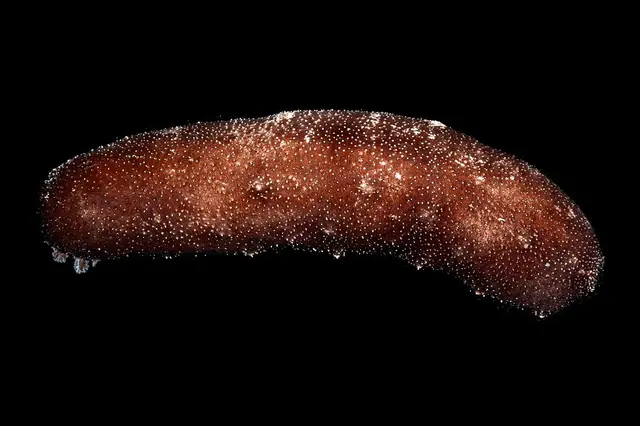
The black teatfish is a blackish-brown and grey sea cucumber with a thick body. It averages about 35 cm and can reach 60 cm, weighing roughly 230 g to 3 kg, with larger adults reported up to 4 kg. Below the mouth sit 6 to 10 small teat-like projections, which give teatfish their name and separate them from other sea cucumbers. The anus is ringed by five small calcareous teeth.
Juveniles look quite different from adults and are often misidentified in the field. Two relatives cause extra confusion. The white teatfish (Holothuria fuscogilva) was once mistaken for it, and Holothuria whitmaei, a Pacific species, is also called black teatfish. Genetics can tell the three apart.
Where it lives
The 2026 IUCN assessment lists it across the western Indian Ocean, including Kenya, Tanzania, Mozambique, South Africa, Madagascar, the Seychelles, Mauritius, Sri Lanka, the Maldives, India, Oman and several Red Sea countries. Some databases describe a much wider Indo-Pacific range, which probably reflects Pacific animals now treated as Holothuria whitmaei.
It lives on the seafloor from the surface to about 40 to 60 metres, depending on the source, mostly on coral reefs. Habitats include reef flats, outer reef slopes, seagrass beds and sandy or gravelly bottoms. It is generally solitary.
Pins are Wikidata “endemic to” fields. Orange dots, when present, are GBIF occurrence tiles — survey bias included.
How it lives
The black teatfish is a deposit feeder, swallowing sediment and digesting the bacteria and detritus in it. Adults release eggs and sperm into open water, so breeding success depends on animals living close enough together, and larger adults have an edge because of their bigger gonads. The buoyant eggs hatch into drifting larvae that spend about 1.5 to 3 months in the plankton.
If threatened, a sea cucumber can expel its internal organs to entangle a predator and then regrow them.
Why it is in trouble
Sea cucumbers are dried and sold as bêche-de-mer, a seafood delicacy, and teatfish are among the most valuable of the roughly 70 species harvested. The black teatfish is collected by hand at low tide, by skin diving and with diving gear. Slow growth, late maturity, limited movement and large size make it very vulnerable. The IUCN names large-scale and small-scale harvest as the threats, lists the population trend as decreasing, and records an estimated past reduction of 90 percent.
Fishery records from elsewhere show the pattern. In Sri Lanka, the southern sea cucumber fishery collapsed within a few years, and the east coast suffered the same fate. Steven Purcell of Southern Cross University told Mongabay in 2019 that fishers who have depleted high-value species can still opportunistically collect the last of them.
What is being done
Black teatfish is in CITES Appendix II, so exporting countries must show that trade won't harm wild populations. A proposal to list teatfish species was put to the 2019 CITES meeting and was backed by the European Union, Kenya, Senegal, the Seychelles and the United States. The IUCN assessment records that the species occurs in at least one protected area and is subject to international trade controls, though it gives no population size estimate.
Sources
Written for this catalog in our own words from the sources below, checked against them on 12 November 2026. Population figures are estimates and carry the year they were made. Status and assessment year: IUCN. 2026. The IUCN Red List of Threatened Species. Version 2026-1. iucnredlist.org.