Endangered
Apostichopus japonicus
Apostichopus japonicus
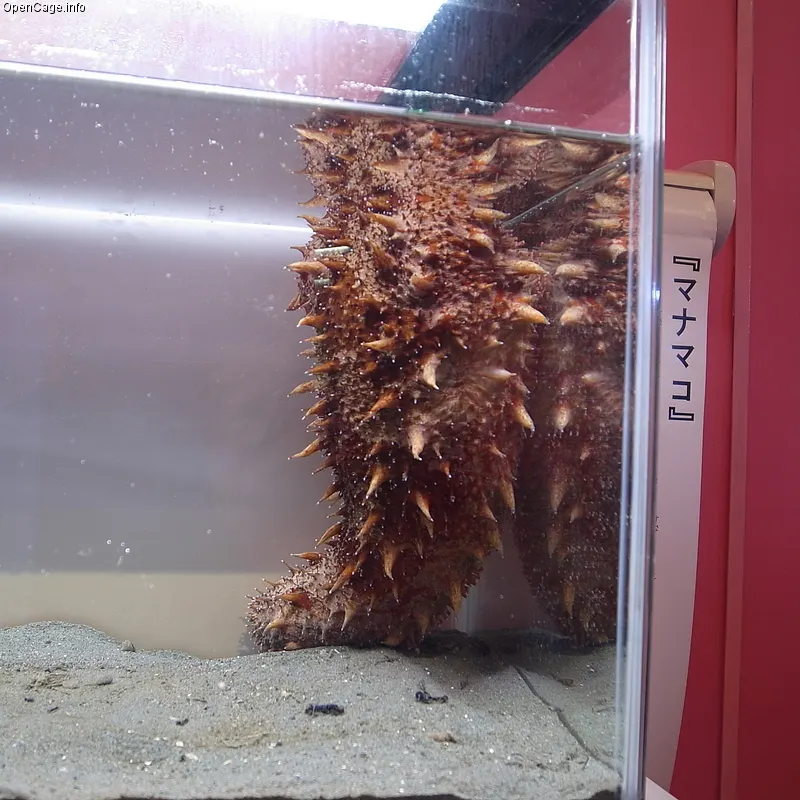
The Japanese spiky sea cucumber is a thorny, leathery seabed animal of the cold north-western Pacific, and one of the most valuable sea cucumbers sold as food. The IUCN lists it as Endangered (assessed 2026) after heavy harvesting cut wild numbers across Japan, Korea, China and Russia.
How to recognise it
It is a cylindrical, leathery animal with blunt, thorny bumps along its body. The mouth sits at the front, surrounded by short feeding tentacles, and the anus is at the rear. It comes in three colour forms, red, green and black, which are sold at different prices in Japan under the names aka, ao and kuro namako. Genetic studies show only slight differences between the red form and the others, and none between green and black.
Where it lives
The species is native to the coasts of Japan, South Korea, North Korea, China and Russia, a range running from Sakhalin Island south to the Amami Islands. The IUCN also records an introduced population in Turkey. It lives from the shoreline down to about 100 m, in tidepools, rocky and pebbly shores, seagrass beds and loose gravel on the shallow seabed.
The red form reportedly lives on offshore gravel at 40 m or deeper, while the green and black forms share the muddier and sandier bottoms in shallower water.
Pins are Wikidata “endemic to” fields. Orange dots, when present, are GBIF occurrence tiles — survey bias included.
How it lives
It feeds by sifting seabed sediment with its tentacles, taking in detritus, bacteria, diatoms, small remains of plants and animals, and droppings. The sexes are separate, and adults shed eggs and sperm into the water. The larvae drift in the plankton, then settle on hard surfaces and change into juveniles.
Where summer seawater gets very warm, around 25 degrees Celsius, the animals reportedly go dormant. They stop feeding, their guts shrink, and they lose weight. In parts of China this dormancy has reportedly lasted up to four years. The IUCN estimates a generation length of 16 years.
Why it is in trouble
Harvest for food is the one threat the IUCN lists, from both large-scale and small-scale fishing, and it records a population decrease. The assessment rests on criterion A2bd, which concerns an observed population reduction. Divers collect the animals by hand to about 20 m, and trawlers work deeper water. Overfishing has greatly reduced populations in Russia and North Korea.
A 2014 study in Proceedings of the Royal Society B put the reduction across its range at more than 60 percent, and found it was the most expensive species studied, fetching up to US$2,950 per kg dried in Chinese markets. Farming has not eased the pressure. China produces huge numbers of juveniles for ponds and sea ranching, yet that study reported no repopulation of wild stocks. A 2025 study by Mercier and colleagues, covered by Mongabay in 2026, found that farming at industrial scale has failed to dampen prices.
What is being done
The IUCN records several measures in place: a recovery plan, a systematic monitoring scheme, a harvest management plan, conservation sites identified over its entire range, and a regional area management plan. It also occurs in at least one protected area. Harvest management and trade management at national and international level are listed as actions still needed. Whether the measures have reversed the decline is unclear, as the 2026 assessment still describes the population as decreasing.
Sources
Written for this catalog in our own words from the sources below, checked against them on 12 November 2026. Population figures are estimates and carry the year they were made. Status and assessment year: IUCN. 2026. The IUCN Red List of Threatened Species. Version 2026-1. iucnredlist.org.




