Critically Endangered
Zhou's box turtle
Cuora zhoui
Zhou's box turtle (Cuora zhoui) is a medium-sized freshwater turtle known only from animals sold in southern Chinese markets and from captivity. Nobody has documented one in the wild. The IUCN Red List rated it Critically Endangered in 2000, and specialists say it may already be Extinct in the Wild.
How to recognise it
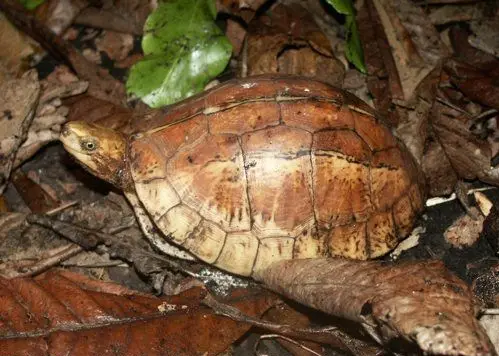
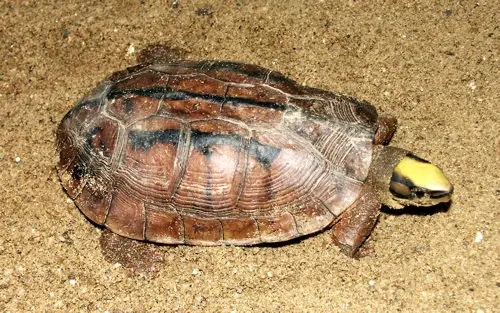
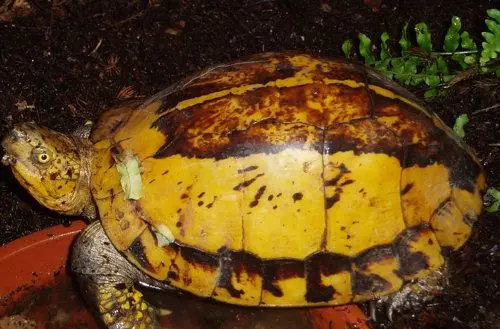
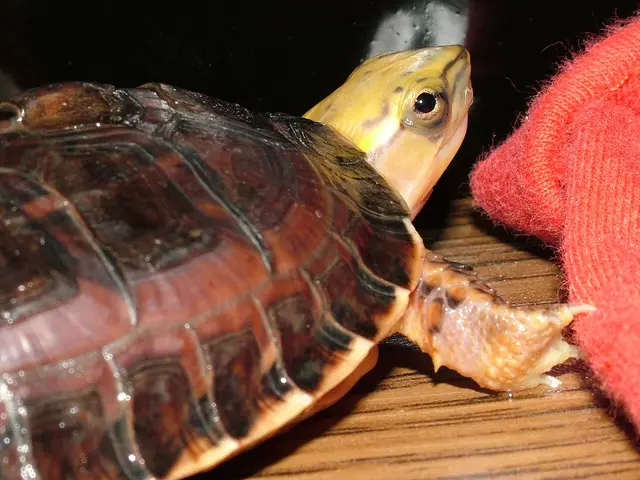
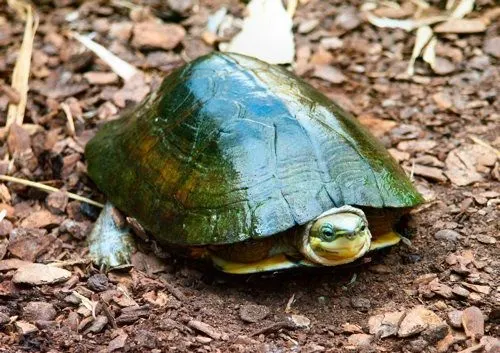
It's a medium-sized box turtle. Males reach up to about 170 mm along the midline of the shell and females up to about 223 mm. The carapace is oval and moderately domed, with three low keels, and is chestnut brown to nearly black in adults. The plastron is mostly black with a yellow figure in the middle, sometimes compared to a fir tree, and has a hinge that lets the shell close.
The head is narrow, with a hooked upper jaw, especially in males. The top of an adult's head ranges from cream-white to yellowish olive or olive brown. Males have a slightly concave plastron and thicker tails. Hatchlings are dark brown to black with a pointed head and a bright plastral pattern that changes to the adult look after about two years.
Where it lives
The honest answer is that no one knows. The species was described in 1990 from turtles bought in markets in Pingxiang and Nanning in Guangxi, China. A second description the next year, under the name Cuora pallidicephala, came from market animals said to originate in Yunnan. The IUCN lists only China as a range country. A 2024 account by Torsten Blanck and colleagues suspects a very small area of mountainous highlands along the border between Guangxi, Yunnan and northern Vietnam.
During a survey in Vietnam, locals at one site said it lived in swamps and slow streams in a highland area, but no turtle was found. Surveys near the market-reported localities in China have found none either. Its tolerance of cool water, and its trouble above about 30 degrees Celsius in captivity, hint at a cooler, higher habitat.
Pins are Wikidata “endemic to” fields. Orange dots, when present, are GBIF occurrence tiles — survey bias included.
How it lives
Everything known about its natural history comes from captive animals. They are mostly or entirely carnivorous, mainly active by day, rarely bask, and prefer to hide under leaves or moss. They're strongly aquatic, shy, and sensitive to water quality.
Mating happens in spring and fall, but a female lays only one clutch a year, usually in June or July, of 1 to 8 eggs (typically 2 to 4). Incubation takes 65 to 125 days. Sex is set by incubation temperature, with males produced only at colder temperatures.
Why it is in trouble
Collection for the pet trade is the main pressure, and the IUCN lists small-scale harvest as an ongoing threat. Local people may also have eaten them. A Guangzhou trader interviewed in 2008 said he bought 50 to 60 of the turtles in the Pingxiang markets between 1997 and 2006, with yearly numbers falling from 10 to 15 in 2002 and 2003 to 2 or 3 in 2005 and 2006. The last verified freshly wild-caught turtle, an old female, appeared in the Chinese trade in late 2009 or early 2010. Prices climbed from under 300 euros in the 1990s to more than 3,000 euros per animal in 2007 and 2008, and one report cited a market price as high as $38,461.
Many imported turtles died soon after arrival. A Hong Kong exporter said more than 90 percent of the animals he imported did. Habitat damage is probably a further threat, but without a known range its effect can't be judged.
What is being done
Zhou's box turtle has been on CITES Appendix II since 2000. That has stopped legal international trade, but domestic pet sales in China and smuggling from Vietnam reportedly continue. Cuora species considered native to China have been Class II nationally protected animals there since 1988.
The main safety net is captive breeding. The first captive breeding came in 1994, and the International Turtle Center at the Allwetter Zoo in Münster, Germany has bred it every year since 2005, the only place with regular success. It has set up 15 new captive colonies with other zoos and private breeders. A 2024 census counted 180 to 198 living animals, 25 to 37 of them wild-caught.
The concern is genetics. All the Münster offspring descend from only six wild-caught founders, and some captive animals have died with shell osteoporosis. Specialists call for field surveys in southern China and northern Vietnam to find any wild turtles, in the hope of one day restocking a protected habitat.
Sources
Written for this catalog in our own words from the sources below, checked against them on 12 November 2026. Population figures are estimates and carry the year they were made. Status and assessment year: IUCN. 2026. The IUCN Red List of Threatened Species. Version 2026-1. iucnredlist.org.