Critically Endangered
Golden coin turtle
Cuora trifasciata
The golden coin turtle (Cuora trifasciata), also called the Chinese three-striped box turtle, is a freshwater turtle of southern China and Hong Kong. The IUCN Red List rated it Critically Endangered in 2020. Wild animals are so valuable that collectors and the medicine and pet trades have stripped it from much of its range.
How to recognise it
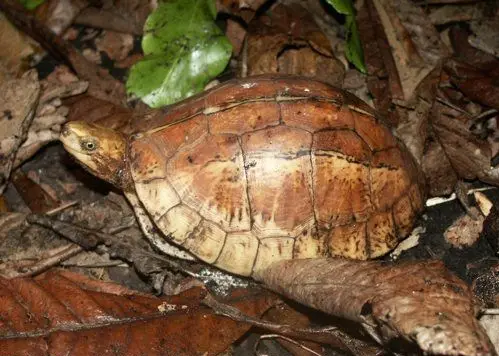
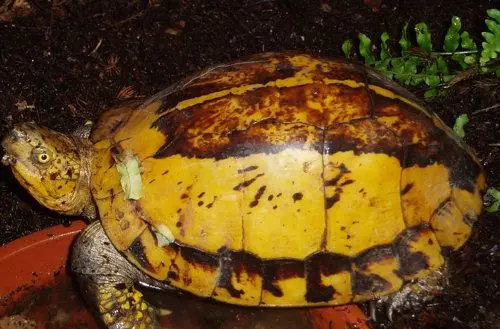
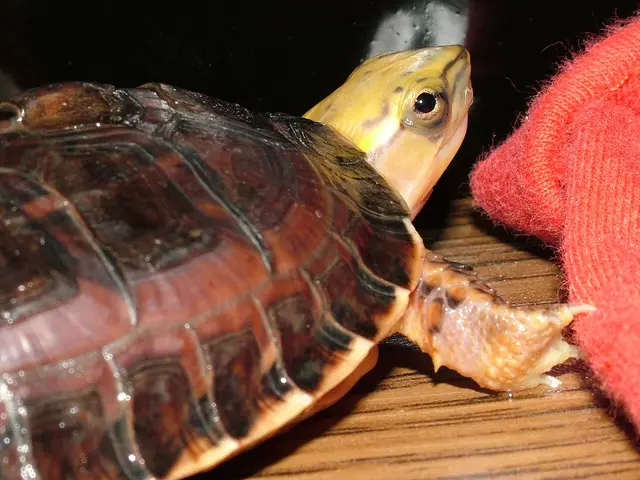
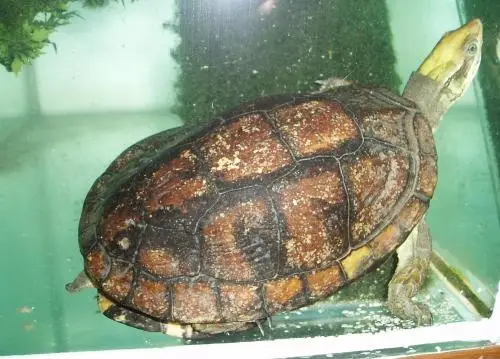
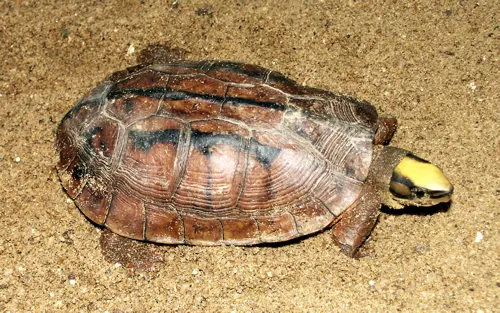
Three black stripes run along a brown shell, which can reach about 25 cm in straight-line length. The upper jaw is yellow and slightly hooked, with a yellow stripe running back from the mouth, and the belly shell is mostly black with a yellow edge.
It's a box turtle in the family Geoemydidae. Two subspecies are recognised. Turtles from Vietnam and Laos once counted as this species are now treated as a separate one, the Vietnamese three-striped box turtle (Cuora cyclornata).
Where it lives
The IUCN lists the species from Guangdong, Guangxi, Hainan and Fujian in China, and from Hong Kong. Other accounts say it has been wiped out on the Chinese mainland, leaving Hainan Island and Hong Kong, and a 2013 report said that in Hong Kong it survives in very small numbers, in a few undeveloped areas and on offshore islands.
It lives in streams and in forest. In Hong Kong it eats mainly fish, frogs and carrion, and remains of crabs, snails and insects have been found in droppings.
Pins are Wikidata “endemic to” fields. Orange dots, when present, are GBIF occurrence tiles — survey bias included.
How it lives
The temperature at which eggs are incubated decides the sex of the hatchlings. Farms in warm lowlands have produced mostly females, which is one reason wild-caught males have sold for around $20,000. A breeding centre in California incubated eggs at 26 degrees C to favour males. Captive-bred turtles reach breeding age at about 8 years.
Why it is in trouble
Hunting is the main cause. The IUCN lists targeted harvest, accidental capture, aquaculture, housing and urban growth, and genetic pollution as threats, and it records a decreasing population. The turtle is a key ingredient in guilinggao, a jelly sold as a health tonic, and the belief that it cures cancer has no scientific support.
Around 1993, turtles in Vietnam were reportedly worth $500 to $1,000 each. By 2013 a single animal could fetch $25,000 or more on the black market, and one male reportedly sold for $50,000 in Europe. A survey of about half of China's registered turtle farms estimated a herd of roughly 115,900 of these turtles, but most farmed stock is hybrid, which makes it of little use for conservation, and escapes can pollute wild genes. Medicine users also tend to want wild animals.
What is being done
The turtle is on CITES Appendix II. The IUCN records captive breeding outside the wild and international trade controls as in place, and lists reintroduction, a genome resource bank and site protection among the actions it recommends.
In early 2013 the Turtle Conservancy, Kadoorie Farm and Botanic Garden and Hong Kong's conservation department flew five captive-bred young from California to Hong Kong, the first return of captive-bred turtles from the United States to their home country. The stated aim is eventual release into the wild to re-establish healthy populations. No later update on releases was found.
Sources
Written for this catalog in our own words from the sources below, checked against them on 12 November 2026. Population figures are estimates and carry the year they were made. Status and assessment year: IUCN. 2026. The IUCN Red List of Threatened Species. Version 2026-1. iucnredlist.org.