Critically Endangered
Indochinese box turtle
Cuora galbinifrons
The Indochinese box turtle (Cuora galbinifrons) is a high-domed, forest-living turtle from the uplands of northern and central Vietnam, Laos and southern China, including Hainan. The IUCN Red List rated it Critically Endangered in 2020, mainly because collectors have taken so many for food, medicine and the pet trade.
How to recognise it
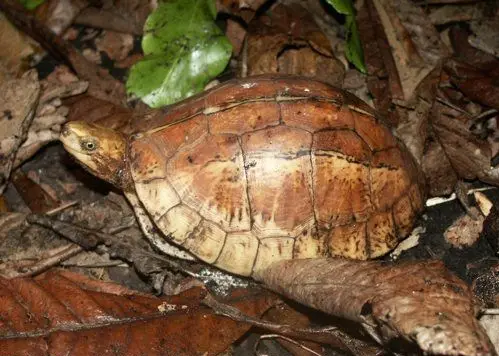
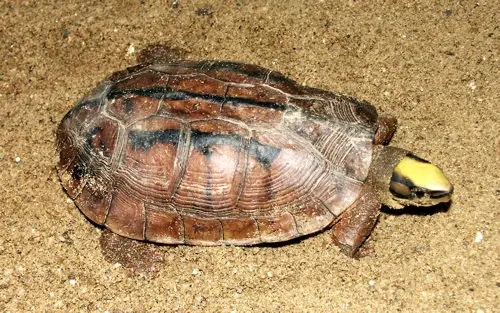
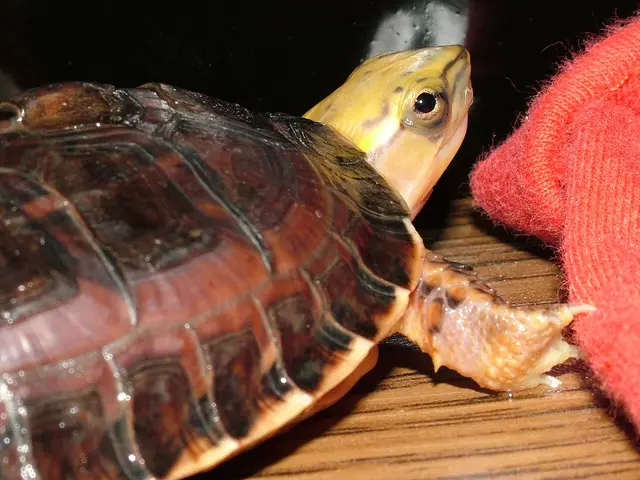
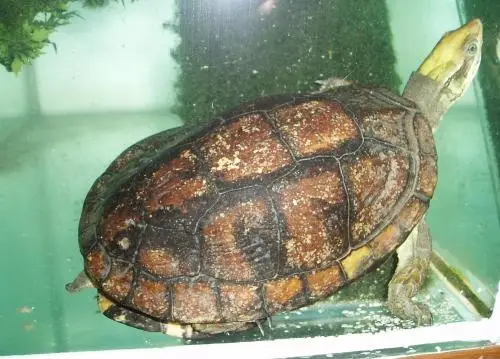
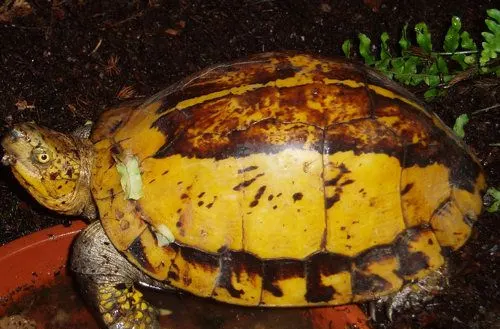
The shell is tall and domed, marked with dark brown and yellowish cream stripes that fan out from the middle of each plate. The chin and throat are yellow or cream, and the head is pointed with a short snout and a yellowish grey tone. Hinges on the underside let the turtle close itself completely inside its shell. Adults reach a carapace length of up to about 19.8 cm.
Taxonomy is unsettled. Some authorities recognise regional forms as subspecies, and a 2004 study by Stuart and Parham argued that the northern Vietnamese form, the central Vietnamese form (bourreti) and Cuora picturata can each be told apart well enough to rank as full species.
Where it lives
The Red List records it in Vietnam, Laos and China (Hainan and Guangxi), and northeastern Cambodia has been suggested as a possible addition. Red List habitat records cover subtropical forest, from lowland to moist montane and drier types, at roughly 350 to 1,800 metres above sea level. It is probably one of the least aquatic box turtles in its genus. It will enter water but favours bushy upland woodland, where it hides in the undergrowth.
Pins are Wikidata “endemic to” fields. Orange dots, when present, are GBIF occurrence tiles — survey bias included.
How it lives
It is omnivorous. Zoo accounts describe a diet of greens and small animals such as worms, and captive animals have also been fed earthworms and fish. Captive females lay small clutches of one to three hard-shelled, oval eggs. In one record, two captive hatchlings took 65 and 72 days to emerge at 28 to 29 degrees Celsius. The Red List puts a generation at about 20 years, so a population that is cut down takes a very long time to recover.
Why it is in trouble
Targeted collection is the main driver. The assessment found that deliberate taking affects essentially the whole population, with very rapid declines. Turtles go into trade as food, traditional medicine, pets and household goods, nationally and internationally. Animals caught by accident add to the losses. Small farms, plantations, grazing, mining and small dams are also recorded, but each affects less than half the population and the assessment rates their effect as slower or negligible.
The assessment estimates a population reduction of about 90 percent in the past and about 95 percent ongoing, based on an abundance index and levels of exploitation, with a further 50 percent drop projected. The population trend is decreasing.
What is being done
The turtle occurs in at least one protected area, and conservation sites have been identified over part of its range. Captive populations exist outside the wild, and the species is subject to international trade controls under CITES. At the 2020 assessment there was no species recovery plan, no systematic monitoring scheme and no harvest management plan in place. The actions listed as needed include trade management, harvest management, awareness work and captive breeding.
Sources
Written for this catalog in our own words from the sources below, checked against them on 12 November 2026. Population figures are estimates and carry the year they were made. Status and assessment year: IUCN. 2026. The IUCN Red List of Threatened Species. Version 2026-1. iucnredlist.org.