Critically Endangered
Pan's box turtle
Cuora pani
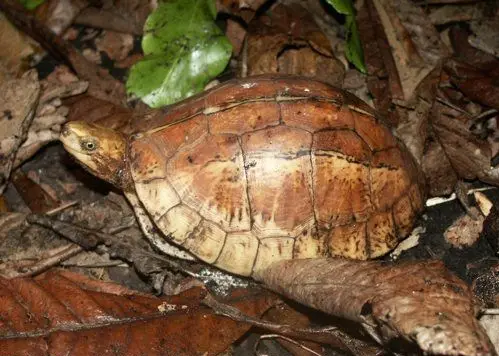
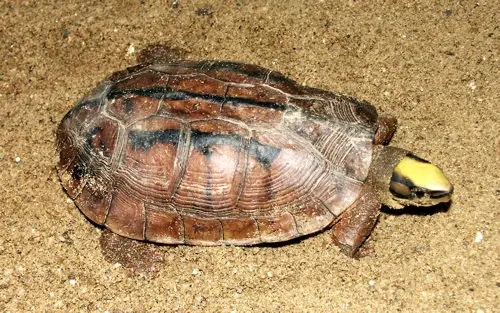
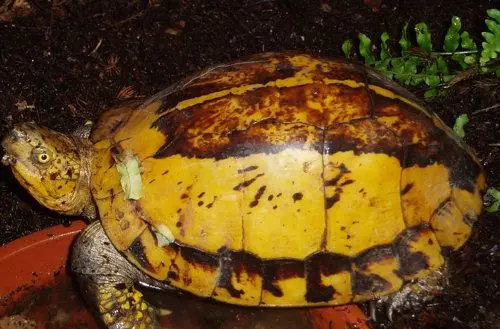
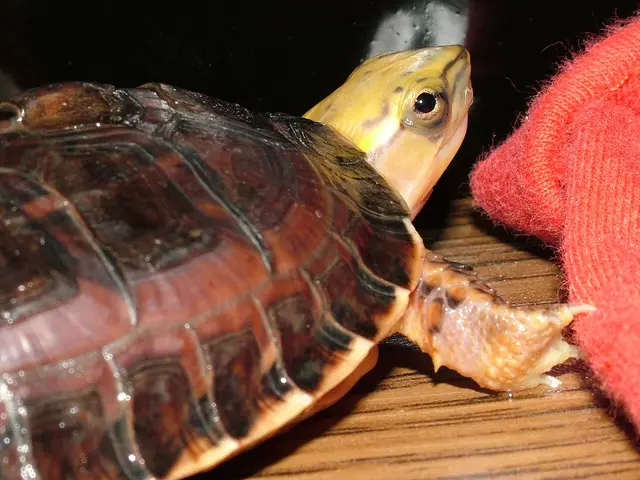
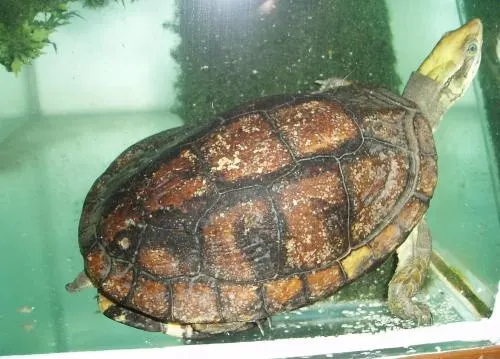
Pan's box turtle (Cuora pani) is a freshwater turtle from the mountain streams of central China that can seal itself inside its shell. The IUCN Red List rated it Critically Endangered in 2000, and conservation groups now describe it as functionally extinct or close to it in the wild, after heavy collecting for the medicine and pet trades.
Names and relatives
It is a box turtle in the family Geoemydidae, the Asian river and pond turtles. The common name refers to its ability to close itself inside its shell. It lays eggs.
Pan's box turtle was described by Song in 1984, and the species name probably honours the Chinese herpetologist Pan Lei. Its taxonomy is unsettled. The yellow-headed box turtle (Cuora aurocapitata) is very close to it, possibly the same species, and some authors treat the two as subspecies. A 2004 study found almost no mitochondrial DNA difference between them, even though they look distinct. A turtle described in 1987 as Cuora chriskarannarum was folded into this species in 1991.
Where it lives
The species is endemic to a small part of central China. Records come from the provinces of Shaanxi, Sichuan, Hubei and Chongqing. Its type locality is reported as Xujiaba in Pingli County, at about 420 m elevation, although one author has considered the type locality unknown.
It lives in clear, fast-moving mountain streams in subtropical and temperate country, according to the Turtle Survival Alliance.
Pins are Wikidata “endemic to” fields. Orange dots, when present, are GBIF occurrence tiles — survey bias included.
Why it is in trouble
The Turtle Conservancy says the turtle may have been locally common until the 1990s, when traditional medicine markets began buying it in bulk. Collecting for medicine and the pet trade followed, and a turtle can sell for more than 10,000 US dollars. Habitat destruction and degradation add to the pressure.
The Turtle Survival Alliance lists the wild population as decreasing and presumes it to be at or near functional extinction, with fewer than ten turtles seen in the wild per year. The Turtle Conservancy calls it functionally extinct in China.
The IUCN assessment dates from 2000. It used the older version 2.3 of the Red List categories, criteria A1d+2d, and recorded harvest as the threat, with no population trend given. The species is also on Appendix II of CITES, which regulates international trade.
What is being done
Most of the work is in captivity. The Turtle Conservancy keeps one male and four female adults in California as part of a North American assurance colony, a safeguard against extinction. These parents hatched at Zoo Atlanta and Fort Worth Zoo under the Association of Zoos and Aquariums Species Survival Program, and moved to the Conservancy in 2010. They first bred in spring 2017, and in October that year three hatchlings emerged, the first hatching of the species in the United States from captive-born parents.
The long-term aim is to restore wild populations, though the Conservancy's president says returning this turtle to the wild would be far harder than earlier repatriations such as the Golden Coin Turtles sent to Hong Kong in 2012.
Sources
Written for this catalog in our own words from the sources below, checked against them on 12 November 2026. Population figures are estimates and carry the year they were made. Status and assessment year: IUCN. 2026. The IUCN Red List of Threatened Species. Version 2026-1. iucnredlist.org.