Critically Endangered
Bourret's box turtle
Cuora bourreti
Bourret's box turtle (Cuora bourreti) is a hinge-shelled forest turtle from the uplands of central Vietnam and Laos. The IUCN Red List rated it Critically Endangered in 2020, after hunting cut wild numbers by an estimated 90 percent or more. Zoo breeding programs now hold an insurance population.
How to recognise it
It's a medium-sized box turtle in the family Geoemydidae, with adults reaching about 20 cm in straight shell length. Males and females are similar in size. Hatchlings measure 4.5 to 5 cm, and hatchlings at the Smithsonian's National Zoo in 2017 weighed 25 grams each, against 1,300 grams for their mother.
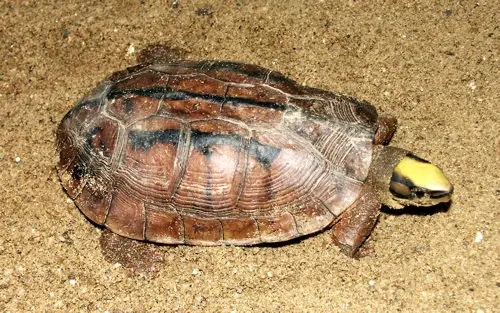
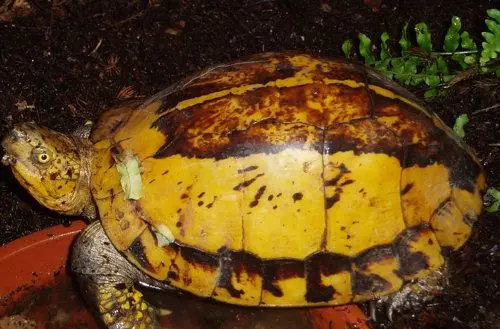
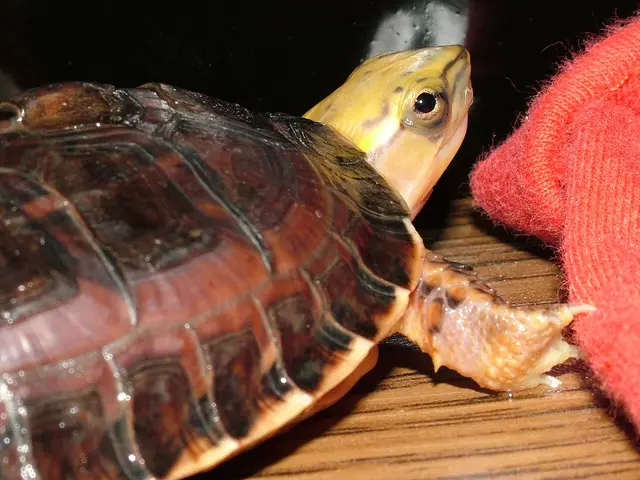
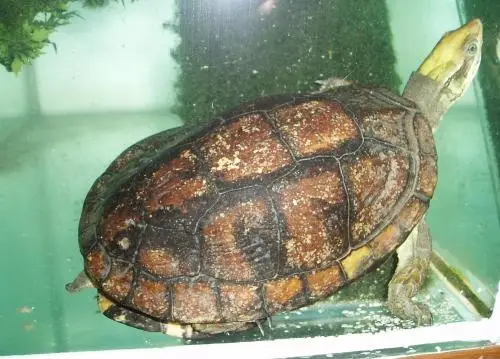
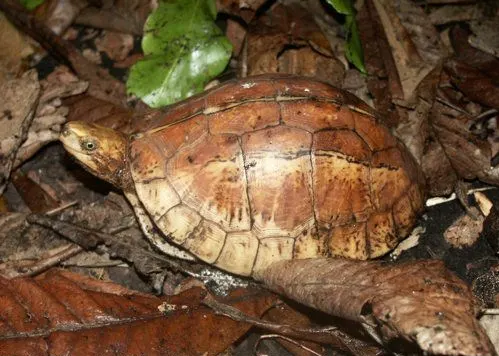
Colour varies a lot between individuals, from brown through yellow to orange, mottled with black streaks, speckles and blotches that blend into fallen leaves. The head, neck and limbs carry yellow, red and orange. It looks much like the Indochinese box turtle (Cuora galbinifrons), and the belly is a quick way to tell them apart. Bourret's has a cream underside with black blotches, while the Indochinese turtle's is mostly black.
Where it lives
The species is native to central Vietnam and neighbouring Laos. It lives mainly on the floor of moist, closed-canopy evergreen forest in the uplands, and the IUCN assessment lists lowland, montane and dry tropical forest between roughly 300 and 1,800 m above sea level.
Its original specimen locality was first given as Linh Cam in Ha Tinh Province and later corrected to Bach Ma in Thua Thien Hue Province. Hybrids with the Indochinese box turtle reportedly occur in north-central Vietnam.
Pins are Wikidata “endemic to” fields. Orange dots, when present, are GBIF occurrence tiles — survey bias included.
How it lives
Very little of its wild behaviour has been recorded. It lays eggs, and zoo experience shows that adults need a cool rest period (brumation) from October to March. At the National Zoo, a female produced eggs every year from 2013, but none developed fully until 2017, when a clutch laid in March hatched after a 12-week incubation.
The IUCN assessment puts a generation at about 20 years, so any loss of adults takes a long time to make up.
Why it is in trouble
Bourret's box turtle was once common in its forests. Intensive hunting in the 1990s and early 2000s drove an estimated decline of more than 90 percent, and wild turtles are now increasingly hard to find. The 2020 assessment rates intentional harvesting as the most serious threat, with a high impact and very rapid declines. Clearance for small farms, plantations, agro-industry and mining adds slower losses across part of its range.
Protection on paper has not ended the hunting. The species is covered by CITES Appendix I and by national protection in Laos and Vietnam, yet turtles are still taken, including from protected areas. No reliable count of the wild population has been published.
What is being done
The turtle occurs in at least one protected area, and conservation sites have been identified over part of its range. It is bred in captivity. The Turtle Survival Center in South Carolina keeps an assurance colony of more than 60 turtles and has produced 60 hatchlings since it opened. In 2017 the Smithsonian's National Zoo reported the first hatchlings of the species under the AZA's Species Survival Plan.
The assessment notes that no recovery plan and no systematic monitoring scheme existed at the time, and it lists trade management, site protection and livelihood alternatives among the actions needed.
Sources
Written for this catalog in our own words from the sources below, checked against them on 12 November 2026. Population figures are estimates and carry the year they were made. Status and assessment year: IUCN. 2026. The IUCN Red List of Threatened Species. Version 2026-1. iucnredlist.org.
- IUCN Red List assessment, Cuora bourreti (2020)
- Bourret's box turtle (reference article)
- Turtle Survival Alliance species spotlight
- Turtle Survival Alliance, Bourret's box turtle page
- Smithsonian National Zoo, Bourret's box turtles hatch (2017)
- Reptile Database, Cuora bourreti
- GBIF species record 7755704
- Rufford Foundation project page