Critically Endangered
Yunnan box turtle
Cuora yunnanensis
The Yunnan box turtle (Cuora yunnanensis) is a freshwater turtle from the mountain valleys of central Yunnan, China. It went unrecorded for decades and was listed as Extinct in 2000. The IUCN Red List now rates it Critically Endangered (assessed 2010), and only one small wild population has been found.
How to recognise it
It's a medium-sized box turtle. The largest known male had a shell about 152 mm long and the largest female about 190 mm. Females weigh roughly 800 to 1,500 g, males 300 to 500 g.
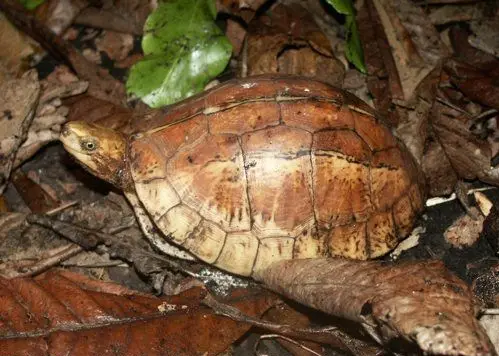
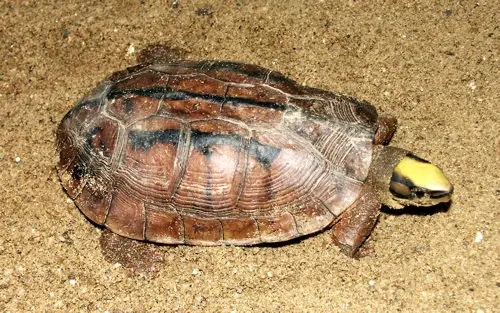
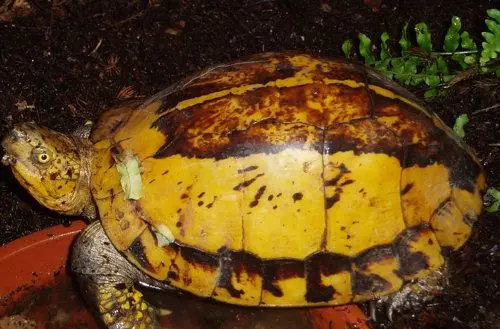
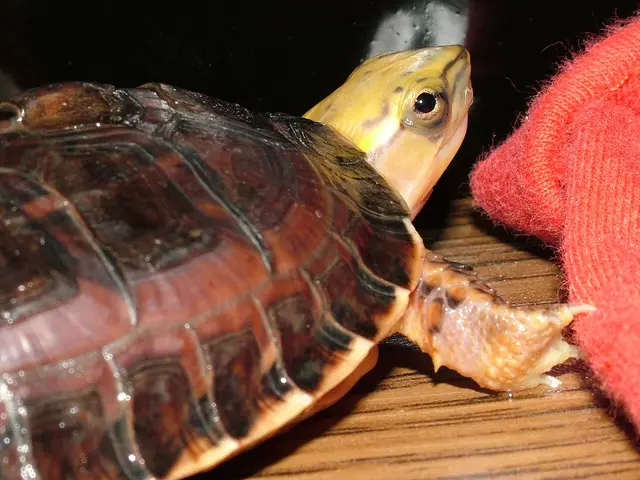
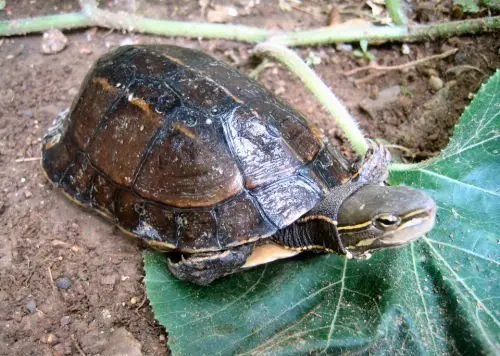
The shell is chestnut to dark brown, with a central keel (ridge) and two lower side keels that fade with age. The head carries two yellow stripes edged in dark colour, turning orange toward the neck, and a stripe runs down each front leg. The belly shell has a hinge that lets adults close up. Males have a flatter, pear-shaped shell, and during the mating season the stripes on both sexes turn a deeper orange.
Where it lives
The species is known only from central Yunnan and possibly southern Sichuan. The first museum specimens, described in 1906, were collected near Huize in 1905 and sent on from Kunming. Wild records fall between about 1,200 and 1,800 m above sea level.
Its habitat is swamps and slow streams in pine and evergreen broadleaf forest. Nothing is known about its ecology in the wild. Everything about its breeding comes from captive animals: one clutch a year, usually 4 to 8 eggs, laid in April or May and incubated for 64 to 68 days.
Pins are Wikidata “endemic to” fields. Orange dots, when present, are GBIF occurrence tiles — survey bias included.
A species that came back
No live animal was recorded after the 1940s, and the IUCN listed the species as Extinct in 2000, partly over a suspicion that it might be a hybrid. A live female turned up in the Kunming pet trade in 2004. More followed, and a 2007 genetic study confirmed they were true Cuora yunnanensis.
In 2008, after several years of surveys, a team from the Kunming Institute of Zoology, working with Kadoorie Farm and Botanic Garden, found a small wild population. The IUCN changed the status to Critically Endangered in 2010.
Why it is in trouble
The IUCN assessment gives the population as 0 to 50 mature individuals at a single location, severely fragmented and still declining. Collecting for the pet trade is a major cause, and Chinese collectors have reportedly paid $15,000 to $50,000 for single animals. A 2025 species account also points to stream pollution from detergent and fertiliser, and to a rise in tobacco plantations. One estimate says up to 98 percent of the habitat may already be destroyed.
Between 2010 and 2014 very few animals were recorded at the one known site, and the species account says the population may now be gone. Later surveys have found no other populations.
What is being done
The turtle is on CITES Appendix II, and a zero export quota for wild animals traded mainly for commercial purposes was set in 2013. It has been in China's second class of nationally protected animals since 1988, though the 2025 account says this has done little to stop poaching.
Ten wild animals were taken between 2008 and 2010 to found an assurance colony at the Kunming Institute of Zoology, which has bred a small number. A 2024 survey of keepers counted about 50 wild-caught and 70 captive-bred turtles in roughly 15 collections across China. The location of the wild population and of the colony is kept confidential.
Sources
Written for this catalog in our own words from the sources below, checked against them on 12 November 2026. Population figures are estimates and carry the year they were made. Status and assessment year: IUCN. 2026. The IUCN Red List of Threatened Species. Version 2026-1. iucnredlist.org.