Critically Endangered
Yellow-headed box turtle
Cuora aurocapitata
The yellow-headed box turtle (Cuora aurocapitata) is a small freshwater turtle from the hill streams of Anhui province in eastern China. The IUCN Red List has classed it as Critically Endangered since its 2000 assessment. Collection for food, medicine and the pet trade collapsed the wild population within about ten years of its description.
How to recognise it
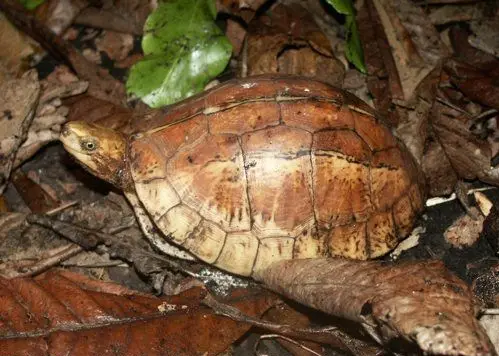
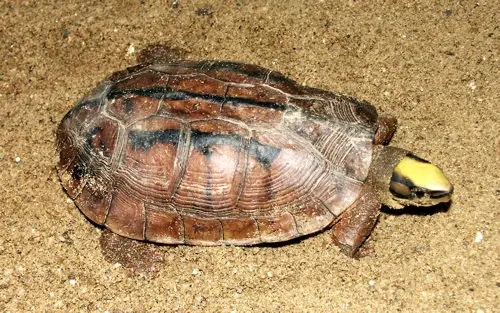
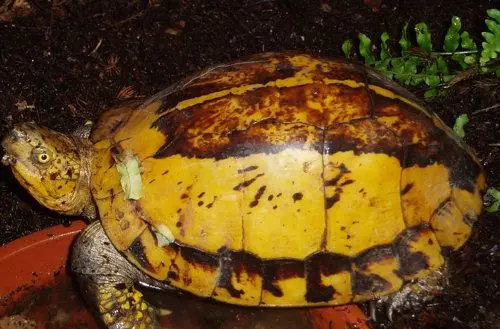
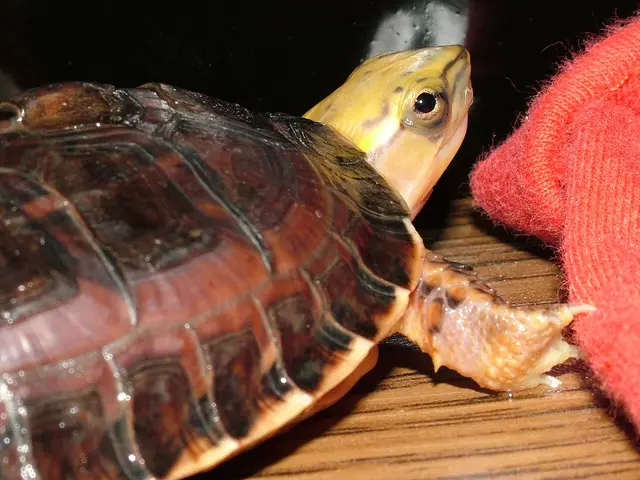
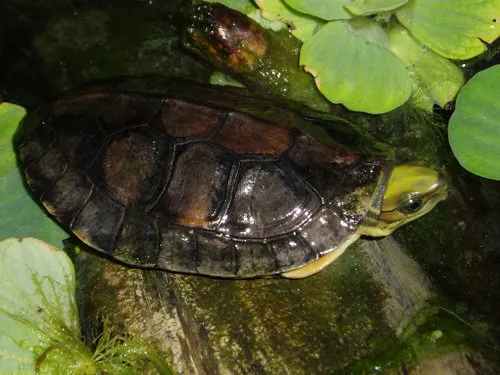
The name fits. The head is lemon yellow, with a narrow brown stripe running back from the eye toward the neck, and the iris is a greenish yellow. The shell is dark brown, with chestnut to reddish tones along the middle row of scutes.
Underneath, the plastron is yellow with black triangles along the seams and a black bar across each bridge. The limbs are olive gray to brown, and the tail is yellow with brown stripes on top. The shell reaches about 15.6 cm. Males have a narrower head, a flatter shell, a slightly dished plastron and a longer, thicker tail than females.
Where it lives
It is found only in Anhui province, in central China. The Turtle Survival Alliance places it in three river systems in the Dabie and Huangshan Mountains, where it lives in clear, fast-flowing hillside streams. Winters there can drop below freezing and summers can pass 27°C.
In 2017 scientists proposed splitting the turtle into two subspecies, separated by the Yangtze River. The western form, dabieshani, lives in the Dabie Mountains and the eastern form, aurocapitata, in the Huangshan Mountains. The western form is generally larger. Some authorities have also treated the whole group as a subspecies of Pan's box turtle (Cuora pani), so its taxonomy is not fully settled.
Pins are Wikidata “endemic to” fields. Orange dots, when present, are GBIF occurrence tiles — survey bias included.
How it lives
This is a highly aquatic turtle that rarely leaves its stream, and its life in the wild is poorly documented. Reports of its natural diet include freshwater shrimp, insects and their aquatic larvae, small fish, snails, worms, frogs, tadpoles and streamside plants.
Most of what is known about breeding comes from captivity. Eggs are small (39 to 42 mm long), and eggs incubated at 28°C began hatching after 66 days. In a Dutch study from 1989 to 1992, two females were given calcium and oxytocin injections to bring on egg laying, and a few young hatched from the eggs. Zoo staff at the Bronx Zoo found that the turtles need a period of hibernation before they will breed, and that females can be aggressive toward males.
Why it is in trouble
The turtle was described by science in 1988 from animals collected for Chinese markets. Overharvesting for food and the pet trade collapsed the wild population within about ten years, and the Red List lists harvest as a threat. The first wild specimen found by scientists was recorded in 2004.
Dams on hill streams, pollution and habitat damage add to the pressure. The Turtle Survival Alliance now describes the species as functionally extinct in the wild, with more individuals in captivity than in nature, and estimates a decline of more than 95%. An older figure from a 2012 zoo report put the wild population at no more than 150 animals. The Red List assessment dates from 2000.
What is being done
The species is listed on CITES Appendix II, which controls international trade. Conservation groups rely mainly on captive breeding. The Turtle Survival Alliance keeps an assurance colony of adults and offspring at its Turtle Survival Center in South Carolina, where 24 young have hatched over the last several years.
In 2012 the Bronx Zoo reported hatching five young from two clutches. At that time the largest captive group was reported to be at the Munster Zoo in Germany.
Sources
Written for this catalog in our own words from the sources below, checked against them on 12 November 2026. Population figures are estimates and carry the year they were made. Status and assessment year: IUCN. 2026. The IUCN Red List of Threatened Species. Version 2026-1. iucnredlist.org.
- IUCN Red List assessment, Cuora aurocapitata (2000)
- Turtle Survival Alliance, Species Spotlight Vol. 15
- Turtle Survival Alliance species spotlight (2023)
- Turtles of the World, Naturalis species account
- Reptiles Magazine, Bronx Zoo hatchlings (2012)
- Conservation Evidence, De Bruin and Zwartepoorte 1994
- Wikipedia, Yellow-headed box turtle