Critically Endangered
Western Santa Cruz tortoise
Chelonoidis porteri
The western Santa Cruz tortoise (Chelonoidis porteri) is a giant tortoise found only on the south-western slopes of Santa Cruz Island in the Galapagos. The IUCN Red List rated it Critically Endangered in 2017, though its population is described as increasing. Introduced animals remain its main problem.
How to recognise it
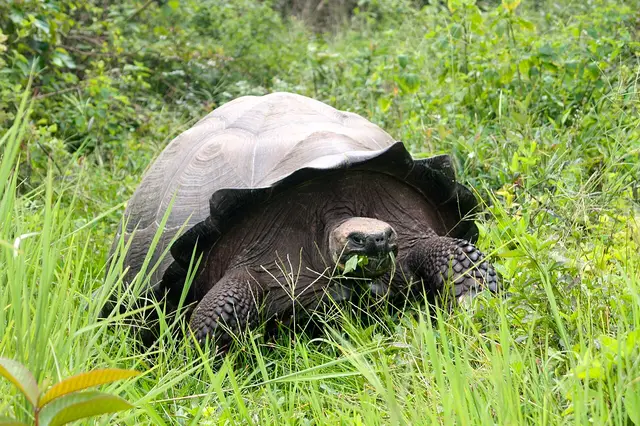
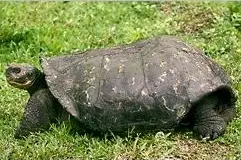
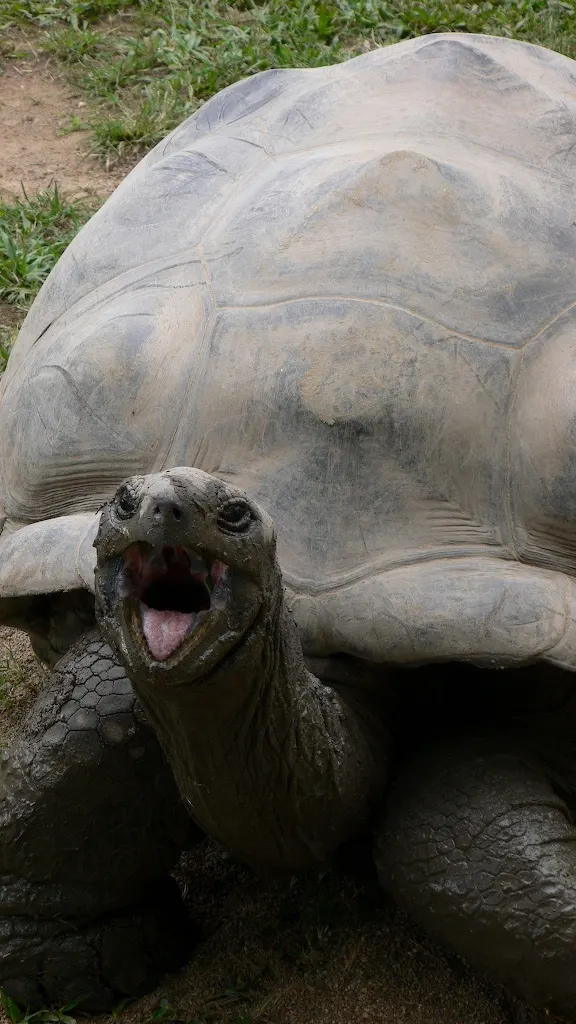
It has a black, oval, domed shell that reportedly reaches about 130 cm in length, highest toward the middle and broad at the front.
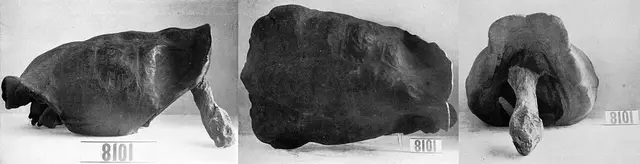
Walter Rothschild described it in 1903 as Testudo porteri. For a long time it was treated as a subspecies of the Galapagos tortoise (Chelonoidis niger porteri), and the Red List assessment uses the name Chelonoidis porteri.
Where it lives
The tortoises occupy the south-western slopes of Santa Cruz Island, with an occupied area of about 141 square kilometres in the IUCN assessment. The IUCN lists dry forest, dry shrubland and pastureland as habitats, between roughly 5 and 450 m above sea level.
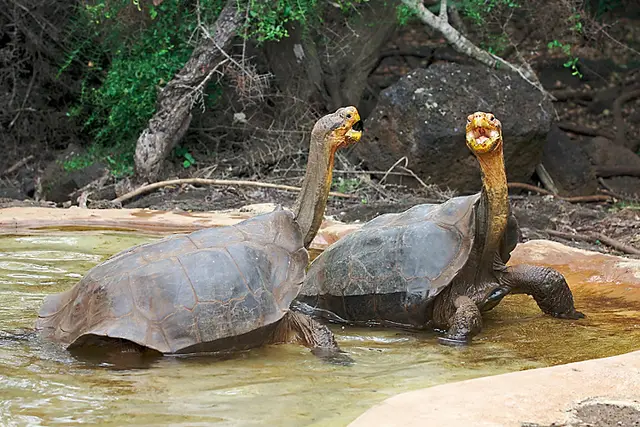
Santa Cruz tortoises were long treated as a single species. In 2015, Poulakakis and colleagues used DNA in PLoS ONE to show that a small population at Cerro Fatal in the east is a separate lineage, and named it Chelonoidis donfaustoi after park ranger Fausto Llerena Sanchez. The western animals kept the name porteri, and the paper proposed calling them the western Santa Cruz tortoise.
Pins are Wikidata “endemic to” fields. Orange dots, when present, are GBIF occurrence tiles — survey bias included.
How many there are
The western population is large by giant tortoise standards but far smaller than it once was. The 2015 paper put it at 2,000 to 4,000 animals, and the IUCN lists about 3,400, with an estimated past reduction of 90 percent. The Cerro Fatal population was put at about 250.
The IUCN gives the trend as increasing and says the decline is not continuing. That is how a species can be Critically Endangered and still be recovering. Across the whole archipelago, giant tortoises number only about 10 to 15 percent of an estimated historical 200,000 to 300,000, according to the Galapagos Conservancy.
Why it is in trouble
Feral pigs dig up nests and eat eggs and hatchlings. An introduced ant, Solenopsis, attacks hatchlings in the nest and as they emerge. Both are present in Santa Cruz nesting zones.
The IUCN assessment also lists use as human food, several invasive species and other ecosystem modification among the pressures, and competition among the effects.
What is being done
Eggs and hatchlings are collected from natural nests and raised at the Fausto Llerena Tortoise Center on Santa Cruz, founded in 1965. Young tortoises are released at around 4 to 5 years old.
The assessment records a systematic monitoring scheme, invasive species control and a regional management plan. It states that 81 to 90 percent of the population is within protected areas, and lists habitat restoration, captive breeding, reintroduction and livelihood alternatives as actions.
Sources
Written for this catalog in our own words from the sources below, checked against them on 12 November 2026. Population figures are estimates and carry the year they were made. Status and assessment year: IUCN. 2026. The IUCN Red List of Threatened Species. Version 2026-1. iucnredlist.org.