Critically Endangered
Chelonoidis guentheri
Chelonoidis guntheri
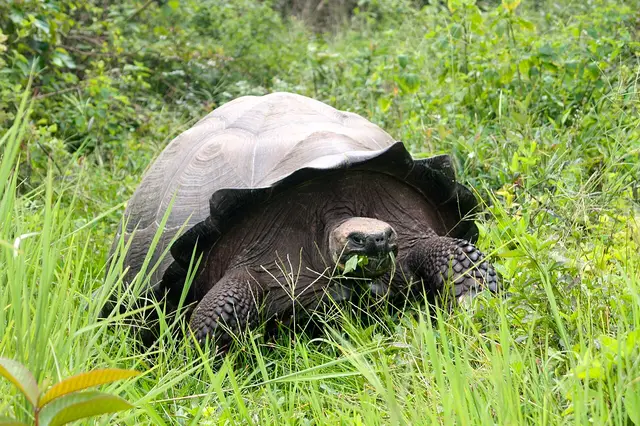
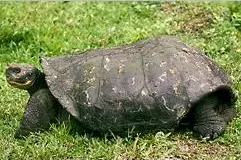
The Sierra Negra giant tortoise (Chelonoidis guntheri) is a Galápagos tortoise confined to the slopes of Sierra Negra volcano on southern Isabela Island. Males can reach about 120 centimetres. The IUCN Red List rated it Critically Endangered in 2018, with an estimated 400 to 700 mature adults.
How to recognise it
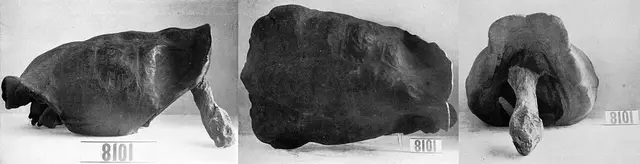
Adult males reach roughly 120 centimetres in shell length and females about 92. The shell comes in two forms: some adults have a high dome, others a flatter, lower carapace.
It is usually treated as a species in its own right, though some authors still list it as a subspecies of the Galápagos tortoise, under the name Chelonoidis niger guentheri.
Where it lives
The range is roughly 800 square kilometres (sources give 800 to 817) on and around Sierra Negra, at the southern end of Isabela, running from near sea level to about 1,000 metres. The IUCN lists the habitat as dry subtropical forest and shrubland, and the tortoises also use dry grassland, introduced vegetation and farmland.
Adults move up and down the slope. Youngsters spend their first 10 to 15 years in the warmer lowlands.
Pins are Wikidata “endemic to” fields. Orange dots, when present, are GBIF occurrence tiles — survey bias included.
How it lives
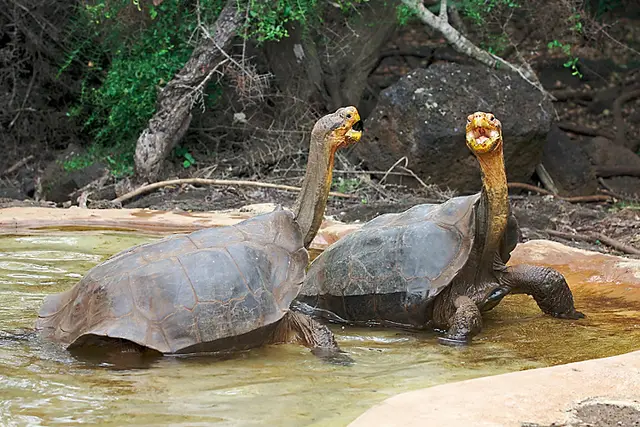
These tortoises are active by day and graze on herbs, grasses, cacti, lichens and fruit. Domed animals mostly eat low plants, while flat-shelled ones take more shrubs. Rival males stretch their necks, gape, bite and bump shells, and mating pairs make loud, guttural sounds.
Females usually lay 6 to 11 eggs in a clutch, and occasionally as many as 17.
Why it is in trouble
Whalers and other sailors took tortoises for meat and oil for generations. Settlement on southern Isabela, from the founding of Puerto Villamil in 1895 through a military presence in the Second World War and a penal colony from 1944 to 1959, pushed the population close to the edge. Estimates suggest about 71,000 tortoises lived here before people arrived, and about 99 percent are gone. One source puts the count at only 300 to 500 by the early 1970s.
Introduced animals have done further harm. Dogs, rodents, pigs and fire ants eat eggs and hatchlings, and feral animals damage the habitat. Pigs and fire ants still wreck nests, and illegal killing continues. Eruptions of the volcano can kill tortoises directly and break up their habitat. The IUCN lists the overall population trend as unknown.
What is being done
Goats have been removed from the Galápagos National Park. Young tortoises are raised at the Arnaldo Tupiza breeding centre and returned to the wild. In January 2022, 43 captive-reared tortoises aged 5 to 7 were flown by helicopter to a remote area of Sierra Negra, in a joint effort by the park directorate and Galapagos Conservancy. The IUCN records a recovery plan and a monitoring scheme in place, and conservation sites covering the whole range.
Sources
Written for this catalog in our own words from the sources below, checked against them on 12 November 2026. Population figures are estimates and carry the year they were made. Status and assessment year: IUCN. 2026. The IUCN Red List of Threatened Species. Version 2026-1. iucnredlist.org.