Critically Endangered
Fernandina Island Galápagos tortoise
Chelonoidis phantastica
The Fernandina Island Galápagos tortoise (Chelonoidis phantasticus) was known from a single male collected in 1906 until a living female turned up on Fernandina in February 2019. The IUCN Red List (2017) rates it Critically Endangered and flags it as possibly extinct. She is still the only living individual known.
How to recognise it
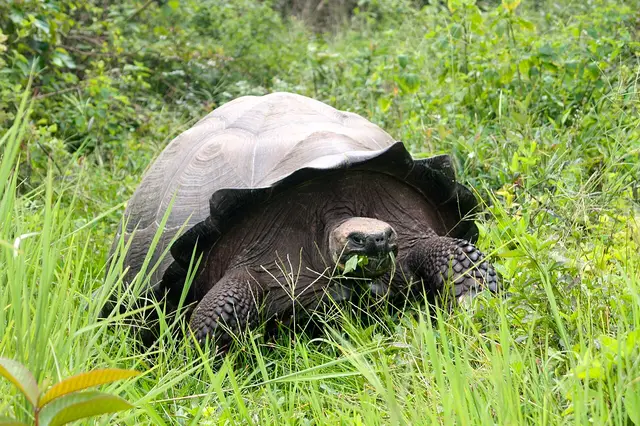
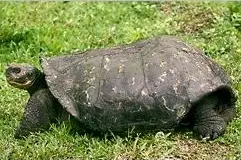
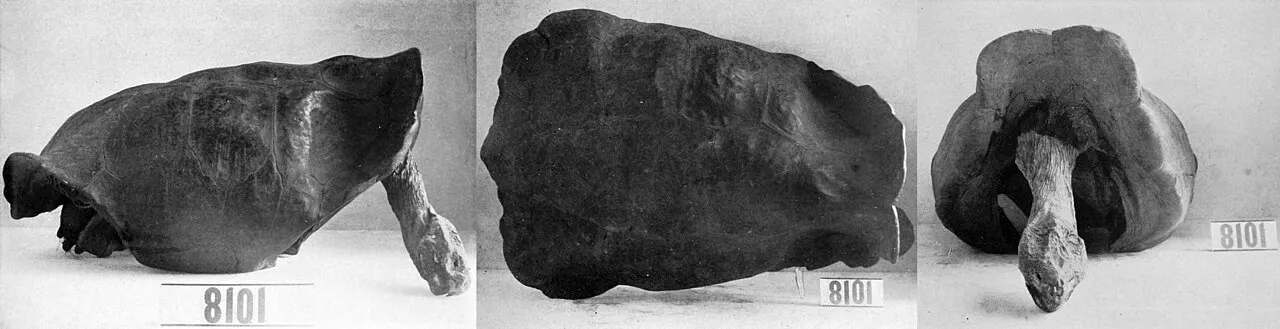
The only other known individual, a male collected in 1906, had a pronounced saddleback shell, with the front of the carapace raised and the marginal scutes strongly flared. Researchers consider that shape unlike any other tortoise.
The living female, nicknamed Fernanda or Fern, looks quite different. Her shell is smaller and smoother. Adalgisa Caccone, senior author of the 2022 genetic study, has suggested that limited food may have stunted her growth. She is likely well over 50 years old.
Where it lives
The species is known only from Fernandina Island (also called Narborough Island) in the Galápagos, Ecuador. The island's volcano erupts regularly, and about 80 percent of its surface is barren lava, which makes the island hard to cross and hard to search.
The 2019 female was found on the lower northwestern flank of the volcano, deep inside a patch of shrubs.
Pins are Wikidata “endemic to” fields. Orange dots, when present, are GBIF occurrence tiles — survey bias included.
A species lost, then found
Members of the 1905 to 1906 California Academy of Sciences expedition collected a male on 3 April 1906, and John Van Denburgh described it in 1907. For more than a century no living animal was confirmed. Droppings and cactus damage were reported in 1964, and possible tracks, droppings or an aerial sighting were reported in 2009, 2013 and 2014, but none proved a living tortoise.
In February 2019 an expedition run by the Galápagos National Park Directorate and Galapagos Conservancy, led by Washington Tapia-Aguilera, found the female. She was moved to a breeding centre on Santa Cruz Island. A blood sample went to Yale University, and on 25 May 2021 officials announced that the comparison with the 1906 male confirmed she belonged to the same species.
A 2022 study in Communications Biology, led by Evelyn Jensen with Caccone as senior author, compared genomes with three individuals from each of the 12 other living Galápagos tortoise species. The two animals were each other's closest relatives and formed a lineage separate from the rest. Their mitochondrial DNA differs, though. Caccone proposed that Fernanda could be the offspring of a phantasticus male and a female of the extinct Floreana tortoise, since people moved tortoises between islands in the past.
Why it is in trouble, and what is being done
No formal population estimate exists. Galápagos tortoises in general were heavily hunted by whalers, pirates and other mariners, and later lost eggs and young to introduced rats, pigs, dogs and ants, while goats and donkeys damaged their habitat. Which of these pressures affected this island's tortoises is not documented in the sources reviewed.
When Fernanda was found, signs of at least two other tortoises were recorded on the volcano, but none was located. In March 2022 an 18-person team searched about 65 square kilometres of unexplored ground and found no tortoises and none of the usual signs. A second expedition, with a helicopter to reach areas that cannot be crossed on foot, was planned for later in 2022.
If a male is found, the plan is to pair him with Fernanda at the breeding centre and start a captive breeding programme, with the hope of seeing the offspring thrive on Fernandina.
Sources
Written for this catalog in our own words from the sources below, checked against them on 12 November 2026. Population figures are estimates and carry the year they were made. Status and assessment year: IUCN. 2026. The IUCN Red List of Threatened Species. Version 2026-1. iucnredlist.org.
- Recently Extinct Species: Chelonoidis phantasticus
- Wikipedia: Fernandina Island Galápagos tortoise
- Phys.org: lonely tortoise has relatives (July 2022)
- Sci.News: Fernandina Island tortoise not extinct
- Re:wild: seventh most wanted lost species rediscovered
- Reptiles Magazine: tortoise confirmed (2021)
- Reptiles Magazine: no tortoises found after extensive search (2022)