Critically Endangered
Sawback angelshark
Squatina aculeata
The sawback angelshark (Squatina aculeata) is a flat, ray-like shark of sandy and muddy seabeds off West Africa and in the Mediterranean. The IUCN rated it Critically Endangered in 2019, with a decreasing population. Surveys now catch it only rarely, and mostly by accident in fishing gear.
How to recognise it
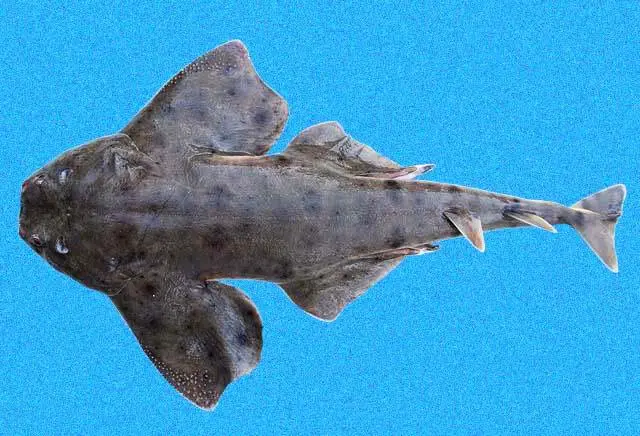
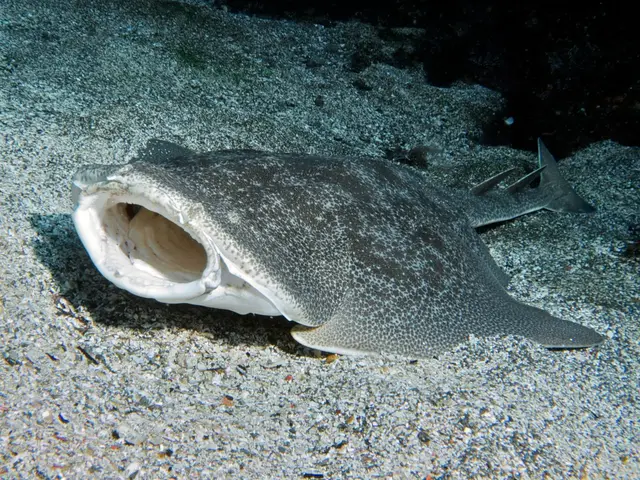
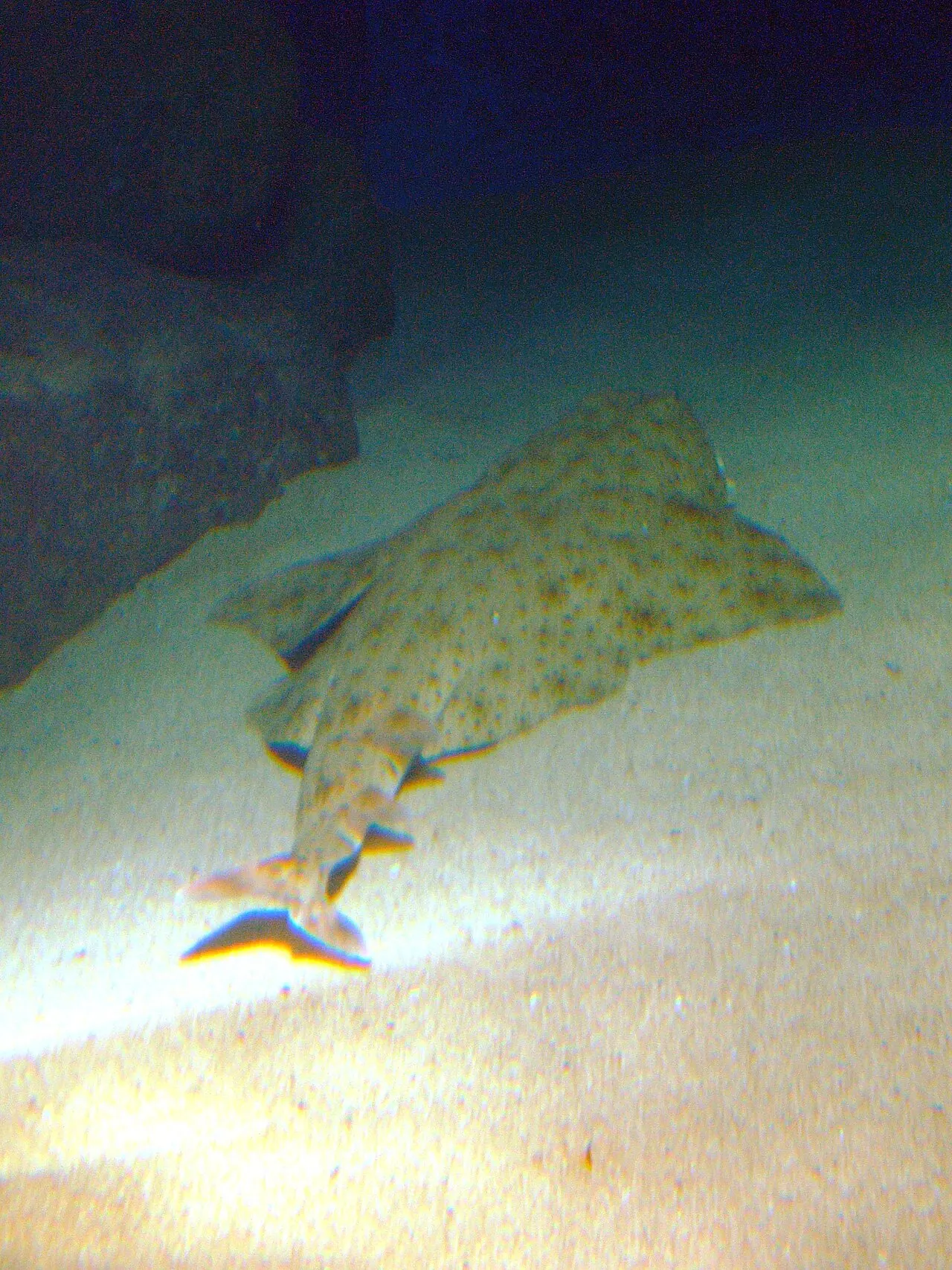
Like other angelsharks, it has a flattened body and broad pectoral fins, so at a glance it can pass for a ray. It's light brown mottled with darker brown, with dark blotches on the head, back, fin bases and tail, and no eye-like spots. A row of large thorns runs down the back, and the skin is covered in big, almost pyramid-shaped denticles.
Newborns reportedly measure 30 to 35 cm. A 2017 conservation strategy gives an average length at maturity of about 124 cm and a maximum of about 188 cm. Mix-ups between the three Mediterranean angelsharks, and landing statistics that lump them together, make its status hard to read.
Where it lives
It is a bottom dweller at depths of about 30 to 500 m on the outer continental shelf and upper slope. The IUCN lists its range as the eastern Atlantic from Mauritania south through Senegal, Gambia and Guinea to Sierra Leone and Liberia, and the Mediterranean from Algeria and Tunisia east to the Levant, plus Italy, Greece, Malta, Albania, Gibraltar and Cyprus.
Its habitat is recorded as muddy and soft seabed. Like its relatives, it lies camouflaged on the bottom and ambushes prey, reportedly including small sharks, bony fish, squid and crustaceans.
Pins are Wikidata “endemic to” fields. Orange dots, when present, are GBIF occurrence tiles — survey bias included.
How it lives
It gives birth to live young. Litters are reportedly 8 to 12 pups. The IUCN puts generation length at 15 years, so a population recovers slowly once it is reduced.
A pregnant female about 150 cm long, brought up by a trawler south-east of Lampedusa in the central Mediterranean in 2021, carried two fetuses about 15 cm long, and she was released alive. Zava and colleagues read this, together with juvenile smoothback angelsharks off Malta, as a sign that the area between Sicily and Malta is an important habitat and nursery ground.
Why it is in trouble
Fishing is the main cause. The IUCN lists unintentional catch in large-scale and small-scale fisheries, plus small-scale targeted harvest, with coastal development, tourism and housing adding to habitat loss. The population is severely fragmented and still declining, and the IUCN estimates a past reduction of about 80 percent.
A 2022 paper in Acta Ichthyologica et Piscatoria collected 18 sawback records from the Mediterranean between 2007 and 2022. Eleven came from the central basin (north Tunisia, Malta, and the Lampedusa and Linosa area), four from the Aegean, two from Egypt and one from off Sardinia. Ten were taken by bottom trawl, three by longline and four by trammel net, and only five were released alive. Mediterranean trawl surveys coordinated between 2016 and 2018 recorded none at all.
What is being done
The assessment notes that a recovery plan and a regional management plan exist, and that only 1 to 10 percent of the population is thought to be inside protected areas. A 2017 conservation strategy for the three angelsharks of the eastern Atlantic and Mediterranean says retaining angelsharks is prohibited in the Mediterranean, although landings persist, and that the Balearic Islands protect them in marine protected areas. The strategy also asks people to report angelshark sightings.
Sources
Written for this catalog in our own words from the sources below, checked against them on 12 November 2026. Population figures are estimates and carry the year they were made. Status and assessment year: IUCN. 2026. The IUCN Red List of Threatened Species. Version 2026-1. iucnredlist.org.