Endangered
Spotted rainbowfish
Glossolepis maculosus
The spotted rainbowfish (Glossolepis maculosus) is a small freshwater fish from the Markham and Ramu river systems of northern Papua New Guinea. The IUCN Red List rated it Endangered in 2020. Each male carries its own pattern of dark blotches along the flanks, and the species is rare even in the aquarium hobby.
How to recognise it
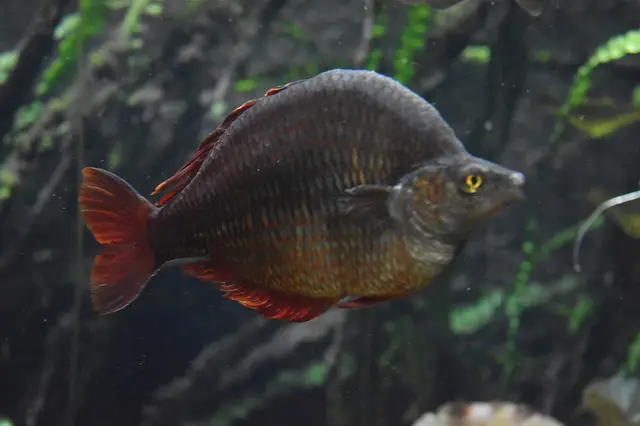
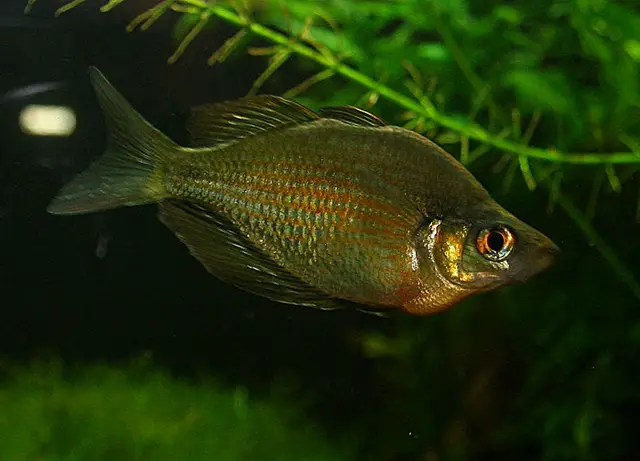
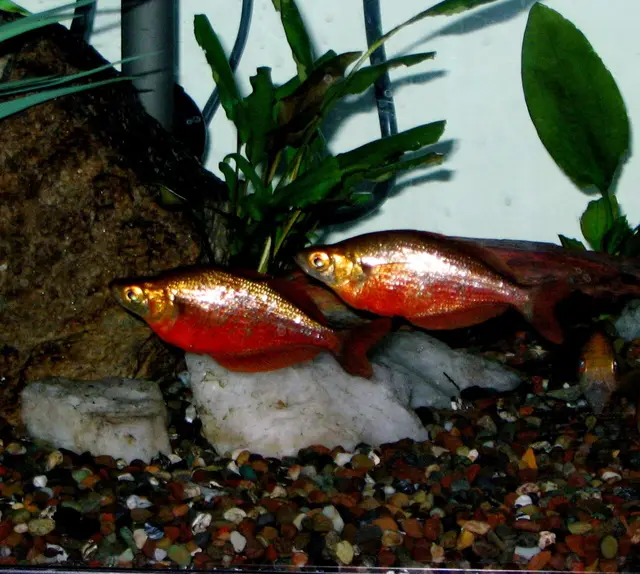
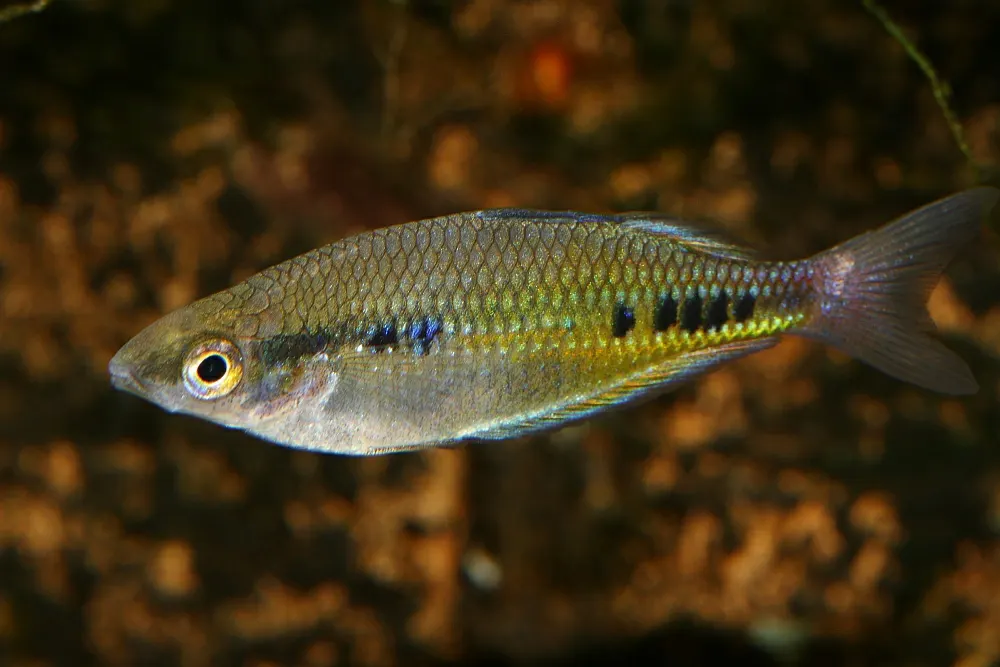
Males are greenish bronze with a faint pale-blue sheen on the scales. A row of dark spots or blotches, anywhere from about 4 to 10, runs along the lateral line. Below it the front of the body is whitish and the rear yellowish, and the fins are blue-green with a slight orange tint and black edges.
Females are plainer, a pale olive with a silvery belly, though they still show distinct spots. Mature males are larger and deeper-bodied, with a taller first dorsal fin. Aquarium sources say it can reach 8 cm but most fish stay under 6 cm, while FishBase gives a maximum of 5 cm. Each fish has its own spot pattern, and the left and right sides can differ.
Where it lives
The species is known from a few localities in northern Papua New Guinea, in the Markham and Ramu river systems. Aquarium literature also mentions the Sepik. The IUCN assessment counts two locations and an extent of occurrence of about 4,300 square kilometres, at elevations of 150 to 800 metres.
It favours slow streams, swamps and quiet backwaters, usually in still, clear water along grassy banks, around submerged plants and near fallen branches. Water temperatures at its sites run from about 18 to 28 C. At one site the water was 25 C with a pH of 7.8. It has been found alongside Glossolepis kabia, Melanotaenia affinis and Chilatherina campsi.
Pins are Wikidata “endemic to” fields. Orange dots, when present, are GBIF occurrence tiles — survey bias included.
How it was found
Barry Crockford collected the first specimens in 1979 from a small tributary of the Oomsis River (spelled Omsis in some sources), about 22 km west of the city of Lae, and took a few live fish back to Australia. He sent a coloured drawing to Gerry Allen at the Western Australian Museum, who recognised a new rainbowfish and described it in 1981. Allen and Crockford returned to the site and collected more fish, which were bred and spread through the Australian hobby. Heiko Bleher later collected fish in the Ramu valley for the European hobby.
Why it is in trouble
The 2020 assessment names agro-industry farming, mining and quarrying, and an unspecified species as threats, and records a continuing decline in the area the fish occupies. The wild population trend is listed as unknown, and no population size has been estimated.
The assessment lists no conservation actions. In the hobby the fish has never been widely available and is still uncommon. Because few founding fish were collected, the colouring of captive stocks has shifted over the years.
Sources
Written for this catalog in our own words from the sources below, checked against them on 12 November 2026. Population figures are estimates and carry the year they were made. Status and assessment year: IUCN. 2026. The IUCN Red List of Threatened Species. Version 2026-1. iucnredlist.org.