Endangered
Red rainbowfish
Glossolepis incisus
The red rainbowfish (Glossolepis incisus) is a bright salmon-red freshwater fish found naturally in only one place, Lake Sentani in Papua, Indonesia. The IUCN Red List rated it Endangered in 2020. It is common in home aquariums and easy to breed, yet its wild home is under pressure.
How to recognise it
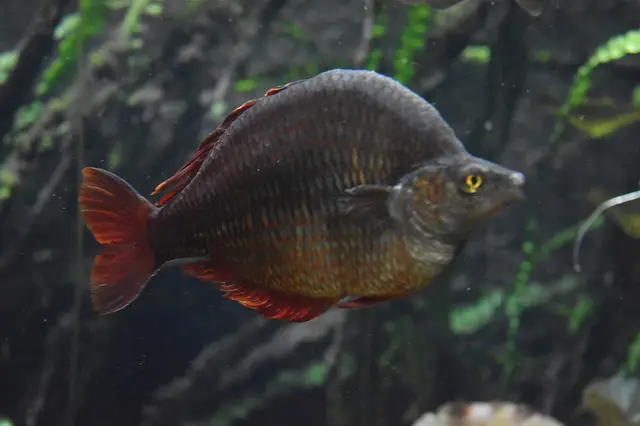
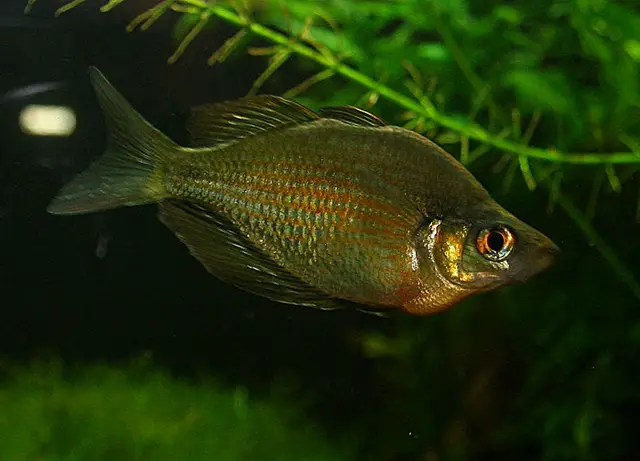
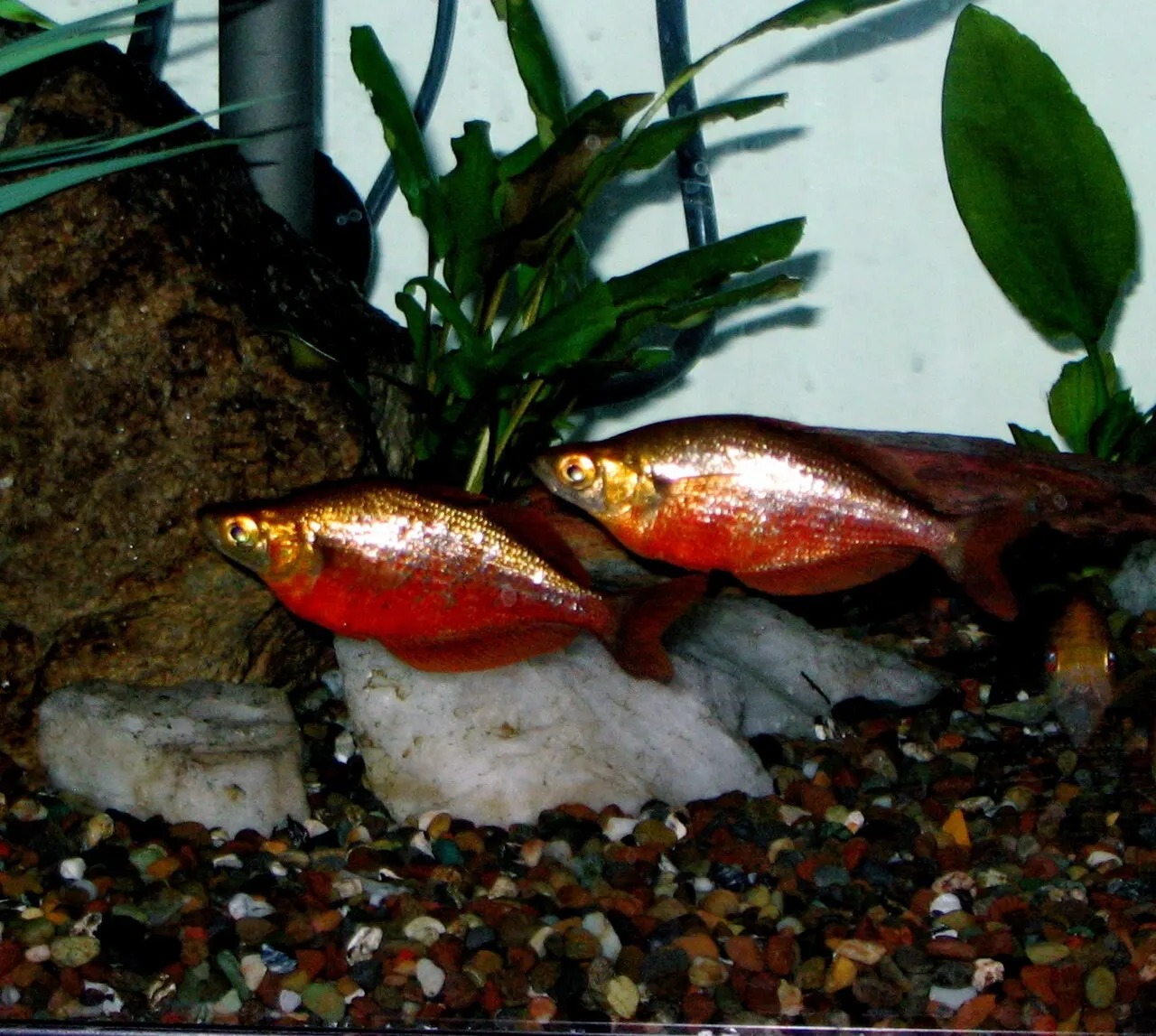
Males can reach about 15 cm, though 12 cm is more typical. As they mature they develop a noticeably high back. A grown male is bright red, and the colour shifts with mood. Subordinate males stay dull. Females stay smaller, usually under 12 cm, and are olive brown.
Males begin to colour up at about 4 to 5 cm and are fully red at 7 to 8 cm. In aquariums, fish from mass-bred stock are much less colourful than wild ones, and the lower the water temperature, the more males turn red.
Spelling of the name
The Red List and most aquarium sources write the species name as incisus. Some references argue that incisa is the grammatically correct form, because the genus name is feminine, and Eschmeyer's Catalog of Fishes now uses that spelling. This account uses the IUCN spelling.
Where it lives
All wild fish come from Lake Sentani and the streams that feed it, about 10 km west of Jayapura. The lake covers roughly 104 square kilometres, has at least 16 small islands and receives about 35 small rivers. Depths range from 7 to 52 m. The Red List counts a single location and puts the extent of the species' range at about 180 square kilometres, at around 75 m above sea level.
Red rainbowfish shoal around heavily vegetated areas. Surface water in the lake measured 29 to 32 degrees Celsius with a pH of 6.2 to 6.8 in surveys carried out in 1970 to 1971, 1984 and 1987.
Pins are Wikidata “endemic to” fields. Orange dots, when present, are GBIF occurrence tiles — survey bias included.
How it lives
It is an omnivore and may be a little more carnivorous than most Australian rainbowfishes. Females scatter eggs among clumps of vegetation, and the eggs hatch in 7 to 8 days.
The species was first collected from the lake during the Siboga Expedition of 1899 to 1900 and described by Max Weber in 1907. Live fish were first collected in 1973 and reached the Australian aquarium hobby in 1977.
Why it is in trouble
A fish with one lake has little margin. The Red List names mining and quarrying, sewage and competition from unspecified problem species, and says the range is still shrinking even though the population trend is listed as stable. A rapidly growing human population around the lake adds pressure.
Escaped aquaculture stock is a major worry. A collecting party that visited in 2023 saw thousands of cichlids in the shallows and only a few rainbowfish near the surface, thin and carrying parasites. Tilapia, snakeheads and red devil cichlids are among the introduced fish named.
What is being done
The Red List says the species occurs in at least one protected area, and it records no conservation actions specific to the fish. Its best insurance may be its popularity with hobbyists, since it breeds readily in captivity.
Sources
Written for this catalog in our own words from the sources below, checked against them on 12 November 2026. Population figures are estimates and carry the year they were made. Status and assessment year: IUCN. 2026. The IUCN Red List of Threatened Species. Version 2026-1. iucnredlist.org.