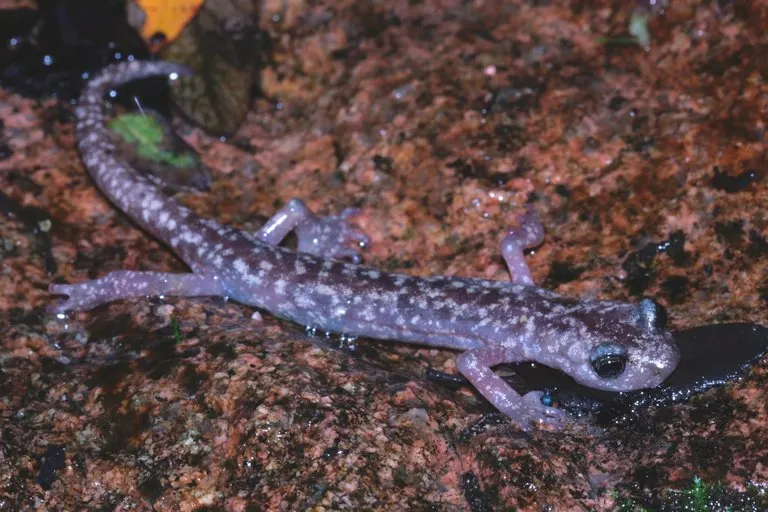
Critically Endangered
Sarrabus' cave salamander
Speleomantes sarrabusensis
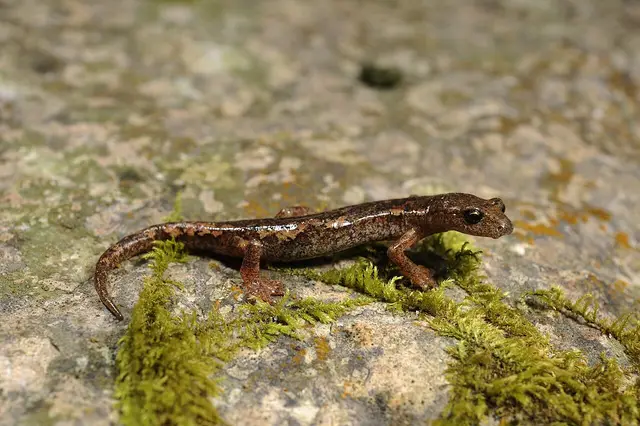
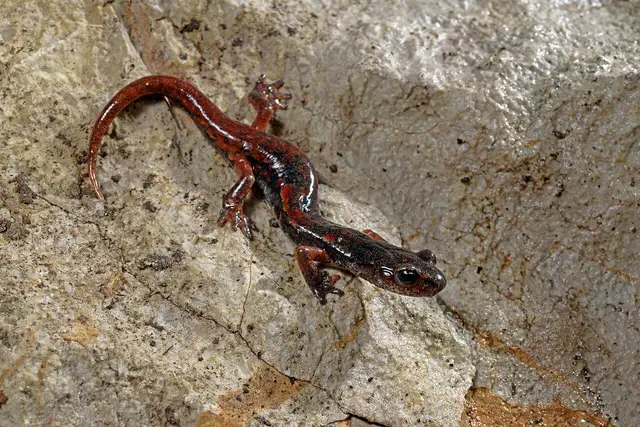
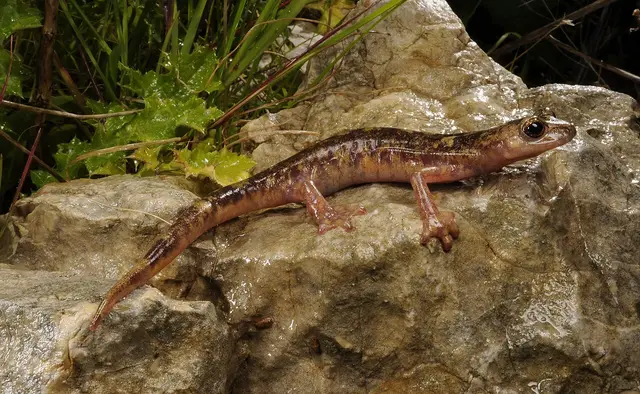
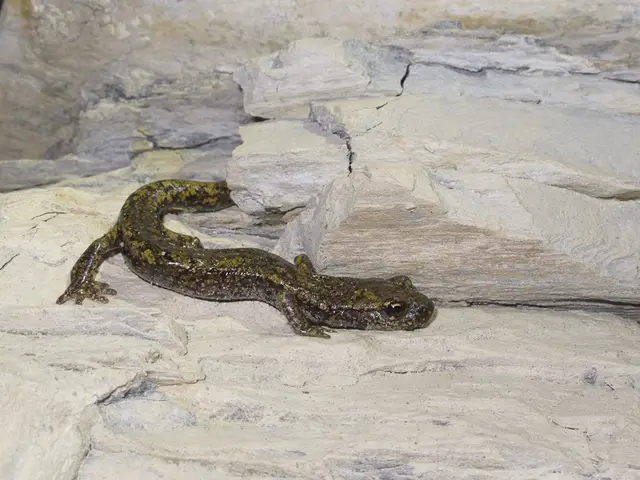
The Sette Fratelli cave salamander (Speleomantes sarrabusensis) is a small amphibian found only in the far southeast of Sardinia, in an area under 70 square km. Despite its name it lives on the surface, not in caves. The IUCN's 2024 assessment lists it as Critically Endangered and decreasing.
What kind of salamander it is
It belongs to the lungless salamander family, Plethodontidae, and to the genus Speleomantes, whose members are mostly found in Italy. Lanza and colleagues described it as a species in 2001. Before that it was treated as a subspecies of Speleomantes imperialis. It lays eggs, and an earlier idea that it bore live young has been set aside. Researchers count females as adults from a snout-vent length of 55 mm.
Where it lives
The range lies in the Sarrabus region east of Cagliari, and the IUCN gives an extent of occurrence of 70 square km at a single location, between 200 and 850 m above sea level. The ground is granite and has no caves. The salamanders live in holm oak and strawberry tree forest, in Mediterranean scrub, and in concrete springs with water tanks, which have cool, damp conditions much like underground sites.
A 2023 study in the journal Animals, by Cogoni and colleagues, found the species only in surface environments. Counts in the springs were highest in June and lowest in November across 2015 to 2018.
Pins are Wikidata “endemic to” fields. Orange dots, when present, are GBIF occurrence tiles — survey bias included.
How it lives
Diet was studied at two sites. At the springs, researchers recorded more than 3,000 prey items, about 94 percent of them flies and rove beetles. In one forest, 356 prey items fell into 31 categories, with springtails the largest group at about 25 percent.
Predators are poorly documented. A 2025 note in Natural History Sciences by Di Nicola and colleagues reported that a Sardinian grass snake captured in early spring during a survey in the Sette Fratelli forest complex regurgitated three adult salamanders, presented as the first documented predation on adults of the species.
Why it is in trouble
The tiny range and the lack of underground refuges leave little room for error. Cogoni's team estimated 2022 numbers at about 34 at the springs, 41 in one forest, and 9 each in a second forest and a scrub site, and said these probably undercount. Counts at the springs fell significantly between 2015 and 2018 for reasons unknown, and 14 salamanders died unexplained in summer 2021, which helped prompt the move to Critically Endangered.
The 2024 assessment records an observed reduction of 70 to 80 percent. Its threat list includes habitat alteration, recreational activity across more than half of the range, collection of animals for use (affecting a minority of the population), and a future threat from a named species.
What is being done
The species is strictly protected and occurs in at least one protected area, and exact site locations are withheld for conservation reasons. The IUCN lists international action, policies and regulations, site management and control of invasive or problematic species among the measures in place or needed.
Sources
Written for this catalog in our own words from the sources below, checked against them on 12 November 2026. Population figures are estimates and carry the year they were made. Status and assessment year: IUCN. 2026. The IUCN Red List of Threatened Species. Version 2026-1. iucnredlist.org.