Endangered
Samoana fragilis
Samoana fragilis
The fragile tree snail (Samoana fragilis) is a small, thin-shelled, air-breathing snail that lives in shaded forest on the Pacific islands of Guam and Rota. The IUCN Red List classed it as Endangered in 2024, with a population estimated at only 300 to 400 animals. Invasive predators are its biggest threat.
How to recognise it
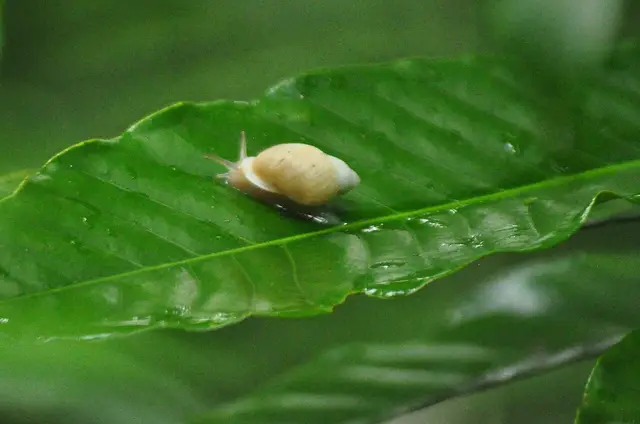
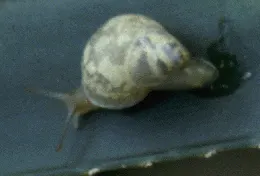
The shell is egg-shaped and conical, buff-coloured, delicate and nearly see-through, with about four whorls. Darker markings and whitish bands show through from the soft body inside. Adults are 12 to 16 mm long and 10 to 12 mm wide.
Two traits are unusual among Mariana Islands tree snails. Its eggs are large (about 4.2 by 3.3 mm) and wrapped in a hard, chalky shell. It also reaches sexual maturity before the lip of its shell flares outward, which has not been reported for any other tree snail in the family. Young ones can be hard to tell apart from young Guam tree snails (Partula radiolata), a species it was always found alongside in 1989 surveys.
Where it lives
Samoana fragilis is the only member of its genus found outside south-eastern Polynesia. It was first collected on Guam in 1819 during a French expedition and described in 1821. On Guam it is mostly a snail of northern limestone forest, though it also turns up in volcanic areas in the south.
A US Fish and Wildlife Service review in 2020 listed seven known sites on Guam, four in the north and three in the south, plus a colony on Rota. Almost all Guam sites are small, with fewer than 100 snails each; the exception is the northern part of the Haputo Ecological Reserve Area. The Rota colony was found on the Talakhaya slope in 1996, after the original collecting site was converted to farmland. The IUCN records 2 to 5 locations and an area of occupancy of 32 square kilometres, at elevations of 75 to 120 m.
Pins are Wikidata “endemic to” fields. Orange dots, when present, are GBIF occurrence tiles — survey bias included.
How it lives
Tree snails of this family need cool, shaded forest with high humidity and little air movement, which keeps them from drying out. This species has been found on the leaves of many native and introduced trees, shrubs, herbs and even ferns. It feeds on fungi and microscopic algae.
Like other partulids, it is a hermaphrodite, and breeding occurs between unrelated individuals. Two Guam populations tested in 2014 showed no genetic differences, which suggests the species may have passed through a population bottleneck.
Why it is in trouble
Predation by the Manokwari flatworm (Platydemus manokwari), an invasive predator now present on both Guam and Rota, is a major threat. Rats also prey on island tree snails. Habitat is shrinking too: about 23% of Guam and 6% of Rota are developed, and the building of Marine Corps Base Blaz will clear about 1,219 acres of limestone forest. Feral pigs and deer, invasive plants, wildfire, typhoons and shell collecting add pressure.
The IUCN gives the population trend as unknown, but records a continuing decline in the number of mature individuals. In 1920 the snail was found at 14 sites on Guam. In 1989 only six of 47 surveyed sites held it. Because survey methods differed, those counts can't be compared directly.
What is being done
The species was listed as endangered under the US Endangered Species Act on 1 October 2015, and Guam listed it as endangered locally in 2009. No critical habitat has been designated, and a recovery plan was still in preparation at the 2020 review. Actions in progress include fencing to keep deer and pigs out of 165 acres of the North Haputo Ecological Reserve Area, surveys before land is cleared, and surveys for little fire ants. According to the 2024 IUCN assessment, none of the population lives in a protected area and the species is not held in captivity.
Sources
Written for this catalog in our own words from the sources below, checked against them on 12 November 2026. Population figures are estimates and carry the year they were made. Status and assessment year: IUCN. 2026. The IUCN Red List of Threatened Species. Version 2026-1. iucnredlist.org.
- IUCN Red List assessment, Samoana fragilis (2024)
- US Fish and Wildlife Service, Fragile Tree Snail 5-Year Review (2020)
- Kerr 2013, The partulid tree snails of the Mariana Islands (University of Guam Marine Laboratory Technical Report 152)
- Wikipedia, Samoana fragilis
- Federal Register final rule 2015-24443 (govinfo copy)