Endangered
Samoana diaphana
Samoana diaphana
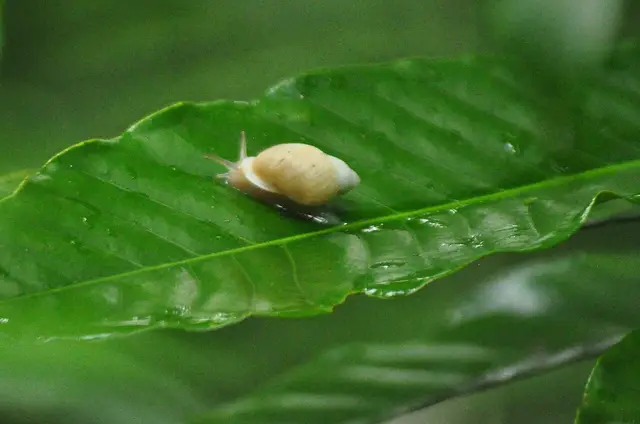
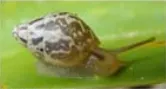
The delicate Samoana tree snail (Samoana diaphana) is a small air-breathing land snail of French Polynesia's Society Islands, known to survive on Tahiti. The IUCN Red List rated it Endangered in 2024, on the strength of a tiny and shrinking range. Introduced predators are the main named threats.
What it is
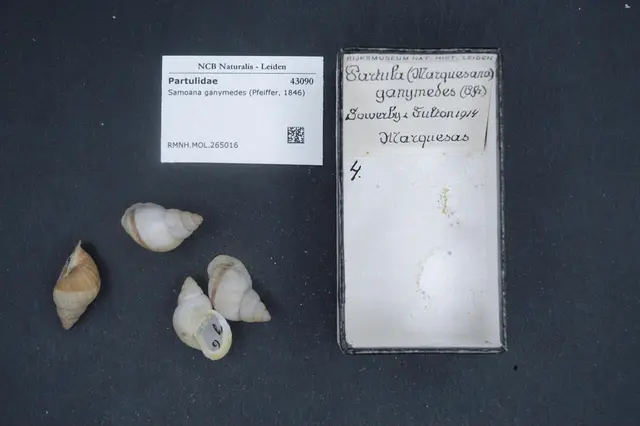
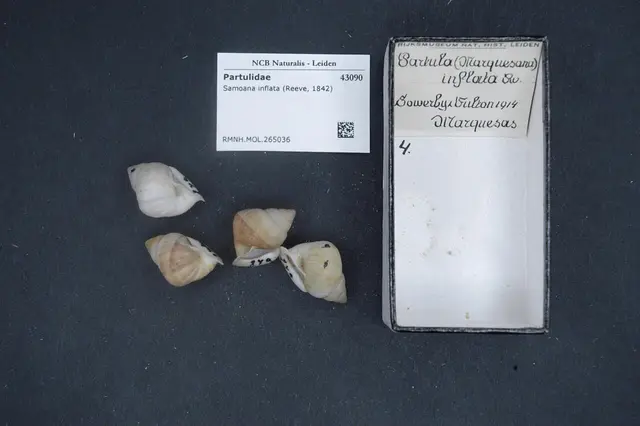
Samoana diaphana belongs to the Partulidae, a family of tree snails found only on Pacific islands. Crampton and Cooke described it in 1953, originally as a Partula. The IUCN's preferred English name is the delicate Samoana tree snail. It is also called the Polynesian tree snail and, in the Tahitian language, Areho. Names such as Moorean viviparous tree snail are shared with other partulids, so they are not a reliable way to identify it.
The genus Samoana has about 23 species spread across Polynesia and the Mariana Islands. Little has been published about this species' shell or body, so most of what is known concerns where it survives and what threatens it.
Where it lives
The species is endemic to French Polynesia. A 2014 survey paper in the journal Oryx lists it among seven partulid taxa still present on Tahiti, the largest island of the Society group. The IUCN assessment, published in 2024, gives an elevation range of 300 to 1,300 m, treats the species as occurring at three locations and records it in both lowland and montane moist forest. Its presence in French Polynesia and the Society Islands is marked as uncertain in the assessment's location records.
The range is tiny. The area the snail actually occupies is put at about 20 square km, inside a wider extent of roughly 200 to 569 square km, and both are listed as still declining. No population estimate has been published and the overall population trend is unknown.
Pins are Wikidata “endemic to” fields. Orange dots, when present, are GBIF occurrence tiles — survey bias included.
Why it is in trouble
Partulid snails in the Society Islands collapsed after the predatory rosy wolf snail (Euglandina rosea) was brought in during the 1970s as a biological control. A 2003 Oryx paper by Trevor Coote and Eric Loeve, titled 'From 61 species to five', reported that partulids had been lost in the wild on every Society Island except Tahiti.
The IUCN assessment names two introduced animals as ongoing threats to this species, each affecting the majority of the population: Euglandina rosea, linked to rapid declines, and the New Guinea flatworm (Platydemus manokwari), linked to fluctuations. The flatworm was first recorded on Tahiti in 2006. During a 2017 expedition, one was found at a single Mount Marau site, though the observer judged that it had not established a population there, and none were seen at the Tiapa valley.
On Tahiti, the Oryx survey of 2014 found partulid survivors most common in cloud forest above 1,000 m, where cooler temperatures probably limit the predator. That finding covers Tahiti's partulids as a group, not this species alone.
What is being done
The assessment lists species recovery and invasive species control among the actions in place, and conservation sites have been identified over part of the range. It gives no further detail on what those actions involve for this snail.
Sources
Written for this catalog in our own words from the sources below, checked against them on 12 November 2026. Population figures are estimates and carry the year they were made. Status and assessment year: IUCN. 2026. The IUCN Red List of Threatened Species. Version 2026-1. iucnredlist.org.