Endangered
Sahyadria denisonii
Sahyadria denisonii
The Denison barb, also called the red line torpedo barb or Miss Kerala, is a slim, silver, red-striped fish of fast-flowing streams in the Western Ghats of southern India. The IUCN Red List assessed it as Endangered in 2015. It is a prized aquarium fish and has been heavily collected.
How to recognise it
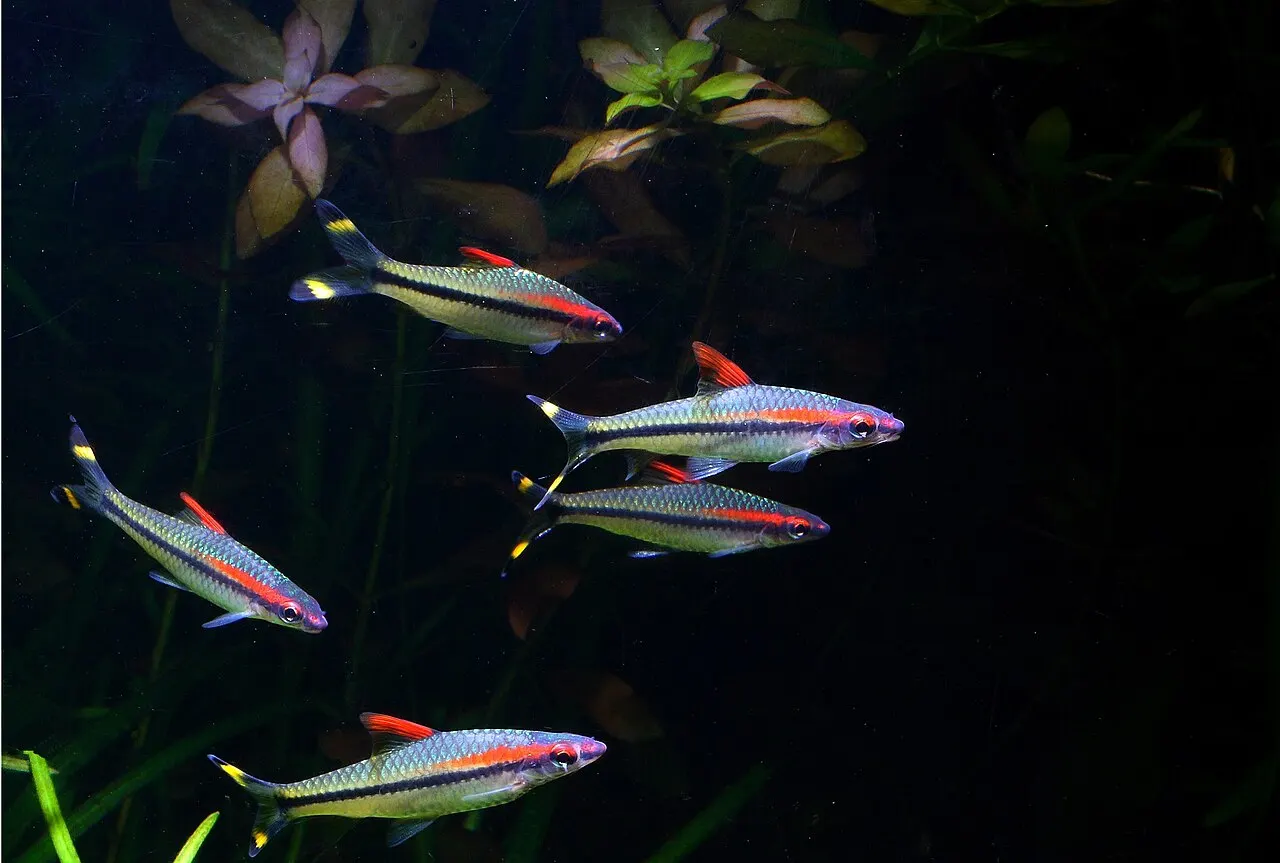
It has a torpedo-shaped body with silvery scales. A red stripe runs from the snout through the eye, with a black stripe below it reaching the tail. Sources differ on size: typical adults are given as 9 to 11 cm in one account and 12 to 15 cm in another, and the largest are reported at about 15 cm. The related Chalakudy barb is sometimes mistaken for it, but is larger and less colourful.
The name has changed. Francis Day described it in 1865 as Labeo denisonii, after Sir William Denison. It has since been placed in several genera, including Puntius, Dawkinsia and Sahyadria. The IUCN assessment lists it as Dawkinsia denisonii.
Where it lives
It is restricted to hill rivers and streams in the Western Ghats, in the Indian states of Kerala and Karnataka. It prefers clear, fast water over rocky beds, in shaded stretches with stable water quality. The IUCN counts 11 locations, with an estimated 300 square kilometres occupied and an extent of occurrence of 12,000 to 13,000 square kilometres. Its population is severely fragmented.
Pins are Wikidata “endemic to” fields. Orange dots, when present, are GBIF occurrence tiles — survey bias included.
How it lives
These are active, social fish that move in schools. They are omnivores, grazing algae and biofilm from submerged surfaces and picking off insects and small invertebrates. Spawning in the wild is tied to the monsoon rains, with eggs scattered over gravel or plants and no parental care.
Why it is in trouble
The IUCN estimated a past decline of 55 to 70 percent and a projected further 50 percent, citing habitat decline, exploitation, and introduced species or pollutants among the grounds. Its listed threats are large-scale harvest and ecosystem modification. Exports began in 1996 to 1997, with Germany an early market, and by 2007 to 2008 the species made up about 60 to 65 percent of India's live ornamental fish exports.
How much the aquarium trade matters is disputed. A 2008 note in Environmental Biology of Fishes by Prasad, Ali and Raghavan attributed the decline to large-scale trade exploitation. A 2022 policy review in Frontiers in Marine Science by Jain, Mercy and Jain argued that wild collection is too small to explain the decline and pointed to dams, sand mining, pollution, invasive species, destructive fishing methods and land-use change. It cited one study finding biomass in two rivers at about a third of the original stock, and another finding stocks not depleted except in the Chalakudy River. The fish is also caught for food locally.
What is being done
About 40 percent of the population is estimated to be inside protected areas, and the IUCN records a harvest management plan. Kerala restricted collection of smaller wild fish in 2008. Captive breeding is now established in India, and farms in Indonesia also supply the trade. The IUCN rated the species Vulnerable in 2009 and Endangered in 2011 and again in 2015.
Sources
Written for this catalog in our own words from the sources below, checked against them on 12 November 2026. Population figures are estimates and carry the year they were made. Status and assessment year: IUCN. 2026. The IUCN Red List of Threatened Species. Version 2026-1. iucnredlist.org.




