Critically Endangered
Red Canarese Barb
Hypselobarbus thomassi
The red Canarese barb (Hypselobarbus thomassi) is a silvery carp relative with orange-red fins that lives in fast rivers of India's Western Ghats. The IUCN Red List has classed it as Critically Endangered since 2011, and the identity of some records remains in doubt.
How to recognise it
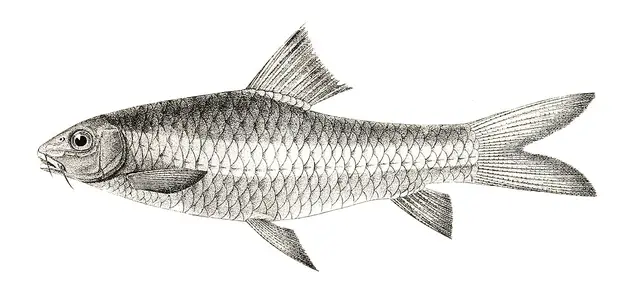
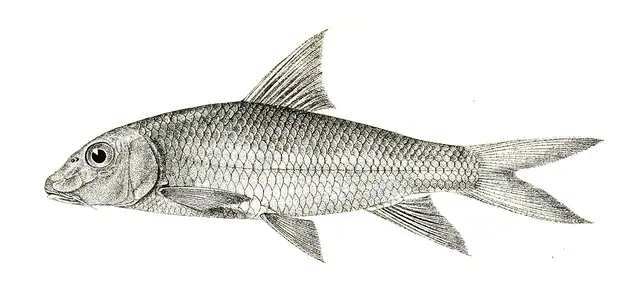
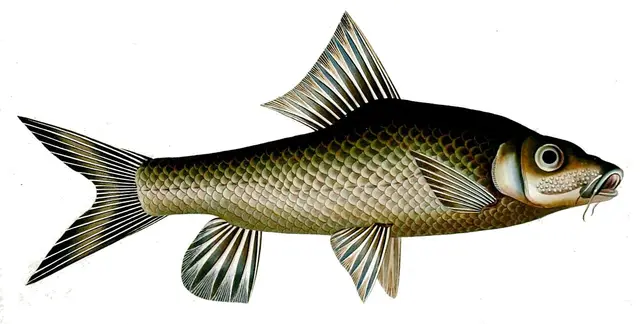
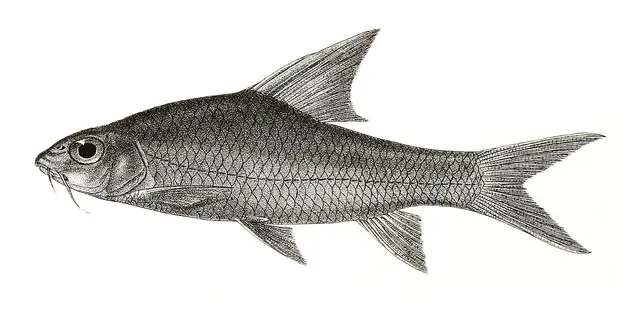
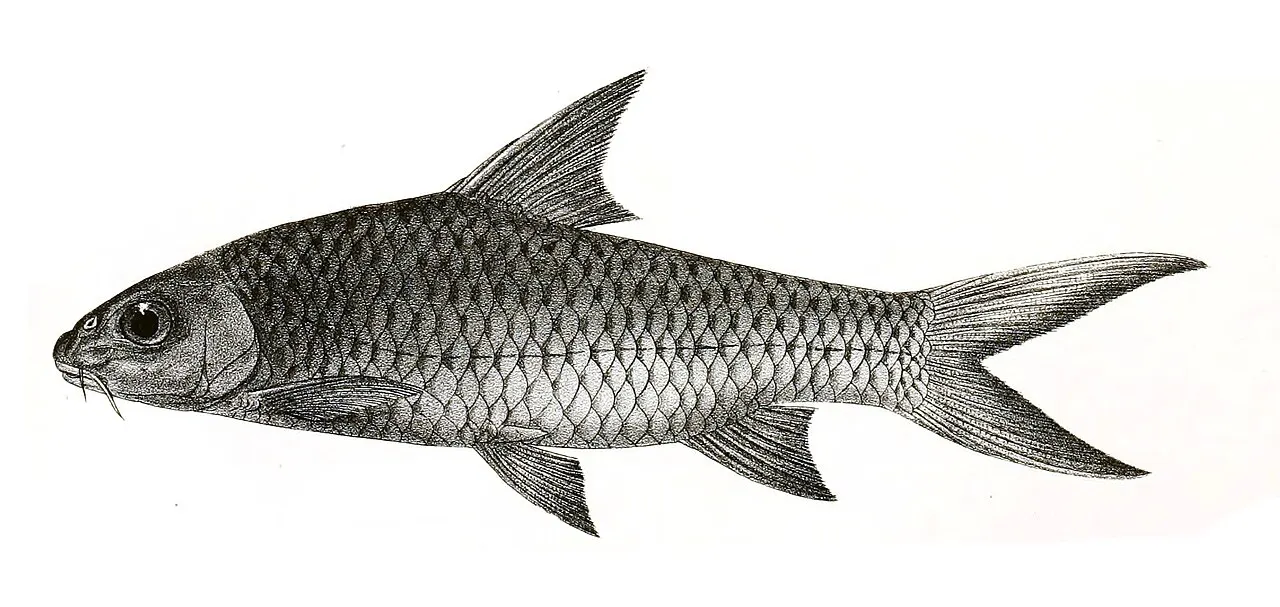
The back and upper flanks are greenish grey, while the lower flanks and belly are bright silver. The fins are orange-red near the base and greyish toward the tips. The body carries no distinct markings, and the mouth sits slightly under the snout.
Size is uncertain. Francis Day, who described the species in 1874 from South Canara, said it grew to more than 450 millimetres. Some accounts reportedly give up to a metre in total length. The four fish measured in a 2013 field study were much smaller, between 83 and 138 millimetres in standard length.
Where it lives
The type locality is South Canara in Karnataka, and the IUCN assessment mentions the Nethravati River there and the Kabini River. It counts only confirmed records from Karnataka and northern Kerala, an area under 10 square kilometres, split between two severely fragmented spots. It lists elevations of 300 to 900 metres and permanent rivers and streams as habitat.
A 2013 paper in the Journal of Threatened Taxa described specimens from three west-flowing Kerala rivers, the Chalakudy, the Kallada and the Periyar, and argued the species needed reassessment. The IUCN assessment had excluded Periyar and Kallada records because of identification doubts within the genus, so how widespread the species is remains disputed.
Pins are Wikidata “endemic to” fields. Orange dots, when present, are GBIF occurrence tiles — survey bias included.
How it lives
It favours clear, well-oxygenated water running over boulders, bedrock and sand, in streams with some shade from bankside trees. Adults stay in moderately deep pools. Juveniles use shallower stretches where pools meet riffles and runs.
Little else about its life history has been published. Fishers interviewed for the 2013 study described it as uncommon and rarely caught in the Chalakudy and Periyar.
Why it is in trouble
No targeted food fishery for it is known, but it turns up as bycatch in the Kallada River alongside other Hypselobarbus species and mahseer. Juveniles are sometimes taken by accident when collectors fish for aquarium specimens of a relative, Hypselobarbus jerdoni.
The more serious damage is from destructive fishing. The 2013 study named dynamiting as a major threat in streams around Pooyamkutty on the Periyar and in parts of the Kallada catchment, and poisoning and electric fishing in the Sullia region of Dakshina Kannada, especially when water is low. The IUCN assessment lists herbicides and pesticides, subsistence harvest, and mining and quarrying, and says the Nethravati drainage faces sand mining and pollution.
What is being done
The assessment records no recovery plan, no monitoring scheme and no captive population, and it identifies conservation sites over only part of the range. It calls for surveys of the Nethravati and Kabini rivers and for sorting out the taxonomy of the genus. The 2013 authors proposed an updated status, but the Red List entry still shows Critically Endangered, with an unknown population trend.
Sources
Written for this catalog in our own words from the sources below, checked against them on 12 November 2026. Population figures are estimates and carry the year they were made. Status and assessment year: IUCN. 2026. The IUCN Red List of Threatened Species. Version 2026-1. iucnredlist.org.