Critically Endangered
Balearic shearwater
Puffinus mauretanicus
The Balearic shearwater (Puffinus mauretanicus) is a medium-sized seabird that breeds only in Spain's Balearic Islands and spends the rest of the year at sea along Atlantic and Mediterranean coasts. The IUCN Red List rated it Critically Endangered in 2018, and it is among Europe's most threatened seabirds.
How to recognise it
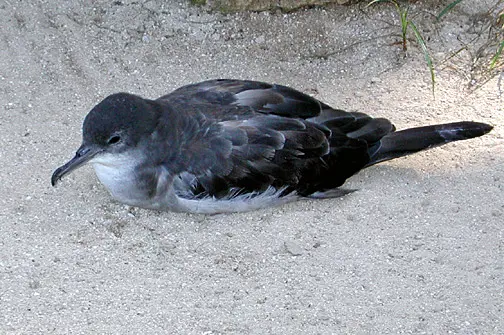
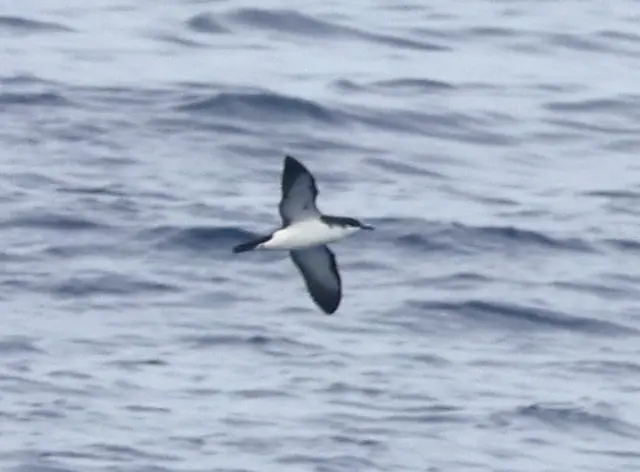
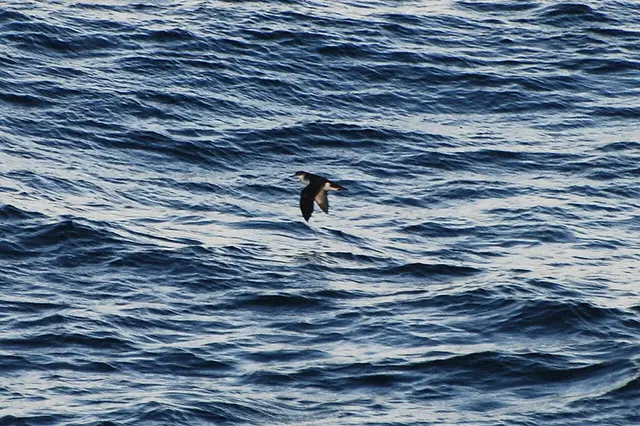
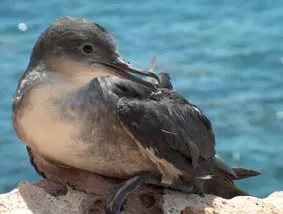
It measures about 34 to 39 cm, with a wingspan of 78 to 90 cm. It flies low over the waves on stiff wings with few wingbeats, dipping from side to side with the wingtips almost touching the water. Its plumage is less contrasting than that of the closely related Manx and yelkouan shearwaters. The IUCN describes the upperparts as dark brown and the underparts as dirty brown-whitish.
It is silent at sea, but breeding colonies are noisy at night.
Where it lives
All breeding takes place in the Balearic Islands, on Mallorca, Menorca, Ibiza, Formentera and Cabrera, in burrows and caves and on coastal cliffs. Birds visit the colonies only at night, which helps them avoid large gulls. Tracked breeders forage over the Iberian shelf and around the colonies, and also in North African waters.
After breeding, some birds move into the Atlantic and reach Britain and Ireland in late summer. Tracking studies reported in 2013 found wintering birds concentrated in a few areas off western Iberia and south-western Brittany, where more than 5,000 were counted in 2010. A 2025 study in Biological Conservation, covering 2000 to 2020, found the species has recently spread into the Celtic Sea, English Channel and southern North Sea, though losses in the Mediterranean and along Atlantic Iberia are not offset by those gains.
Pins are Wikidata “endemic to” fields. Orange dots, when present, are GBIF occurrence tiles — survey bias included.
How it lives
It eats fish and molluscs and doesn't follow boats. Egg laying starts in early March, and tracked birds have been recorded returning to the colonies as early as five months before that. The IUCN gives a generation length of 15 years, so it is long-lived and slow to replace losses.
Why it is in trouble
At sea, fishing bycatch is now regarded as the main threat, with longlines, purse seines and gillnets all implicated. A single fishing event has reportedly caught 100 or more birds. On land, cats take chicks and adults, rats eat eggs and chicks, and artificial lights can disorient fledglings. The IUCN assessment also lists oil spills, tourism development and recreation, and notes that birds were once collected for food.
Counts are hard because the colonies sit on cliffs. About 3,000 breeding pairs are cited. At-sea counts suggest about 25,000 birds in total, roughly double an earlier estimate in a 2013 report, though a 2022 OSPAR assessment calls that figure uncertain. The IUCN lists 19,000 in its 2018 assessment. Population models for two colonies, western Mallorca and western Ibiza, show a fall of about 14 percent a year, driven mainly by low adult survival.
What is being done
All breeding sites lie within Natura 2000 protected areas, some inside national parks. Rodents have been removed from some islets, including Malgrats and Sa Dragonera. The species is covered by the Agreement on the Conservation of Albatrosses and Petrels and by Appendix I of the Convention on Migratory Species.
Management plans exist but need full implementation. Research suggests setting longlines at night could cut bycatch, since the birds appear not to forage then, but this has yet to become routine fishing practice.
Sources
Written for this catalog in our own words from the sources below, checked against them on 12 November 2026. Population figures are estimates and carry the year they were made. Status and assessment year: IUCN. 2026. The IUCN Red List of Threatened Species. Version 2026-1. iucnredlist.org.
- IUCN Red List assessment, Puffinus mauretanicus (2018)
- Balearic shearwater, encyclopedia article
- ACAP species summary for the Balearic shearwater
- OSPAR status assessment, Balearic shearwater (2022)
- ACAP PCSWG1 Doc 15, recent research on Balearic shearwater (2013)
- De la Cruz et al., Biological Conservation (2025), Bangor University record