Critically Endangered
Bryan's Shearwater
Puffinus bryani
Bryan's shearwater (Puffinus bryani) is the smallest shearwater, a slate-black and white seabird whose only known colony sits on a small island in Japan's Ogasawara (Bonin) Islands. The IUCN Red List rated it Critically Endangered in 2018, with an estimated 50 to 249 mature birds and a decreasing trend.
How to recognise it
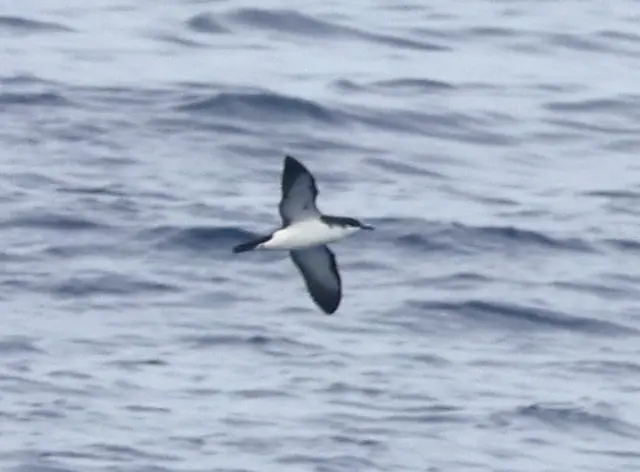
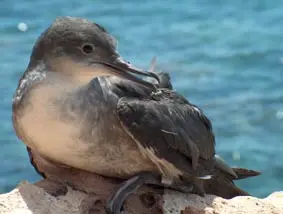
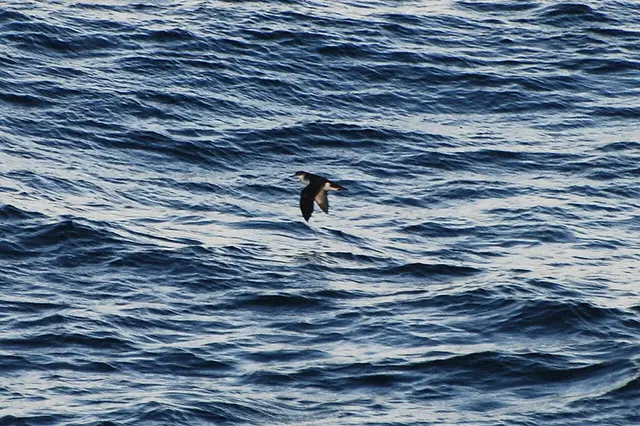
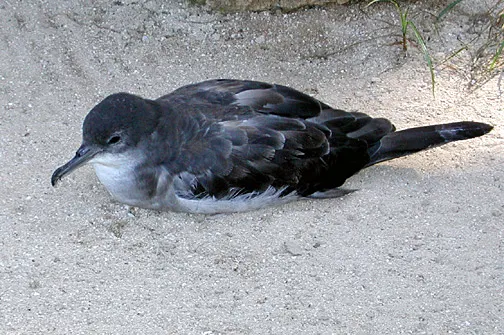
This is a tiny shearwater, about 25 cm long and, in birds weighed in Japan, around 150 g. The upperparts are slaty black and the underparts are white, including the face in front of and above the eye. The undertail feathers are blackish.
It looks very like Boyd's shearwater (Puffinus boydi). Boyd's has considerably longer legs (tarsi), a shorter tail and white undertail feathers, while Bryan's has dark ones. The bill is bluish grey and the legs are blue.
A species found twice
The first specimen was collected on Midway Atoll in 1963 and filed as a little shearwater. A 2011 DNA study showed these birds belonged to a separate species, named after Edwin Horace Bryan Jr., a former curator at the Bishop Museum in Honolulu.
In 2012 genetic tests identified six birds found in the Ogasawara Islands between 1997 and 2011, some alive and some dead. Five of them were corpses, and the Red List records black rats as having preyed on three. That pointed to rats as a danger on the islands where the species was surviving.
Where it lives
The only confirmed nesting site is Higashijima, a small uninhabited island about 3 km east of Chichijima in the Ogasawara group. Passive sound recorders had picked up calls there between 2012 and 2014. In late February 2015 a team from Japan's Forestry and Forest Products Research Institute landed at night and tracked birds down by their high-pitched calls. They searched the island's roughly 3 hectares and found 10 birds, one of them incubating in an underground nest.
The Red List says the birds breed in the northern winter, with birds found on land between December and May. Away from the nest it is a bird of the open ocean. The Red List records it in the Ogasawara Islands in both breeding and non-breeding seasons, and outside the breeding season around Midway Atoll and the Hawaiian Islands. It was seen at Midway in the early 1990s. Whether the Higashijima birds also make the flight of about 4,000 km to Midway is not known.
Pins are Wikidata “endemic to” fields. Orange dots, when present, are GBIF occurrence tiles — survey bias included.
Why it is in trouble
The whole population is treated as a single subpopulation of 50 to 249 mature individuals, and the Red List assessment says it is still declining. Black rats (Rattus rattus) are the named threat, affecting more than half of its range. Light pollution is a lesser problem whose impact is unknown.
Invasive plants may also crowd out the native vegetation the birds shelter in.
What is being done
Japan's Ministry of the Environment had already cleared rats from Higashijima before the nest was found. The Red List assessment calls for keeping Higashijima rat-free and removing rats, goats and pigs from other small islands in the Ogasawara group. The research institute planned a project to remove invasive plants, and one report adds mice to the pests that need to go.
As of the 2018 assessment there was no recovery plan and no systematic monitoring scheme, and it was unknown whether the species occurs in a protected area. Researchers think more birds may survive on other islands. The assessment recommends surveying the seabird colonies on Higashijima and Kitanoshima and checking others in the western Pacific, including the northern Marianas.
Sources
Written for this catalog in our own words from the sources below, checked against them on 12 November 2026. Population figures are estimates and carry the year they were made. Status and assessment year: IUCN. 2026. The IUCN Red List of Threatened Species. Version 2026-1. iucnredlist.org.