Critically Endangered
Pseudophilautus stuarti
Pseudophilautus stuarti
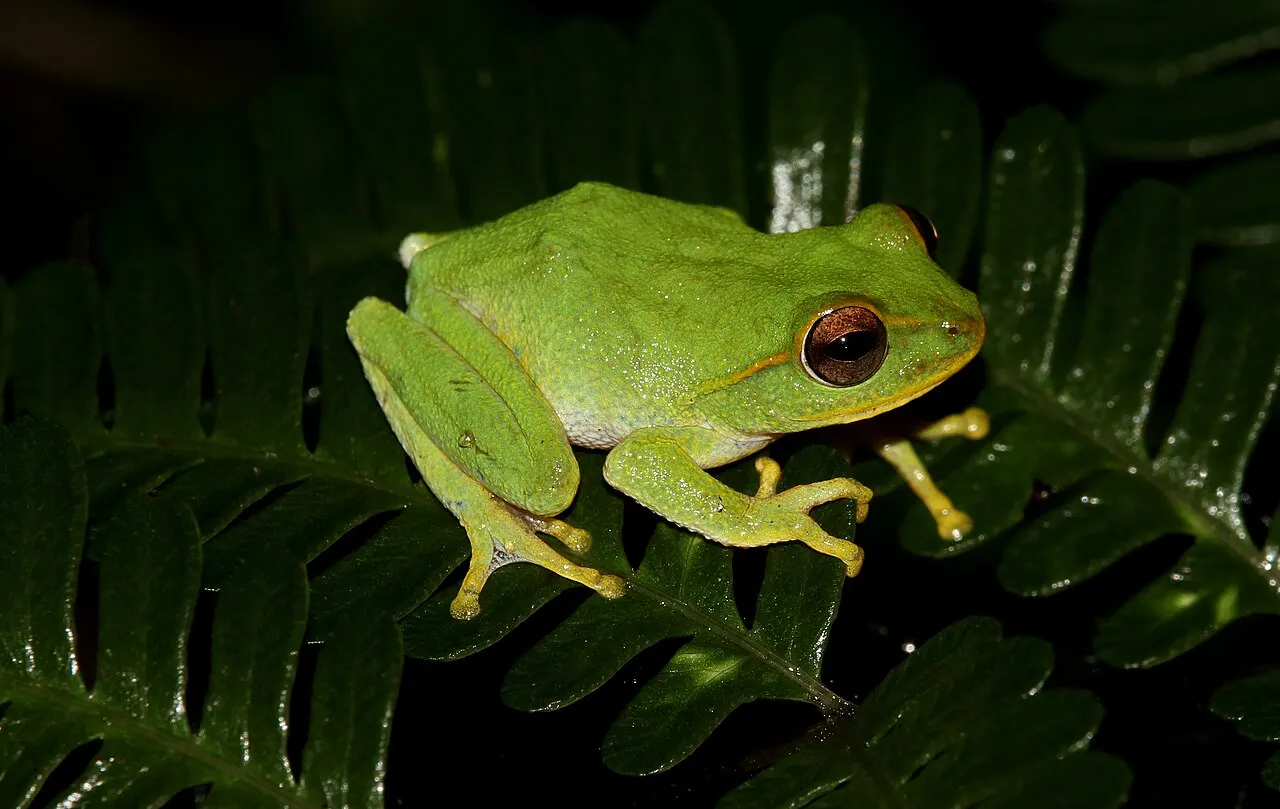
Stuart's shrub frog (Pseudophilautus stuarti) is a small green tree frog known only from the Knuckles mountain range in central Sri Lanka. The IUCN listed it as Critically Endangered in 2020, with a decreasing population. It lives in a single, tiny patch of cloud forest and calls from leaves a few metres above ground.
How to recognise it
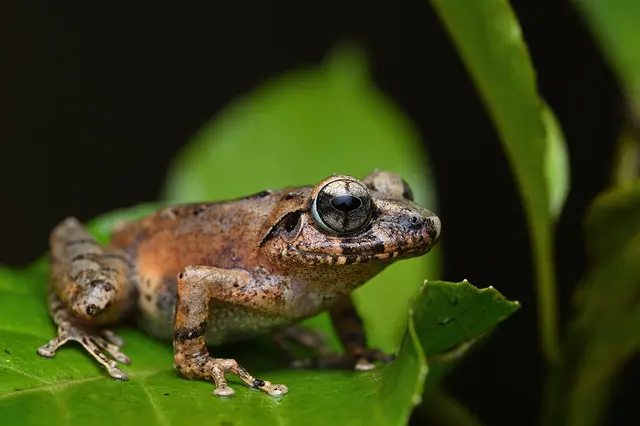
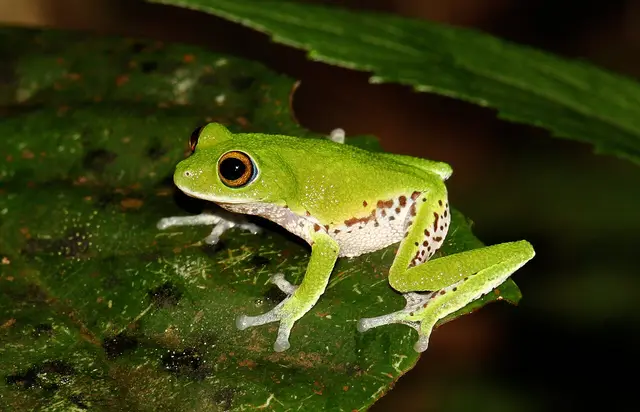
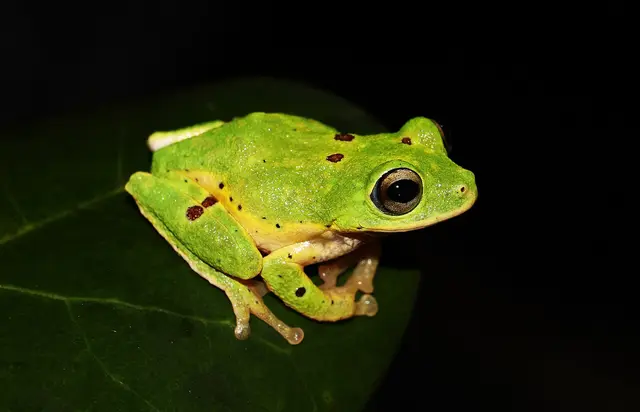
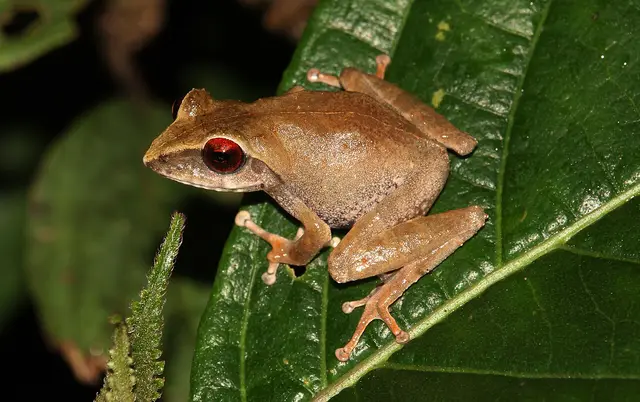
This is a stout little frog. Males measure about 24 to 25 mm from snout to vent, and the one female in the original series was 32.4 mm. In life the back is light green, flecked with ashy green, yellowish or black dots. The ear drum is green, the lips are yellow in most specimens, and so are the sharp edges of the snout, the fold above the ear drum and the tops of the toes. The belly is a fleshy grey dotted with white granules.
Its closest relative, Pseudophilautus viridis, lives on the peaks of the Central Hills and is larger (males reach about 29.6 mm). The two are separated by the Mahaweli River valley, which drops to around 500 metres near Kandy. Their calls differ too. Both are series of terse ticks, but Stuart's shrub frog gives about six, lasting roughly 1.7 to 1.8 seconds, while its relative gives three or four.
Where it lives
The species was first collected at Corbett's Gap, at the southern end of the Knuckles range, at 1,245 metres. It was described in 2005 by Madhava Meegaskumbura and Kelum Manamendra-Arachchi, who placed it in the genus Philautus, and it is named for Simon Stuart, a former acting Director General of the IUCN who led development of the Red List categories. The IUCN assessment treats it as a single location, with records between 1,000 and 1,800 metres, and notes that it occurs in at least one protected area.
The original description put its extent of occurrence at only about 10 square kilometres, from a single population. The IUCN's later estimate of extent of occurrence is just under 100 square kilometres.
Pins are Wikidata “endemic to” fields. Orange dots, when present, are GBIF occurrence tiles — survey bias included.
How it lives
It is a forest specialist. It lives in the understorey of closed-canopy montane forest, and has also been found in cardamom plantations growing within that forest. Males call from leaves 2 to 3 metres above the ground. The 2005 description reports low abundance. Little has been published on its breeding or diet.
Why it is in trouble
Everything depends on one small block of habitat, so any change there matters. The original paper pointed to agricultural expansion as the main risk to that habitat. The IUCN assessment lists small-holder farming, housing and urban areas, tourism and recreation areas, herbicides and pesticides, fire, drought, acid rain and habitat shifting and alteration among the pressures, and it records a continuing decline in the area of habitat. The species was rated Endangered when first described in 2005, and has since moved up to Critically Endangered.
The original paper recommended population monitoring. The IUCN assessment lists site management, site protection and resource and habitat protection among the conservation actions for the frog, but no dedicated recovery programme is described.
Sources
Written for this catalog in our own words from the sources below, checked against them on 12 November 2026. Population figures are estimates and carry the year they were made. Status and assessment year: IUCN. 2026. The IUCN Red List of Threatened Species. Version 2026-1. iucnredlist.org.