Endangered
Pseudophilautus semiruber
Pseudophilautus semiruber
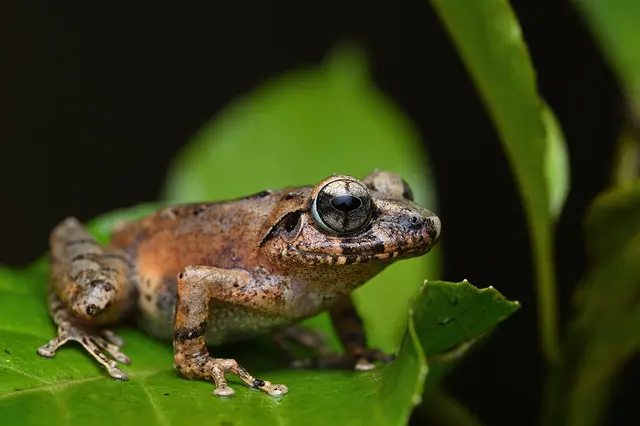
Pseudophilautus semiruber, known as Annandale's shrub frog or the tiny-red shrub-frog, is one of the smallest frogs in the world and lives only in the montane forests of Sri Lanka. Adults measure about 12 to 13 mm and have red limbs. The IUCN Red List lists it as Endangered (2020 assessment), with a decreasing population.
How to recognise it
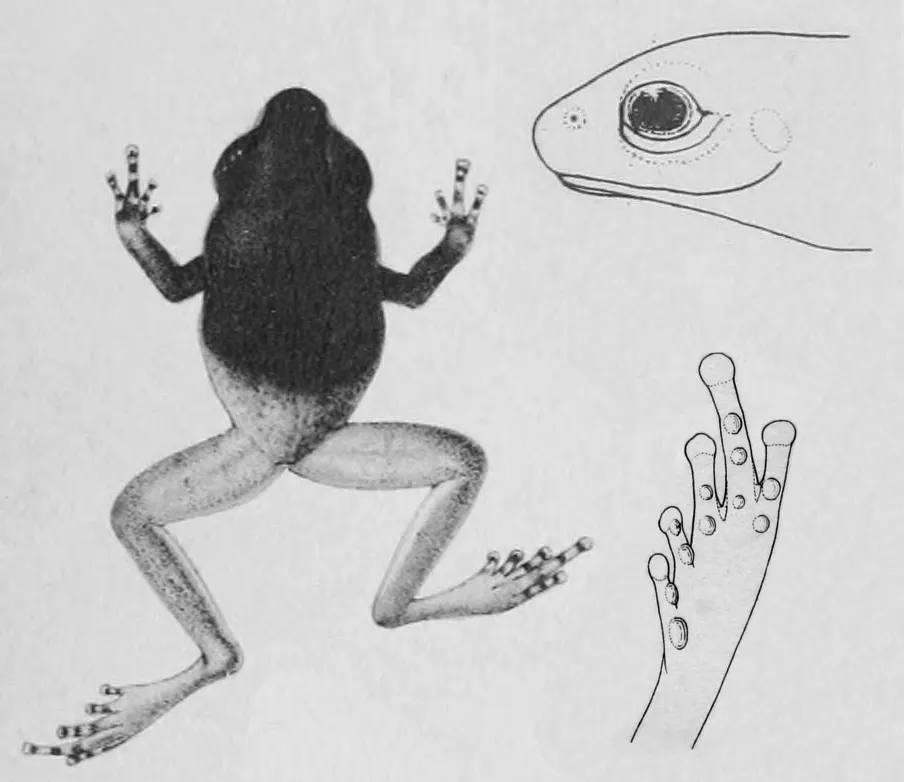
This is one of the smallest frogs in Sri Lanka and among the smallest known anywhere. Adults measure about 12 to 13.4 mm from snout to vent, small enough to rest on the tip of a small finger. Only 46 of the world's 5,000-plus frog species are 15 mm or under. The body is stout, the skin on the head and back is smooth, and the toes are fully webbed.
The colours are the best clue. The throat is ashy brown, while the chest and belly are reddish brown with white patches. The upper arms, thighs and shanks are red on top and light red underneath. Its sister species, Pseudophilautus simba, has a black throat, chest and front belly, granular skin there and brown limbs.
Where it lives
The frog is endemic to Sri Lanka. The Red List records it from five locations in montane forest between about 1,300 and 1,829 m above sea level. The first known animal came from Pattipola, at about 1,850 m. The frog found again in 2005 came from the Agra-Bopath forest reserve, near Horton Plains National Park, at about 1,750 m.
It is a day-active frog of heavily shaded, wet leaf litter on the forest floor, and it is not a migrant. At least one known site lies inside a protected area.
Pins are Wikidata “endemic to” fields. Orange dots, when present, are GBIF occurrence tiles — survey bias included.
A frog lost for 95 years
Nelson Annandale found a single 12 mm specimen at Pattipola in 1911 and described it in 1913 as Ixalus semiruber. Nobody recorded the species again for roughly 95 years. The original specimen was reportedly confirmed lost from its museum collection by 2001, and the species was treated as Data Deficient.
In 2005, Madhava Meegaskumbura and Mohamed Bahir found a single female in wet leaf litter in misty forest near Horton Plains, while Meegaskumbura was sampling Sri Lankan shrub frogs for genetic work. A new description and the rediscovery were published in Zootaxa in 2012. The frog's tiny size may be one reason it is rarely collected, since it could be mistaken for a juvenile of a larger shrub frog.
Why it is in trouble
The 2020 Red List assessment rates the frog Endangered under criterion B1ab(iii), which reflects a small range, few locations and a continuing decline in the area of its habitat. The listed threats are small-holder farming, habitat shifting and alteration, drought, acid rain and unintentional harm from small-scale harvesting. The assessment gives no population size.
What is being done
The Red List lists site and area protection, resource and habitat protection, and site management as relevant actions, and notes that the frog occurs in at least one protected area. No species-specific recovery programme is described in the Red List record.
Sources
Written for this catalog in our own words from the sources below, checked against them on 12 November 2026. Population figures are estimates and carry the year they were made. Status and assessment year: IUCN. 2026. The IUCN Red List of Threatened Species. Version 2026-1. iucnredlist.org.