Endangered
Schmarda's shrub frog
Schmarda's shrub frog
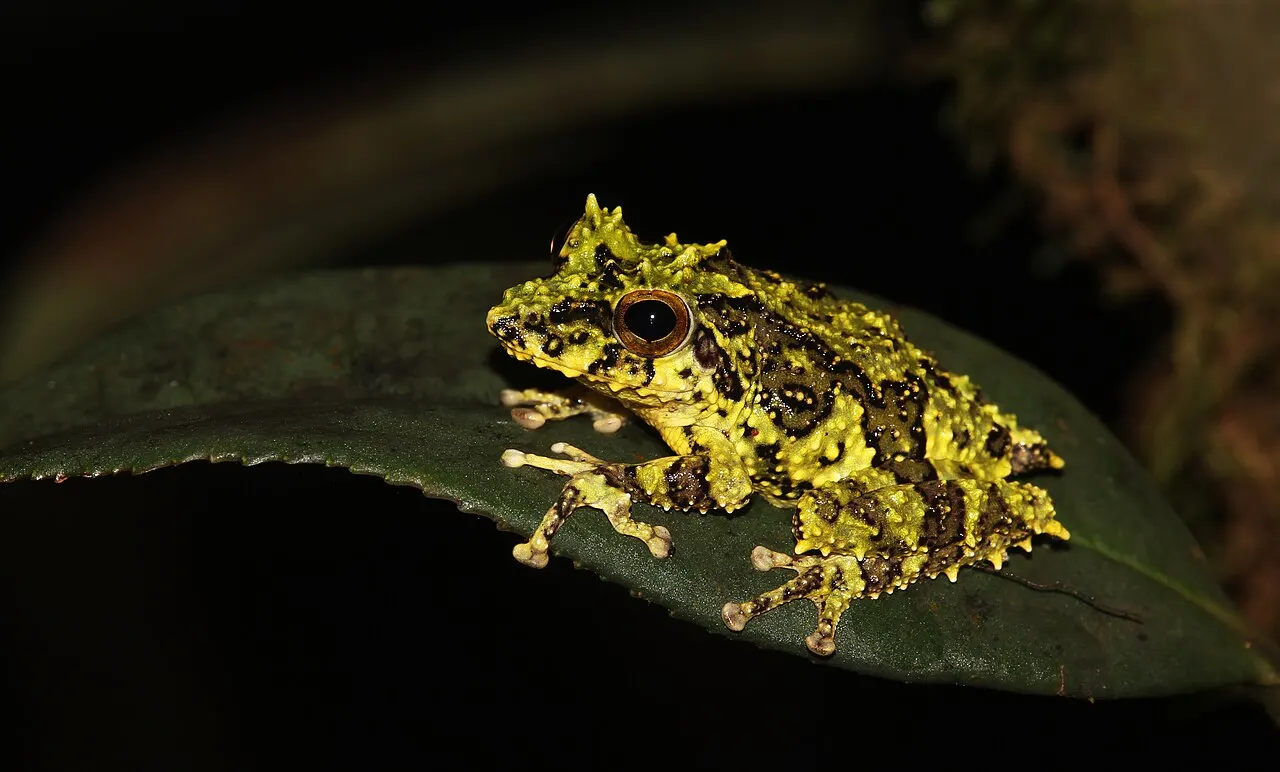
Schmarda's shrub frog (Pseudophilautus schmarda) is a small, rough-skinned tree frog found only in the central hills of Sri Lanka. The IUCN Red List rated it Endangered in 2023 and records a decreasing population. Its eggs are buried in the forest floor and hatch as tiny froglets, with no free-swimming tadpole.
How to recognise it
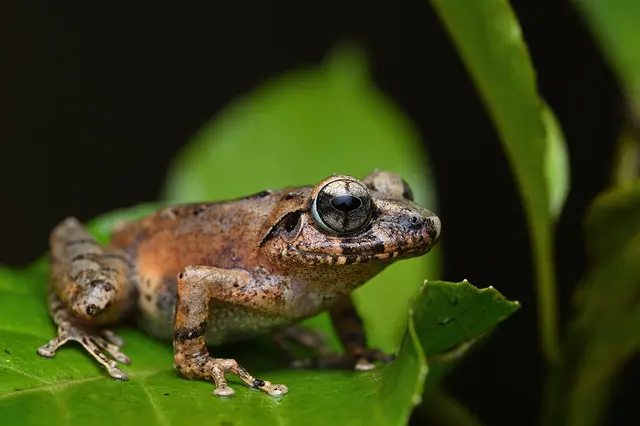
This is a small, stout frog. Males measure about 18 to 27 mm from snout to vent. Females are a little larger, roughly 20 to 30 mm, though that figure rests on only two specimens. The snout is bluntly pointed, and the eardrum and the fold above it are easy to see.
The skin on the back is unusually rough, with glandular folds, warts and small horn-like spines. The upper surface is dark green mixed with red-brown. The flanks shade from yellow to brown, and the chest and belly are yellow with brighter yellow spots. Its fingers have only a trace of webbing, while the toes are webbed about halfway.
Where it lives
The species is endemic to Sri Lanka, which means it occurs nowhere else. It is known from the Peak Wilderness Sanctuary, Agra Bopath, Horton Plains and Pedro, all in the central highlands. The Red List gives its elevation as 810 to 2,300 m and estimates its overall range at about 3,977 square kilometres, spread over between one and five distinct locations.
Most records are from moist montane and lowland forest. It has also been found in pine plantations and in abandoned tea plantations, so it can cope with some disturbed ground.
Pins are Wikidata “endemic to” fields. Orange dots, when present, are GBIF occurrence tiles — survey bias included.
How it lives
Juveniles turn up on the forest floor. Adults tend to sit in understorey vegetation about 1 to 2 m above the ground. Females dig a hole in the forest floor and lay their eggs in it.
A 2005 study of Sri Lankan shrub frogs by Bahir and colleagues in the Raffles Bulletin of Zoology examined 98 clutches from 17 species. Sixteen of them, including this one, bury cream or white eggs in nests dug by the female in the forest floor, and none provides parental care. The young develop inside the egg and emerge as small froglets.
Why it is in trouble
The Red List lists several pressures on its habitat: farming by large agribusiness and by smallholders, shifting and altered habitat, droughts and acid rain, plus unintentional harvest effects. Local forest has reportedly been cleared for timber and firewood and converted to crops such as tea, and fires and agrochemical pollution are possible extra threats.
Its range is small and still shrinking, which is what places it in the Endangered category (criterion B1ab(iii)).
What is being done
Part of its range lies inside protected areas, and the Red List notes that it occurs in at least one. Site protection, site management and habitat protection are the actions recorded for it. The assessment flags life history, population trends, threats and taxonomy as areas where more research is needed.
Sources
Written for this catalog in our own words from the sources below, checked against them on 12 November 2026. Population figures are estimates and carry the year they were made. Status and assessment year: IUCN. 2026. The IUCN Red List of Threatened Species. Version 2026-1. iucnredlist.org.