Endangered
Pseudophilautus sarasinorum
Pseudophilautus sarasinorum
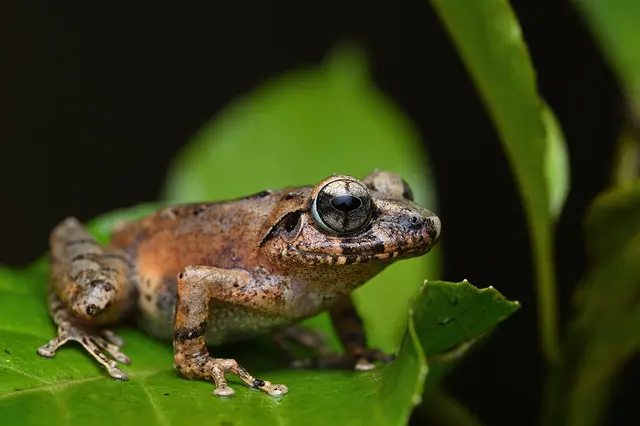
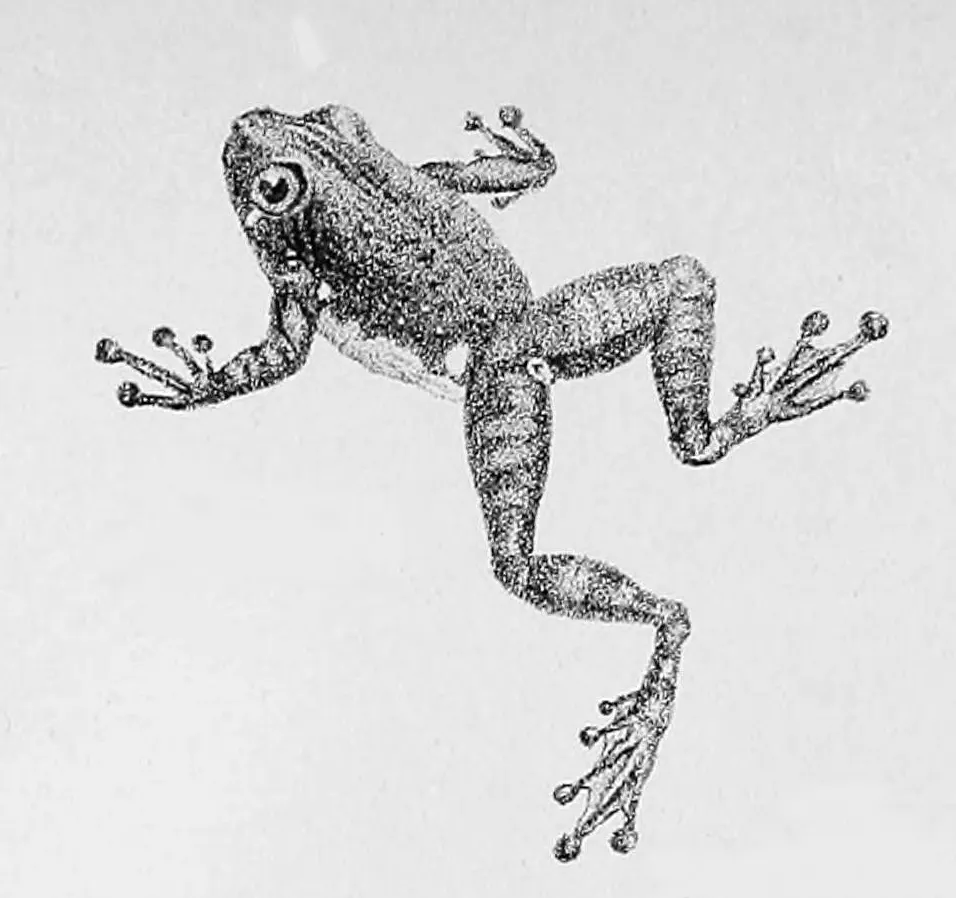
Müller's shrub frog (Pseudophilautus sarasinorum) is a small, dark frog found only in the central hills of Sri Lanka, in cool montane forest and along streams. Described in 1887, it was rated Endangered by the IUCN in 2020, with a decreasing population and a range of about 4,000 square kilometres.
How to recognise it
This is a small frog. Adult males measure roughly 27 to 30 mm from snout to rear, and females are larger, at about 32 to 38 mm. The back is dark with a W-shaped marking near the middle. The belly is yellow in places and peach in others.
Fritz Müller first named it Ixalus sarasinorum in 1887. Over the years it has been placed in several genera, including Micrixalus, Staurois and Philautus, before settling in Pseudophilautus, the shrub frogs, in the family Rhacophoridae.
Where it lives
It is endemic to central Sri Lanka. The IUCN describes two separate subpopulations, one in the Central Hill Country and one in the Knuckles Range. Specific records include the Gannoruwa forest and Hanthana Environmental Protected Area, Agra-Bopath, Bogowantalawa and the Knuckles. The species is not thought to occur more widely.
The IUCN gives an elevation band of 1,200 to 1,600 m, an extent of occurrence of about 3,996 square kilometres and between two and five locations. Its habitats are permanent streams and creeks including waterfalls, subtropical or tropical moist montane forest, and rural gardens. The IUCN records it as a resident that does not migrate.
Pins are Wikidata “endemic to” fields. Orange dots, when present, are GBIF occurrence tiles — survey bias included.
How it lives
Little has been published on this frog's daily life, but its reproduction was studied by Bahir and colleagues in a 2005 paper in the Raffles Bulletin of Zoology. They bred P. sarasinorum in captivity, observed it in the wild, and found it to be one of 16 Sri Lankan shrub frogs that nest on the ground.
In those species the female digs a shallow nest in the forest floor and buries her eggs in it. No parental care was seen. The eggs develop directly into froglets, with no free-swimming tadpole stage, although the young pass through a larval form inside the egg.
Why it is in trouble
The 2020 assessment gives the criteria B1ab(iii) and records a decreasing population, with a continuing decline in the area of habitat. The small range is the core of the problem. The IUCN lists small-holder and industrial farming, small-holder and industrial plantations, housing and urban areas, rubbish and solid waste, acid rain, shifting or altered habitat, drought, more frequent fires, and small-scale harvesting that harms it by accident. Each is scored as low impact.
The population is not considered severely fragmented. The species was already rated Endangered in 2004, so the concern is long-standing.
What is being done
The frog occurs in at least one protected area. The Red List lists site protection, site management and wider habitat protection as the conservation actions in place or needed.
Sources
Written for this catalog in our own words from the sources below, checked against them on 12 November 2026. Population figures are estimates and carry the year they were made. Status and assessment year: IUCN. 2026. The IUCN Red List of Threatened Species. Version 2026-1. iucnredlist.org.
- IUCN Red List assessment, Pseudophilautus sarasinorum (2020)
- Bahir et al. 2005, Reproduction and terrestrial direct development in Sri Lankan shrub frogs, Raffles Bulletin of Zoology Supplement 12
- Pseudophilautus sarasinorum, English Wikipedia article
- Pseudophilautus sarasinorum, Simple English Wikipedia mirror
- GBIF species record