Endangered
Pseudophilautus frankenbergi
Pseudophilautus frankenbergi
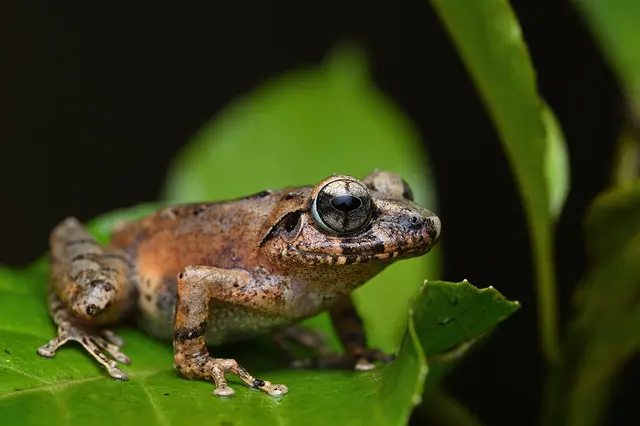
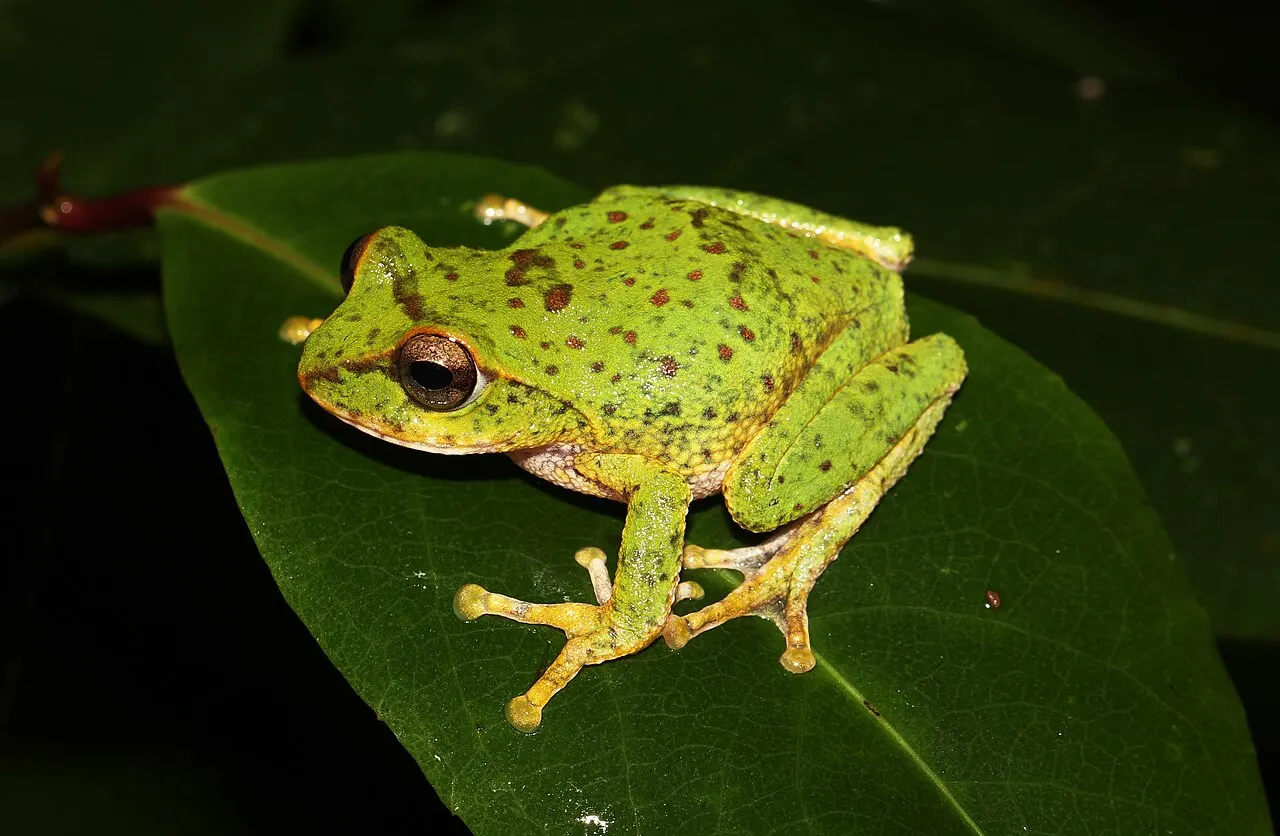
Frankenberg's shrub frog (Pseudophilautus frankenbergi) is a small, ashy-brown frog that lives only on the highest peaks of central Sri Lanka, in cool cloud forest above 1,850 m. The IUCN Red List rated it Endangered in 2020 and describes its numbers as decreasing. It was only described in 2005.
How to recognise it
This is a stout little frog with a flat head and sharp ridges along the edges of the snout. The males measured in its 2005 description were 26.7 to 29.3 mm from snout to vent. No females were in that description.
The back is a fairly uniform ashy brown, with scattered tiny horny spines. The limbs carry distinct dark crossbars, the toes are webbed, and the flanks show white patches, with the groin marbled in black and white. Some individuals have dark brown blotches, pale reddish dots or a dark bar between the eyes. Its sister species, a smaller frog from the Rakwana hills (Pseudophilautus auratus), has rounded rather than sharp snout edges, no spines on the back and a ridge on the roof of the mouth.
Where it lives
It is endemic to Sri Lanka and was described from two mountain sites in the central hills: Horton Plains National Park (about 2,135 m) and Namunukula Peak (about 1,850 to 1,980 m). The IUCN's 2020 assessment counts four locations between 1,850 and 2,300 m. The original 2005 description estimated the whole range at around 100 square km, while the 2020 assessment calculates an extent of occurrence of roughly 2,130 square km.
The frog lives in the sub-canopy of closed moist montane forest, and also in cardamom plantations growing within that forest. The IUCN treats plantations as marginal habitat. Males call from about 1 to 3 m above the ground, perched on branches or big leaves. Its range and its closest relative's range are separated by a valley about 1,450 m deep.
Pins are Wikidata “endemic to” fields. Orange dots, when present, are GBIF occurrence tiles — survey bias included.
How it lives
Shrub frogs of Sri Lanka develop directly, meaning the eggs hatch as tiny froglets rather than swimming tadpoles, and this species presumably does too. Males have vocal slits and call from perches about 1 to 3 m above the ground.
Why it is in trouble
Its life depends on a thin strip of cool, undisturbed cloud forest. The 2005 describers warned that this leaves it exposed to land-use change and to stress in dry spells. The IUCN's 2020 assessment lists small-holder farming, other habitat alteration, droughts, accidental harm from small-scale harvesting and acid rain as ongoing threats, each rated low impact, and records a continuing decline in the area it occupies.
It was placed in the Endangered category by the original describers in 2005, listed as Endangered by the IUCN in 2006, and has stayed there since.
What is being done
The IUCN records the frog in at least one protected area, and Horton Plains National Park is one of its two original sites. The assessment lists site and habitat protection and site management as the actions needed. It records no breeding programme and no species-specific recovery plan. The 2005 describers recommended continuous population monitoring.
Sources
Written for this catalog in our own words from the sources below, checked against them on 12 November 2026. Population figures are estimates and carry the year they were made. Status and assessment year: IUCN. 2026. The IUCN Red List of Threatened Species. Version 2026-1. iucnredlist.org.