Endangered
Pseudophilautus femoralis
Pseudophilautus femoralis
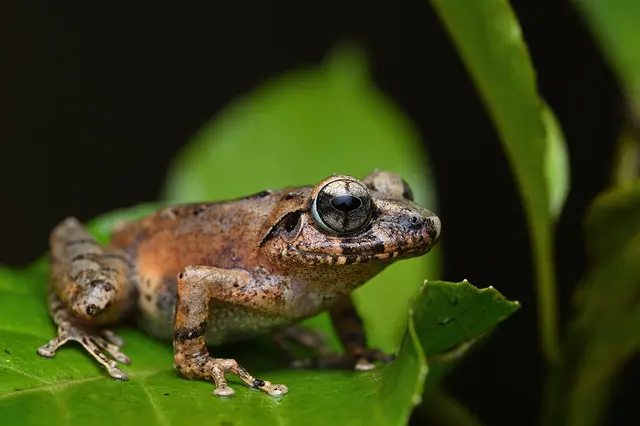
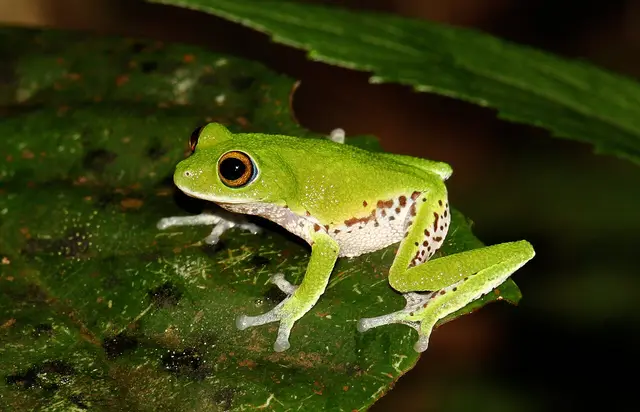
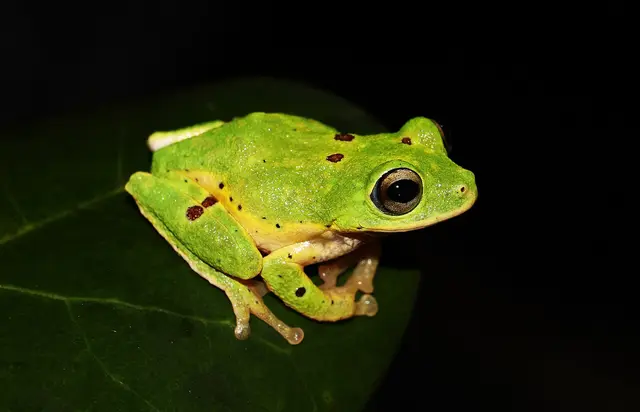
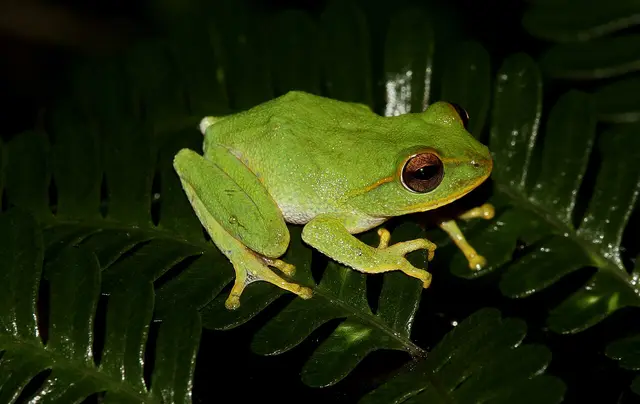
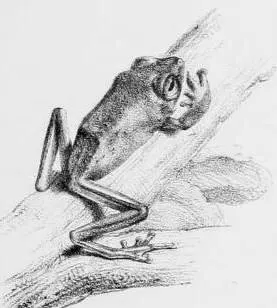
The round-snout pygmy frog (Pseudophilautus femoralis) is a bright-green shrub frog found only in the hill country of Sri Lanka. The IUCN Red List assessed it as Endangered in 2020, with a decreasing population. Unlike most of its relatives, it glues its eggs to the underside of leaves.
Where it lives
This frog is endemic to Sri Lanka. It lives in subtropical and tropical moist montane forest, at roughly 600 to 2,100 m above sea level. The IUCN assessment counts only one to five separate locations for it, which leaves the population exposed to a single bad event.
Recent photo records on the citizen-science platform iNaturalist, gathered through GBIF, come mostly from the districts of Nuwara Eliya, Ratnapura and Badulla, with a few from Kandy and Matale. GBIF also carries some stray records of the name from Kerala and Madagascar, but the IUCN lists the species for Sri Lanka alone.
Pins are Wikidata “endemic to” fields. Orange dots, when present, are GBIF occurrence tiles — survey bias included.
How it lives
Shrub frogs of the genus Pseudophilautus skip the tadpole stage. The young develop inside the egg and hatch as tiny frogs. Most Sri Lankan shrub frogs bury their eggs in soil, but this species is the exception. A 2005 study of reproduction in Sri Lankan shrub frogs, led by Mohomed Bahir, watched it breed in the Agarapatana area. Males call from leaves about 0.3 to 3 m above the ground.
The female picks a leaf 0.3 to 2 m up and lays 7 to 22 green, sticky eggs in a disc-shaped mass on its underside. The male leaves soon after, and she sits on the eggs for one to three hours. After that the eggs are left alone. Brown-black froglets emerged 37 to 49 days later, in a small sample of five clutches.
The eggs are vulnerable to drying. Three clutches kept for three days at relative humidity below 75 percent failed. The frog therefore needs shrubs and understory growth in forest that stays damp.
Why it is in trouble
The IUCN lists the frog under criterion B1ab(iii), which means a small range, few locations and continuing decline in habitat quality. The population trend is recorded as decreasing, and the area it occupies is still shrinking.
The threats named are farming, both large agro-industrial operations and small-holder plots, habitat shifting and alteration, drought and acid rain. No overall population count has been published.
What is being done
The frog occurs in at least one protected area. The assessment calls for site and area management and for protection of its habitat and resources. No species-specific recovery programme or captive breeding effort turned up in the sources.
Sources
Written for this catalog in our own words from the sources below, checked against them on 12 November 2026. Population figures are estimates and carry the year they were made. Status and assessment year: IUCN. 2026. The IUCN Red List of Threatened Species. Version 2026-1. iucnredlist.org.
- IUCN Red List assessment, Pseudophilautus femoralis (EN, 2020)
- Wikipedia, Pseudophilautus femoralis
- Wikipedia, Pseudophilautus
- GBIF occurrence records, Pseudophilautus femoralis
- Bahir et al. 2005, Reproduction and terrestrial direct development in Sri Lankan shrub frogs, Raffles Bulletin of Zoology Supplement 12