Endangered
Bell's rainfrog
Pristimantis bellae
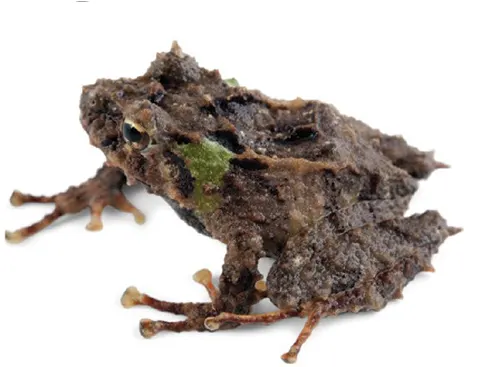
Bell's rainfrog (Pristimantis bellae) is a small frog of the cloud forests on the eastern slopes of Ecuador's central Andes. It is known from only five locations, and the IUCN Red List rates it Endangered (assessed 2022), with a decreasing population. Its black belly with large white spots makes it easy to tell from similar frogs.
How to recognise it
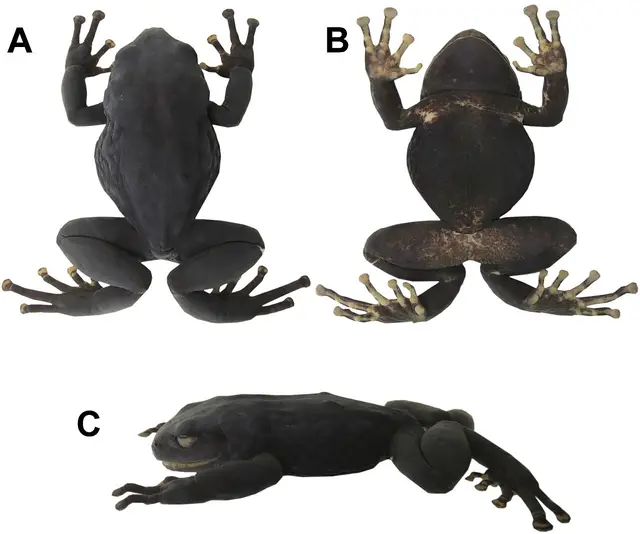
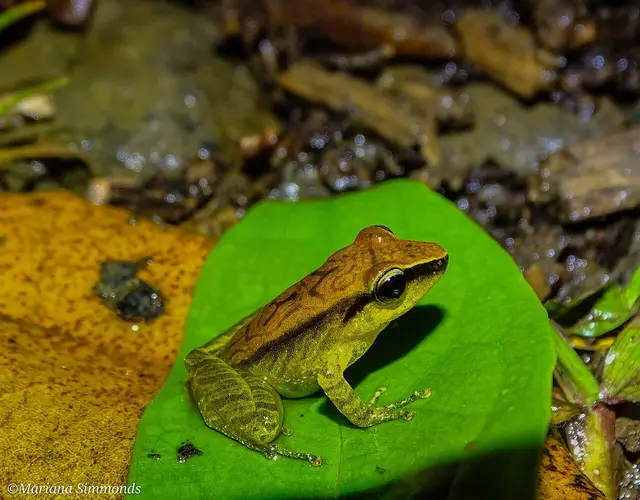
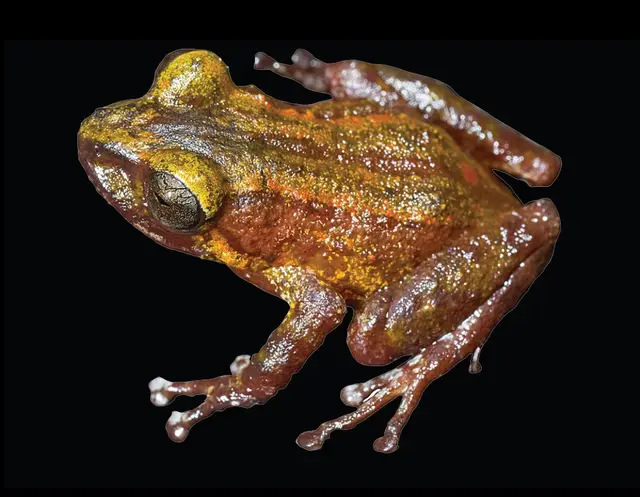
This is a small frog. The single adult female in the original series measured about 26 mm from snout to vent, and the adult males were smaller, around 22 to 24 mm. The holotype was mostly lime green, with a network of large, irregular wine-red blotches on the back, wine-red bands on the flanks and limbs, and a dark band above the eardrum. The iris is two-toned, with a dark brown bar. Colour varies between animals, from green to brown and reddish brown.
The belly is the giveaway. It is black with large white spots, and the same pattern runs onto the chest and the hidden surfaces of the limbs. The skin is finely granular, rows of small warts form an inverted V across the shoulders, and the upper eyelid carries one or two pointed, conical tubercles. Seen from above, the snout is long and pointed.
Where it lives
Bell's rainfrog is found only in Ecuador. It lives in montane evergreen forest and cloud forest on the Amazon-facing slopes of the Andes, in Tungurahua, Pastaza and Napo provinces. The 2012 description listed four localities between about 1,800 and 2,300 m, three of them in the upper Pastaza river basin. The type locality is the Cerro La Candelaria protected forest, in Baños canton.
The IUCN's 2022 assessment counts five locations, at elevations from about 1,670 to 2,300 m, within an estimated range of roughly 1,300 square kilometres. No population estimate exists.
Pins are Wikidata “endemic to” fields. Orange dots, when present, are GBIF occurrence tiles — survey bias included.
How it lives
Little has been written about its daily life. The people who described it found it in mature forest, perched on low vegetation less than a metre above the ground, including herbs, ferns, shrubs and arum plants. The forest there has a canopy 20 to 25 m high, thick with moss, orchids and bromeliads. Several other Pristimantis frogs share the same sites, among them P. pastazensis and P. galdi. The IUCN records it as not migratory.
Why it is in trouble
The IUCN lists the population as decreasing and the area of habitat as still shrinking. Its assessment names small-holder farming as an ongoing threat and mining and large dams as future ones. The scientists who described the frog had already warned that the forest corridor where it lives is strongly threatened by hydroelectric and mining projects.
With so few locations, a single dam, mine or patch of cleared farmland could remove a large share of what is left.
What is being done
The IUCN records that the frog occurs in at least one protected area. The type locality is a protected forest, and other sites include the Zuñac Biological Reserve and the Ankaku communal reserve. The 2012 description linked conservation of the species to two of the reserves set up by the Ecominga foundation in the Llanganates-Sangay corridor, which connects two national parks. The species is named for Hilary Bell, a donor whose gifts helped create the Cerro La Candelaria reserve. The IUCN assessment lists site protection, site management and habitat protection as conservation actions.
Sources
Written for this catalog in our own words from the sources below, checked against them on 12 November 2026. Population figures are estimates and carry the year they were made. Status and assessment year: IUCN. 2026. The IUCN Red List of Threatened Species. Version 2026-1. iucnredlist.org.