Endangered
Parosphromenus tweediei
Parosphromenus tweediei
Tweedie's licorice gourami is a thumb-sized fish of the peat swamp forests of Peninsular Malaysia, known mainly from the state of Johor. The IUCN Red List assessed it as Endangered in 2019, with numbers still falling. It lives in dark, acidic water that few other fish tolerate.
How to recognise it
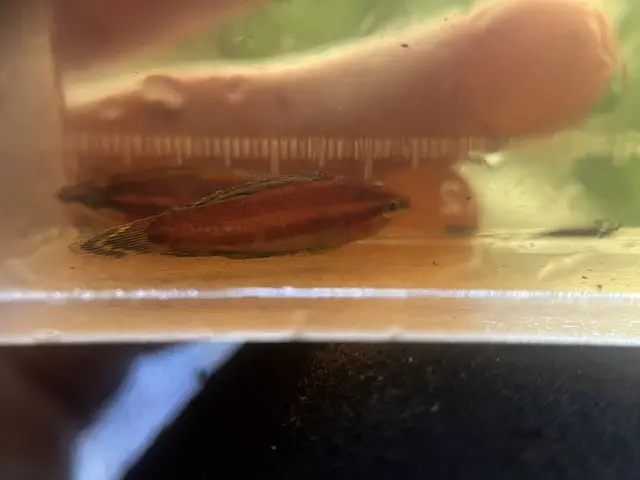
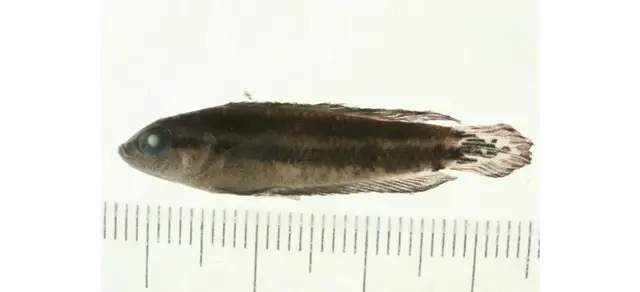
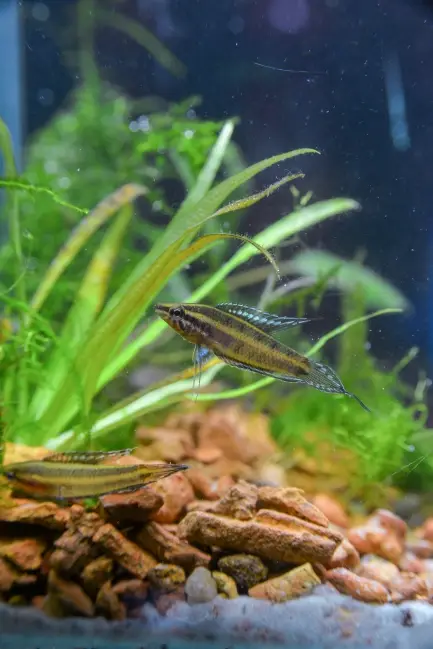
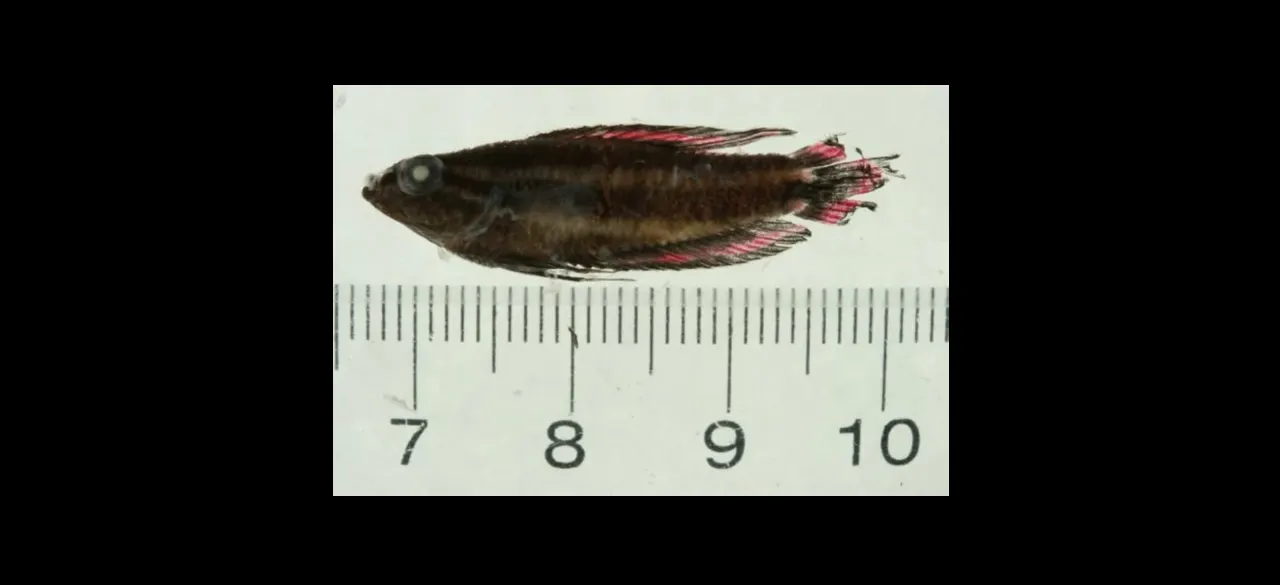
Parosphromenus tweediei is a tiny gourami. One reference gives about 2.5 cm in standard length, while hobby sources quote 3.5 cm (standard length) or about 4 cm. Males are light brown with three black stripes along the body. Their unpaired fins have a black band near the edge, a red band inside it broken by a blue spot, and a white rim. Females are paler and yellowish and lack the blue and red fin bands.
The blue patch on the front of the anal fin varies the most from fish to fish. The species was described in 2005 by Maurice Kottelat and Peter Ng and named for Michael Tweedie, a naturalist at the Singapore museum who studied Malay Peninsula fishes. It has been in the aquarium trade since the mid-twentieth century, but for decades it was almost always labelled as a relative, the licorice gourami (P. deissneri), a species from the islands of Bangka and Belitung.
Where it lives
The IUCN assessment records the species from Peninsular Malaysia and counts three locations. An aquarium-fish profile places the surviving fish in a handful of sites in western Johor, near Pontian, and says it has disappeared from Melaka and from Ayer Hitam.
Its home is peat swamp forest and the blackwater streams that drain it. The water is stained brown by humic acids and holds almost no dissolved minerals, with a pH as low as 3 to 4. The IUCN lists bogs, marshes and peatland, permanent streams, and artificial ditches and canals as its habitats. Today it survives mainly in altered swamp, including irrigation ditches and roadside canals.
Pins are Wikidata “endemic to” fields. Orange dots, when present, are GBIF occurrence tiles — survey bias included.
How it lives
It reportedly can gulp air at the surface, though it does not depend on doing so. It hunts tiny aquatic invertebrates and, in aquariums, takes live foods such as brine shrimp larvae, water fleas and mosquito larvae while refusing most dried food.
Aquarium keepers have recorded how it breeds. A male holds a small territory around a cave, which in the wild is usually made of leaf litter, and courts females into it. Eggs are stuck to the cave ceiling, and the male tends the brood. Eggs hatch in roughly 24 to 36 hours, the fry begin to move about 4 to 6 days later, and they are fully free-swimming 3 to 5 days after that. These details come from aquarium observation, not field study.
Why it is in trouble
The Red List assessment, last done in 2019 under criteria B1ab(iii,iv,v)+2ab(iii,iv,v), describes a falling population in a small, shrinking range, with an estimated area of occupancy of 32 square kilometres. Its listed threats are industrial-scale farming, housing and urban growth, erosion and silt, herbicides and pesticides, and small-scale harvesting.
Hobby sources blame deforestation and the conversion of peat swamp, and one shows a former Johor habitat now planted with oil palm. The IUCN gives no population estimate.
What is being done
The assessment lists no conservation actions as currently in place. It calls for protection of the remaining swamp habitat and sites, management of harvesting, captive breeding, and public awareness. The fish does breed in aquariums, which gives hobbyists and institutions a possible backup population, but that is not a substitute for protected swamp.
Sources
Written for this catalog in our own words from the sources below, checked against them on 12 November 2026. Population figures are estimates and carry the year they were made. Status and assessment year: IUCN. 2026. The IUCN Red List of Threatened Species. Version 2026-1. iucnredlist.org.