Endangered
Licorice gourami
Parosphromenus deissneri
The licorice gourami (Parosphromenus deissneri) is a tiny freshwater fish found only on Bangka, an Indonesian island off Sumatra, in dark, slow-moving streams and swamps associated with peat swamp forest. The IUCN Red List classes it as Endangered (2020 assessment), under criteria B2ab(iii), which point to a small, shrinking habitat.
How to recognise it
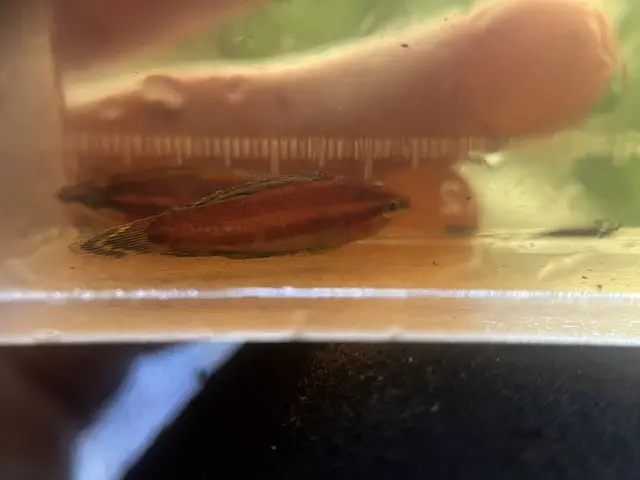
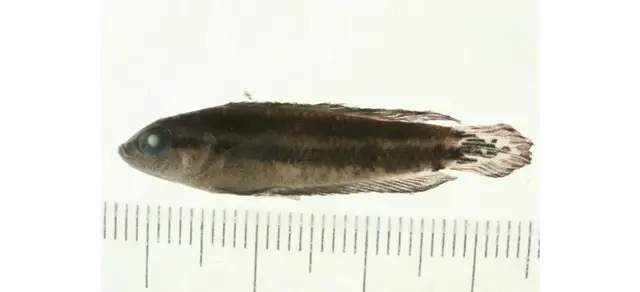
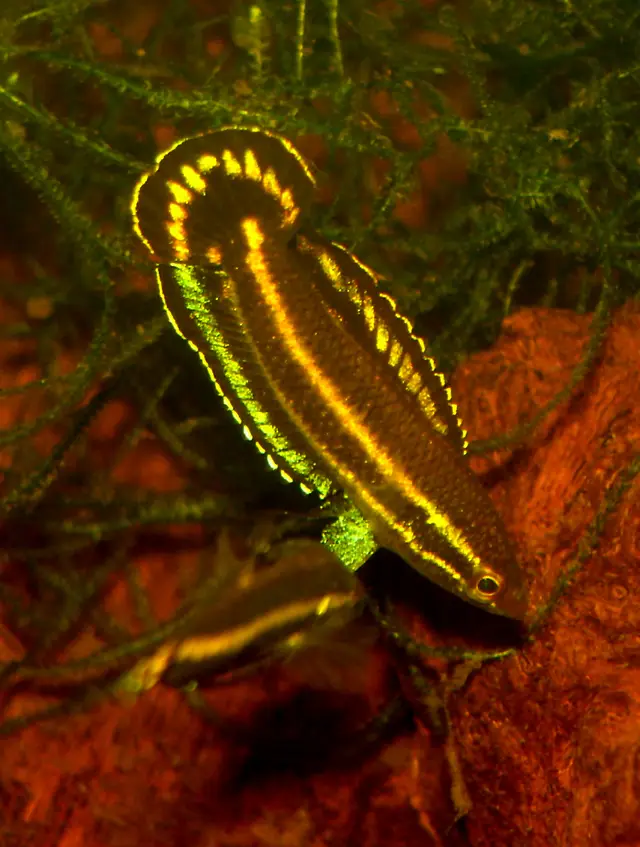
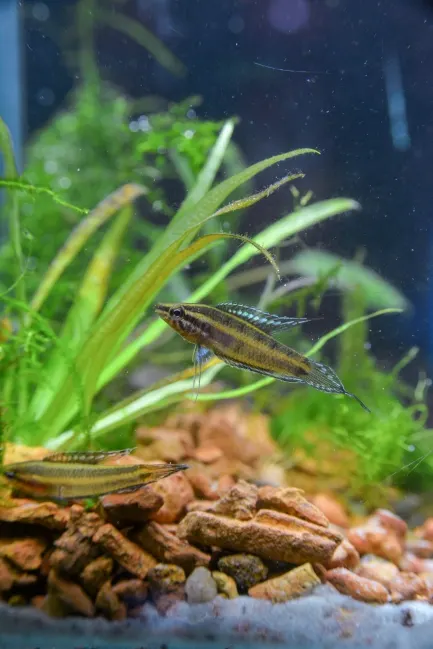
Adults reach only about 40 millimetres in standard length. Males are the colourful sex. Their dorsal, anal and tail fins have a thin whitish to bluish edge and a black band bordered inside by bluish oval spots, and the pelvic fins are iridescent greenish blue with a pale thread-like tip. One tail-fin ray stretches out into a filament.
Females are much plainer and lack the blue and red bands in the unpaired fins.
Where it lives
The species is endemic to Bangka and is found mostly in the north and east of the island. Known localities span roughly 70 kilometres. It lives among vegetation in slow-moving, tea-coloured water in jungle swamps and streams.
A 2012 survey by Linke recorded a pH of 4.72 to 4.84, conductivity of just 4 to 8 microsiemens per centimetre and temperatures between 26.9 and 27.6 degrees Celsius. Fish were collected in shallow margins 40 to 100 centimetres deep, some among emergent plants. That water is very acidic and holds almost no dissolved minerals.
Pins are Wikidata “endemic to” fields. Orange dots, when present, are GBIF occurrence tiles — survey bias included.
How it lives
Most of what is known comes from aquarium keepers. A male holds a small territory centred on a cave, which in the wild is usually made from leaf litter. He displays to lure a female inside, and eggs and milt are released in batches during embraces. The eggs are attached to the cave ceiling.
After spawning the female defends the surrounding area, and the male guards the brood. Eggs hatch in about 24 to 36 hours. The young become mobile roughly 4 to 6 days later and are free-swimming 3 to 5 days after that, when the male's care ends.
Why it is in trouble
The Red List criteria (B2ab(iii)) refer to a small area of occupancy and continuing decline in habitat quality. Many populations now survive only in remnants of modified peat swamp, such as irrigation ditches and roadside canals. That suggests the original forest swamps where the fish evolved are being lost or altered across the island.
No total population has been published, and the fish was already regarded as very rare in the aquarium trade.
In the aquarium
The species has been kept and bred in home aquaria. Seriously Fish advises against general community tanks and recommends keeping it alone or with small, peaceful fish such as Boraras or Sundadanio. Sexed pairs are preferred, and different Parosphromenus species should not be mixed, since females are hard to tell apart and some may hybridise. The fish has probably always been very rare in the hobby, and its name was widely misapplied to other licorice gouramis for almost a century.
Sources
Written for this catalog in our own words from the sources below, checked against them on 12 November 2026. Population figures are estimates and carry the year they were made. Status and assessment year: IUCN. 2026. The IUCN Red List of Threatened Species. Version 2026-1. iucnredlist.org.