Critically Endangered
Beilun Pygmy Frog
Microhyla beilunensis
The Beilun pygmy frog (Microhyla beilunensis) is a tiny narrow-mouthed frog from Zhejiang Province in eastern China, described as a new species in 2018 from Beilun District, Ningbo. The IUCN Red List rated it Critically Endangered in 2021, counting it as a single location with ongoing habitat decline.
A frog that was hiding in plain sight
Frogs from Beilun were reported in a 1999 paper under the name Microhyla mixtura, a related species. In 2018 a team led by Meihua Zhang, writing in Asian Herpetological Research, compared their form and mitochondrial DNA and concluded they were a separate species. The name refers to Beilun District, where the frogs were collected, and the team proposed the English name Beilun pygmy frog.
On the mitochondrial genes the team studied, its closest relatives are M. mixtura and M. okinavensis.
How to recognise it
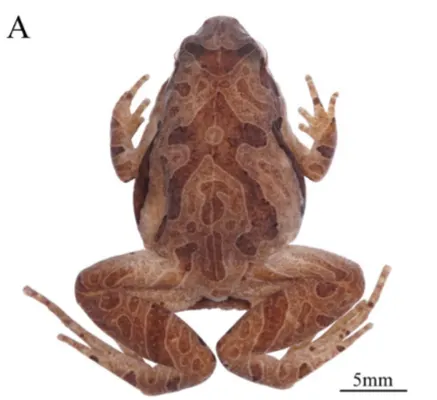
Like other Microhyla, it is small. Newly metamorphosed frogs measure only 8 to 10 mm. The back and legs carry stripes, bar-shaped and oval marks and rounded spots. The toes have rudimentary webbing at the base and discs on the tips, while the fingertips lack discs. The outer palm tubercle is clearly larger than the inner one.
That tubercle difference, along with the pattern and several body proportions in males, separates it from M. mixtura.
Where it lives
The frog was described from Chaiqiao Town in Beilun District, Ningbo City, and the 2018 team knew it only from there. A 2020 paper in Mitochondrial DNA Part B describes it as endemic to East China and mainly found in Ningbo and Lishui cities, with a sequenced specimen from Jiulongshan National Nature Reserve. The IUCN's 2021 assessment still counts a single location, at about 120 m above sea level.
The IUCN lists its habitats as small ponds, seasonally wet grassland, marshy pools and flooded farmland. The original description records the frogs in small water pits and ponds about 3 m across, in nearby grass thickets, and in holes and mud pits.
Pins are Wikidata “endemic to” fields. Orange dots, when present, are GBIF occurrence tiles — survey bias included.
How it breeds
Males call in the last ten days of March. On 9 April 1998 researchers found four females carrying eggs, along with egg clumps and small tadpoles, and tadpoles were seen again in late April. Fertilised eggs took about 60 days to reach metamorphosis in the breeding observations reported for the species.
Why it is in trouble
The IUCN assessment lists housing and urban expansion and herbicides and pesticides as ongoing threats, and records a continuing decline in the area its habitat covers. Its population trend is listed as unknown, and no population count exists.
The conservation actions the IUCN lists as needed are habitat protection and site protection.
Sources
Written for this catalog in our own words from the sources below, checked against them on 12 November 2026. Population figures are estimates and carry the year they were made. Status and assessment year: IUCN. 2026. The IUCN Red List of Threatened Species. Version 2026-1. iucnredlist.org.