Endangered
Microhyla karunaratnei
Microhyla karunaratnei
Karunaratne's narrow-mouth frog (Microhyla karunaratnei) is a tiny frog known only from the wet forests of southern Sri Lanka, including Sinharaja. Adults are under 2 cm long. The IUCN Red List assessed it as Endangered in 2020, as its forest habitat keeps shrinking.
How to recognise it
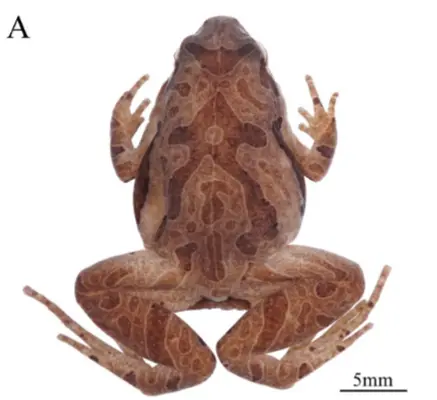
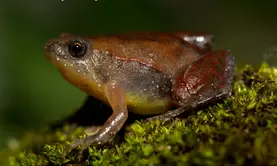
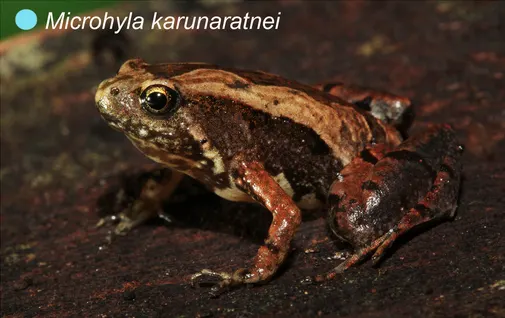
This is a very small frog. Males measure 16 to 17 mm from snout to vent, and the one adult female described measured about 19 mm. The snout is blunt, the skin is smooth and the eardrum is hidden. The back is pinkish grey brown with a blackish stripe along each side and a dark brown mark down the middle, which is faint in some frogs. The belly is white with black marbling. Toes are webbed, while the fingers are not.
The species was described in 1996 by Fernando and Siriwardhane and honours G. Punchi Banda Karunaratne, a Sri Lankan naturalist.
Where it lives
It is endemic to southern Sri Lanka and occurs in the Sinharaja Forest Reserve. It lives in shaded, damp leaf litter in moist tropical forest between about 515 and 1,110 m. The IUCN counts four locations and puts the extent of occurrence at only about 307 square kilometres, while some accounts describe the frog as known from only two sites.
Pins are Wikidata “endemic to” fields. Orange dots, when present, are GBIF occurrence tiles — survey bias included.
How it lives
Tadpoles develop in wetlands, including old, flooded pits left by gem mining. It is possible those pits have helped the species, although that is a suggestion, not a measured effect. Beyond this, its breeding and diet are poorly documented.
Why it is in trouble
Forest in its range is lost to small-holder farming and plantations, with cardamom expansion and agricultural pollution reportedly the main pressures, along with housing, mining, pesticides and herbicides. The IUCN also lists drought, more frequent fires and renewable energy development among the threats, and it gave the population trend as decreasing in 2020. An earlier 2004 assessment had rated the frog Critically Endangered.
What is being done
The IUCN records that the species occurs in at least one protected area, and lists habitat protection, site protection and site management as conservation actions. No recovery programme or captive population is described in the sources reviewed.
Sources
Written for this catalog in our own words from the sources below, checked against them on 12 November 2026. Population figures are estimates and carry the year they were made. Status and assessment year: IUCN. 2026. The IUCN Red List of Threatened Species. Version 2026-1. iucnredlist.org.