Endangered
Sri Lanka narrow-mouth frog
Sri Lanka narrow-mouth frog
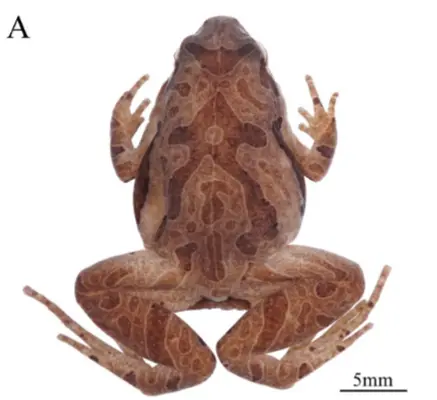
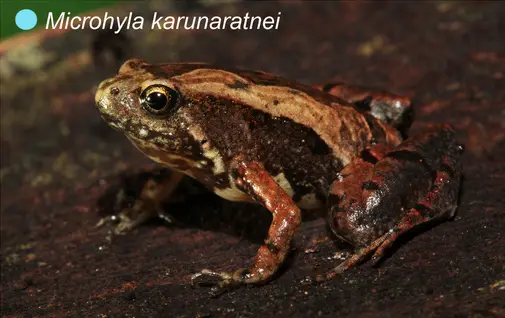
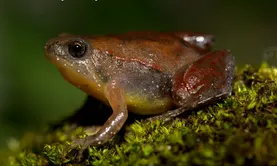
The Sri Lanka narrow-mouth frog, also called the Sri Lanka rice frog, is a tiny frog confined to cool mountain wetlands and grassland in the island's central highlands. The IUCN rated it Endangered in 2020, citing a small range and continuing habitat decline.
How to recognise it
It is a very small frog. Adult males measured in one comparison ranged from 11.8 to 20.0 mm from snout to vent (five animals), and three males recorded in the field in 2014 averaged 18.3 mm. That makes it smaller than its Sri Lankan relative Microhyla mihintalei, whose males run 21.7 to 27.3 mm.
Its voice is easier to notice than the frog. Males give a pulsed call that lasts just under two seconds, with a dominant pitch around 2.6 kHz and no rise or fall in pitch within the call.
Where it lives
The species is found only in Sri Lanka, on mountain tops in the Central Hills and Rakwana Hills. The IUCN gives its elevation as 1,800 to 2,200 m, an extent of occurrence of about 342 square kilometres, and one to five locations. A 2016 acoustic study recorded it at Horton Plains National Park at 2,135 m.
Its habitats include moist montane forest, high-altitude grassland, marshes, swamps and bogs, and both seasonal and permanent pools under 8 hectares. The IUCN records that it occurs in at least one protected area.
Pins are Wikidata “endemic to” fields. Orange dots, when present, are GBIF occurrence tiles — survey bias included.
How it lives
Little has been published beyond its call. On 22 and 23 August 2014 at Horton Plains, males called at night between about 21:00 and 02:00 from a shallow temporary pool in grassland, when the air was 18.2 °C. They called in duets or small groups, with one male often starting after a pause and others joining in. The IUCN records it as not a migrant.
Why it is in trouble
The IUCN lists a declining trend and continuing loss of habitat in its small range. The pressures it records are farming, drought, more frequent fires, soil erosion and sediment, herbicides and pesticides, acid rain and shifting habitat. A 2016 paper in PLoS One calls the species and one other Sri Lankan frog 'highly threatened montane isolates'.
What is being done
The conservation actions the IUCN lists are site protection, site management and protection of resources and habitat. Part of its range lies inside a protected area, but the assessment gives no population count and lists no species-specific program.
Sources
Written for this catalog in our own words from the sources below, checked against them on 12 November 2026. Population figures are estimates and carry the year they were made. Status and assessment year: IUCN. 2026. The IUCN Red List of Threatened Species. Version 2026-1. iucnredlist.org.