Critically Endangered
Mantidactylus pauliani
Mantidactylus pauliani
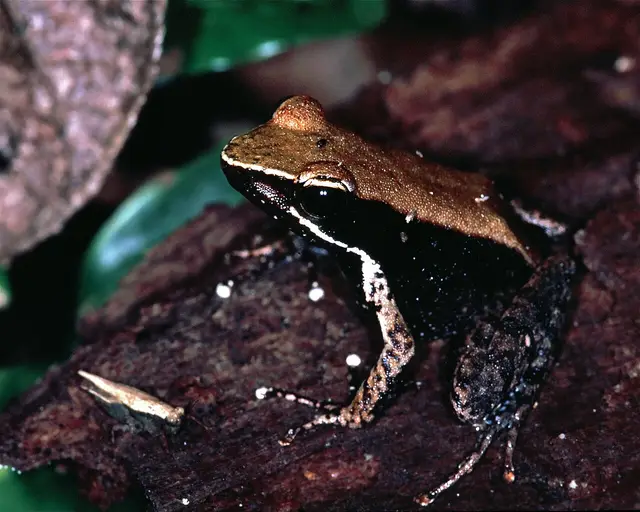
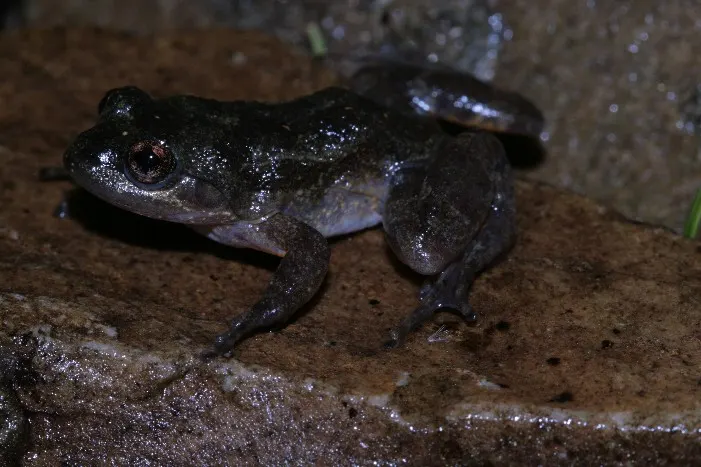
Mantidactylus pauliani is a stream frog of the family Mantellidae, found only on the Ankaratra Massif in the central highlands of Madagascar, at roughly 1,900 to 2,400 m. The IUCN Red List rated it Critically Endangered in 2016, because its range is tiny and its mountain habitat keeps being burned, grazed and cleared.
Where it lives
This frog is a microendemic: it lives on the Ankaratra massif in the central highlands of Madagascar. The study area lies about 84 km from the capital Antananarivo by the RN7 road. The IUCN counts a single location for it, at 2,000 to 2,285 m. A field study from 2018 to 2021 recorded it from 1,900 m up to about 2,380 m, a wider band than the IUCN figure.
It lives along mountain streams, in patches of humid montane forest and in the high-altitude grassland (savannah) around them. The Red List names three habitats: montane moist forest, high-altitude grassland and permanent streams.
Pins are Wikidata “endemic to” fields. Orange dots, when present, are GBIF occurrence tiles — survey bias included.
How it lives
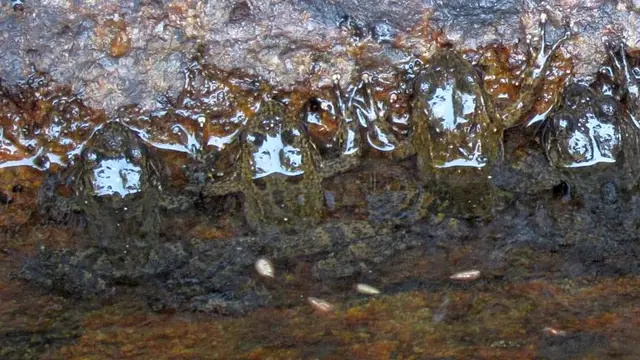
Surveys from 2018 to 2021 found that the life stages use different parts of the stream. Adults sat on steep banks beside narrow, shallow, fast-moving water. Juveniles hid under or behind rocks on gentler slopes. Tadpoles were found in deeper, still water of 40 to 60 cm, over sandy bottoms.
The researchers describe it as breeding in both the humid and dry seasons. Adults outnumbered tadpoles in the dry-season surveys of 2018 and 2021, and tadpoles outnumbered adults in the humid-season surveys of 2019 and 2020. Total counts per survey trip ranged from 226 to 548 animals. Most frogs were seen between about 1,993 and 2,200 m, and on most trips more were found in forest than in open grassland.
Naming and relatives
Jean Marius René Guibé named the species in 1974. Specimens from Ankaratra were later treated under Mantidactylus madecassus, until a 1999 study in the Herpetological Journal by Miguel Vences and Frank Glaw found two distinct groups, one on Ankaratra and one on Andringitra, and revived the name pauliani for the Ankaratra frogs.
The Ankaratra frogs have more toe webbing and a less contrasting back pattern, and they lack the bilobed finger tubercles of the Andringitra frogs. The two are treated as closely related sister species living on separate mountains.
Why it is in trouble
The Red List describes a decreasing population and a continuing decline in its habitat. The listed threats are small-holder farming and grazing, soil erosion and sedimentation, and shifts and alterations in habitat.
The 2018 to 2021 study scored six pressures on the Ankaratra streams: bush fires, charcoal production, logging, grazing fires, cattle trampling the waterways, and farms spreading up the slopes. Livestock grazing was the main pressure in open areas.
The damage can be local and sudden. At the Manotongana stream, at 2,167 m, researchers counted 1 adult, 2 juveniles and 22 tadpoles in the 2018 dry season and 26 tadpoles in 2019. They recorded none in 2020 or 2021, after erosion fragmented and degraded the habitat and the stream dried out.
What is being done
The study area lies within the Ankaratra New Protected Area, about 8,130 hectares. The 2016 assessment, however, recorded no protected-area coverage for the species. It lists habitat and site protection, species recovery, captive breeding and a genome resource bank as conservation actions.
The 2018 to 2021 study recommends forest ranger patrols, especially in savannah, a firebreak system around the forest, environmental education for village communities, and better local livelihoods, including access to water from Ankaratra.
Sources
Written for this catalog in our own words from the sources below, checked against them on 12 November 2026. Population figures are estimates and carry the year they were made. Status and assessment year: IUCN. 2026. The IUCN Red List of Threatened Species. Version 2026-1. iucnredlist.org.